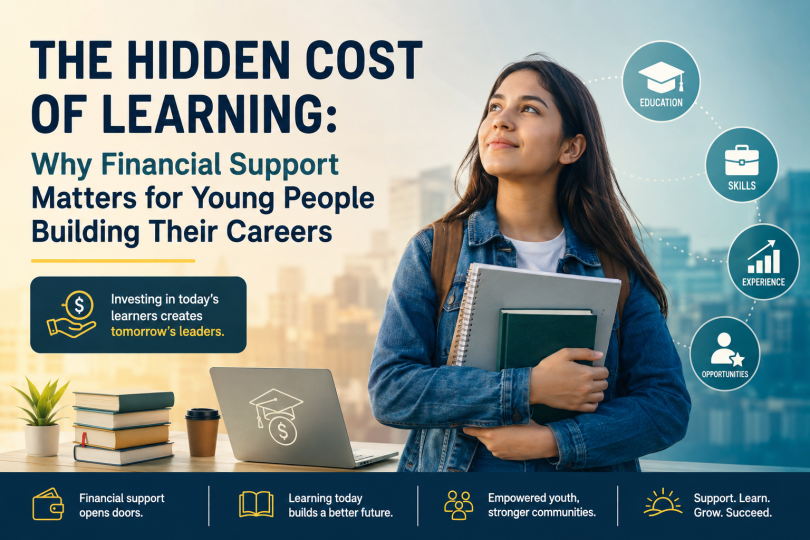

For many young people, the biggest obstacle to building a career is not a lack of ambition. It is the cost of getting started.
Education and career preparation are often discussed as if motivation and talent are the only ingredients needed for success. A young person is told to take a course, gain experience, attend training, build a portfolio, travel to interviews, or accept an entry-level opportunity. But each of these steps can carry a cost.
Transportation, food, internet access, work clothing, childcare, accommodation, and the loss of income from time spent training can turn a promising opportunity into something financially impossible.
This creates a problem that is easy to overlook: an opportunity is not truly accessible if a young person cannot afford to participate in it.
The transition from education to employment is also a period of financial instability. The OECD has highlighted that young people often experience volatile incomes, limited savings, and gaps in access to support while moving from education into the labour market.
That reality makes financial support more than a simple benefit. For many young people, it can be the difference between participating in career-building opportunities and being forced to abandon them.
The real cost of gaining experience
One of the most common frustrations among young people is the demand for experience before they have been given a realistic opportunity to gain it.
Employers frequently value practical skills, workplace familiarity, communication, teamwork, and professional experience. Yet gaining those skills may require months of unpaid or low-paid participation in internships, training programs, or entry-level roles.
Imagine a young person who finds an excellent training opportunity several kilometres from home. To participate, they may need money for:
- Daily transportation
- Meals during the day
- Mobile data and internet access
- Appropriate clothing or equipment
- Basic professional materials
- Unexpected health or family expenses
For a young person from a financially secure household, these costs may seem manageable. For someone living in a low-income household, however, they can become a serious barrier.
This is why financial support should not be viewed simply as “extra money.” It can help remove the hidden costs that prevent people from accessing education, training, and professional development in the first place.
Why talented young people sometimes leave opportunities behind
A lack of financial support can create a difficult choice.
A young person may want to improve their skills, but they may also need to earn money immediately to support themselves or contribute to their household. In that situation, a training opportunity with no income may feel like a luxury they cannot afford.
The result is a cycle that can be difficult to escape:
No money to participate in training → limited experience → fewer employment opportunities → continued financial pressure.
This is particularly important during the transition from school to work. Young people are often expected to make career decisions before they have stable incomes, professional networks, or savings.
Research and policy discussions increasingly recognize that helping young people move successfully into employment requires more than simply telling them to find work. The OECD emphasizes the importance of combining income and social support with effective employment and education policies to help young people build more secure pathways toward self-sufficiency.
In other words, financial security and career development are closely connected.
Financial support can improve access to practical learning
Practical learning is valuable because it allows young people to experience how knowledge works outside a classroom.
A student may understand a subject academically but still need opportunities to develop skills such as:
- Working with clients or customers
- Communicating with colleagues
- Following professional schedules
- Solving real-world problems
- Using workplace technology
- Managing responsibilities
- Adapting to professional expectations
However, practical learning requires time and commitment. When young people must constantly worry about transportation costs or household expenses, it becomes much harder to focus fully on developing these skills.
This is where programs that combine training with financial support can make a meaningful difference.
In Mexico, for example, the Jóvenes Construyendo el Futuro program connects eligible young people with workplace training opportunities for up to 12 months. The official program states that participants between the ages of 18 and 29 who meet the eligibility conditions can receive practical training, monthly financial support, and medical coverage through the IMSS during their training period.
For young people researching opportunities, information about a jovenes construyendo el futuro beca can therefore be important not only because of the payment itself, but because financial support may make it possible to participate in a full training experience that would otherwise be inaccessible.
The question young people ask first: Can I actually afford this opportunity?
When governments, schools, and organizations announce training programs, they often focus on the benefits:
- New skills
- Professional experience
- Certificates
- Networking
- Better employment prospects
These benefits matter. But many young people immediately ask a more practical question:
“Can I afford to take part?”
That question deserves more attention.
Career-building programs are most effective when participants can realistically complete them. A young person who begins a training program but cannot afford transportation after several months may not receive the full benefit of the experience.
Financial support can provide greater stability during the learning process. It may help participants plan their monthly expenses, reduce pressure to abandon training prematurely, and allow them to concentrate more consistently on their professional development.
This does not mean that money alone creates successful careers. Mentorship, high-quality training, relevant skills, supportive workplaces, and employment opportunities are all essential.
But financial stability can make it easier for young people to take advantage of those opportunities.
How much support makes a practical difference?
The value of financial support depends on local living costs and the personal circumstances of each participant. A young person living with family may face very different expenses from someone who contributes significantly to household costs or lives independently.
That is why many young people look for clear information before deciding whether to apply.
For example, those searching cuanto pagan en jóvenes construyendo el futuro 2026 are often trying to answer a practical question: Will the support be enough to help me participate consistently in the program?
According to the official Jóvenes Construyendo el Futuro platform, eligible participants currently receive a monthly scholarship of $9,582.47 MXN, along with IMSS medical coverage during the training period, which can last up to 12 months.
The significance of this support goes beyond the number itself. For many participants, a predictable monthly payment can help cover essential costs while they develop workplace skills and gain professional experience.
The hidden connection between financial stress and learning
Financial stress can affect much more than a person’s bank account.
When someone is constantly concerned about paying for transportation, food, internet, or other basic needs, it becomes harder to focus on long-term goals. Career planning requires time and mental energy. Financial uncertainty can make both difficult.
Young people may begin to prioritize immediate survival over long-term development.
For example, someone may:
- Decline a valuable training opportunity because it does not provide immediate income.
- Leave a course to take temporary work.
- Avoid applying for opportunities located far from home.
- Choose a job based only on short-term income rather than future career potential.
- Miss training sessions because of transportation problems.
- Delay learning new skills because equipment or internet access is too expensive.
These decisions are often described as a lack of ambition. In reality, they may be rational responses to financial pressure.
Understanding this distinction is important for educators, employers, policymakers, and organizations working with young people.
The problem is not always that young people do not want opportunities.
Sometimes, the problem is that opportunities have been designed without considering what participation actually costs.
Financial support should work alongside meaningful training
Of course, financial support alone is not enough.
A monthly payment cannot replace high-quality mentoring, relevant training, safe workplaces, or genuine career pathways. A poorly designed program with financial support may still fail to help young people build useful skills.
The strongest approach combines several elements:
1. Financial stability
Participants need enough support to make consistent participation realistic.
2. Practical skills
Training should develop abilities that young people can use beyond the program itself.
3. Mentorship
Experienced mentors can help participants understand professional expectations and make informed career decisions.
4. Recognition of learning
Certificates, documented competencies, and verifiable experience can help young people demonstrate what they have learned.
5. A pathway after training
The end of a training program should not feel like the end of support. Participants should have clearer routes toward employment, further education, entrepreneurship, or additional skills development.
The International Labour Organization describes Mexico’s Jóvenes Construyendo el Futuro as a program designed to support young people who are not studying or employed by connecting them with practical workplace training, a monthly stipend, and health coverage as they transition toward productive employment.
That broader combination is important. Financial support helps address immediate barriers, while practical experience can contribute to longer-term employability.
Employers also have a role to play
The responsibility for supporting young people’s careers should not fall entirely on schools or governments.
Employers benefit when young workers arrive with stronger skills, better workplace awareness, and relevant experience. Businesses can therefore play an important role by creating environments where learning is treated seriously. A meaningful training opportunity should provide more than routine tasks.
Young participants should have opportunities to:
- Learn from experienced professionals
- Understand how decisions are made
- Practice relevant technical skills
- Receive constructive feedback
- Take on increasing responsibility
- Explore possible career paths
When employers invest time in mentoring young people, training becomes more than a temporary placement. It can become an entry point into a professional community.
For young people who lack family connections or professional networks, that experience can be especially valuable.
Building a fairer path from learning to employment
Not every young person starts from the same position.
Some have financial support from their families. Others need to work immediately. Some have reliable internet, transportation, and professional networks. Others have to overcome multiple barriers before they can even attend a training session.
A fair education and employment system should recognize these differences.
Equal opportunity does not simply mean offering the same program to everyone. It also means identifying the barriers that prevent some people from participating and finding practical ways to reduce them.
Financial support is one of those practical tools.
It can give young people time to learn.
It can reduce the pressure to choose short-term income over long-term development.
It can make workplace training accessible to people who would otherwise be excluded.
And, when combined with high-quality education and mentorship, it can help transform training from a privilege into a more realistic opportunity.
Conclusion
Young people are frequently told that education is an investment in their future. That is true, but investments require resources. The hidden cost of learning can include transportation, food, technology, professional materials, time, and lost earning opportunities. When these costs are ignored, many talented young people are effectively excluded from opportunities that could help them build successful careers. Financial support is not a substitute for ambition, effort, or quality education. Instead, it can provide the stability that allows those things to produce results. The most effective career-building systems will be those that understand a simple reality: young people cannot fully benefit from an opportunity they cannot afford to access. Supporting the transition from learning to work therefore requires more than advice about working harder or gaining experience. It requires practical solutions that recognize the financial realities young people face.