
There is a quiet shift happening in the way young engineers are thinking about their future. A few years ago, most students would choose conventional branches and then decide what to specialise in later. That pattern is slowly fading. Today, students are looking ahead from the very beginning. They want clarity, direction, and relevance.
This is where B.Tech. Robotics and Artificial Intelligence course stands out. It is not just another engineering program. It sits at the intersection of machines, intelligence, and real-world problem-solving. In 2026, that combination is not optional.
If you are trying to decide whether this path is worth considering, the answer lies in understanding how the field is evolving and what kind of future it is quietly building.
Why Robotics and AI Are No Longer “Future” Concepts
A decade ago, robotics and AI were often discussed as emerging technologies. Now they are already embedded in everyday systems.
- Manufacturing plants rely on robotic automation
- Hospitals use AI-assisted diagnostics
- Agriculture uses smart sensing and automation
- Logistics systems run on predictive intelligence
These are not isolated examples. They are part of a wider shift often referred to as Industry 4.0.
Choosing B.Tech. Robotics and Artificial Intelligence today means stepping directly into this ecosystem rather than trying to catch up later.
What Makes This Degree Structurally Strong
One of the biggest strengths of B.Tech. Robotics and Artificial Intelligence is its multidisciplinary nature. It does not limit students to one domain.
At DIT University, the program draws from three major engineering areas:
| Core Area | What You Learn | Why It Matters |
| Mechanical Engineering | Robotics design, kinematics, dynamics | Builds physical systems and machines |
| Computer Science | AI, machine learning, algorithms | Enables intelligent decision-making |
| Electronics | Sensors, PLC, embedded systems | Connects machines with real-world data |
This blend ensures that students do not just understand theory. They understand how systems behave, interact, and solve problems.
A Closer Look at the Learning Experience
The difference between a standard engineering course and a well-designed one often comes down to exposure. Not just what you study, but how you study it.
At DIT University, the program places strong emphasis on application.
Students engage with:
- Robotics design and control systems
- Machine vision and Internet of Things
- Human-robot interaction
- Industrial automation technologies
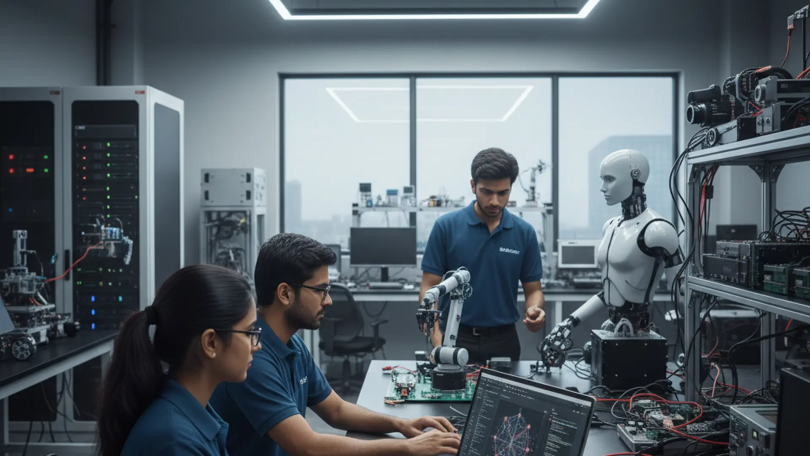
The learning environment includes advanced labs with 6-axis robots, PLC systems, and high-end workstations. These are not simulation-heavy setups. They are built for real experimentation.
Industry Alignment That Actually Matters
Many engineering programs claim industry relevance. Few manage to maintain it consistently.
This program takes a more grounded approach. It builds direct exposure through:
- Industry visits
- Guest lectures by working professionals
- Collaboration with companies like HYDAC India Pvt. Ltd.
This matters because robotics and AI are not static fields. Tools, frameworks, and expectations evolve quickly. Regular industry interaction ensures that students remain aligned with current demands.
Career Scope: Where Do Students Actually Go?
The career outcomes for graduates of B.Tech. Robotics and Artificial Intelligence are not limited to a single sector.
Here is a simplified view:
| Sector | Example Roles |
| Manufacturing | Automation Engineer, Robotics Specialist |
| Healthcare | AI Systems Developer, Medical Robotics Engineer |
| Automotive | Autonomous Systems Engineer |
| Agriculture | Smart Systems Designer |
| IT & Software | AI Engineer, Machine Learning Specialist |
There is also a growing space in research and entrepreneurship. Many students are choosing to build solutions instead of just applying for jobs.
How It Compares with Traditional Engineering Paths
Students often hesitate between newer programs and established ones. That hesitation is understandable.
For example, B.Tech. Computer Science Engineering still offer strong career pathways. They remain relevant and widely accepted.
However, robotics and AI add an additional layer. Instead of focusing only on software or systems, they bring both together.
You can think of it this way:
- Computer Science builds intelligence
- Robotics applies that intelligence in the physical world
For students who want to work at that intersection, the choice becomes clearer.
If you want to explore foundational computing alongside this field, reviewing the B.Tech. Computer Science and Engineering course overview from the best college in Dehradun provides useful context.