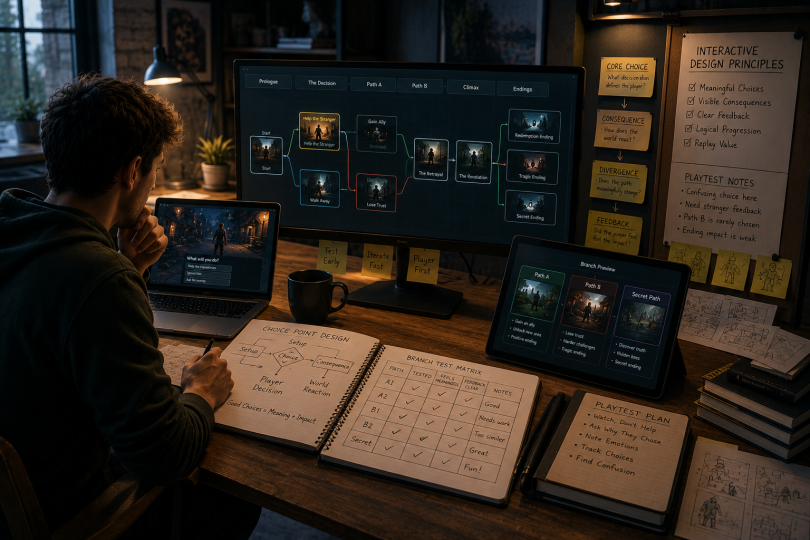

Interactive games live or die by how well they respond to a player’s choices. That responsiveness is harder to get right than it looks, and it’s a completely different challenge than building a game with a single linear path. Getting it right takes a specific approach, and getting it wrong usually means a game that looks interactive on paper but feels flat the moment someone actually plays it.
Here’s how to actually develop interactive games well, not just technically build them.
What Makes a Game Genuinely Interactive
Interactivity isn’t just about having branching paths or multiple outcomes. It’s about whether player choices feel like they matter, whether the game responds in a way that reflects the decision made, not just a cosmetic variation on the same underlying experience. A game with ten branching paths that all lead to functionally identical outcomes isn’t meaningfully interactive, no matter how the flowchart looks.
Start With the Decision, Not the Content
Identify the Core Choice First
Before building any content, define the specific decision the player will make repeatedly. Every other system should exist to make that decision feel meaningful. Games like Speed Per Step demonstrate this well, the core decision stays simple and immediate, which is exactly what keeps an interactive mechanic feeling responsive rather than convoluted.
Make Consequences Visible Quickly
Players need to see the result of a choice fast enough to connect the decision to the outcome. A consequence that shows up too far removed from the choice that caused it stops feeling like a consequence at all, it just feels like something that happened.
Avoid Choices That Don’t Actually Diverge
If two options lead to functionally the same result dressed up differently, players notice, often faster than developers expect. Genuine divergence, even in small ways, matters more than the number of choices offered.
Building the Interactive Layer Without Overcomplicating It
Fewer, Meaningful Choices Beat Many Shallow Ones
It’s tempting to add branching options everywhere, but each additional path multiplies the testing and balancing required. A game with three deeply meaningful choices tends to feel more interactive than one with fifteen shallow ones, because depth matters more than volume here.
Use Fast Prototyping to Test Branch Feel
Because interactive systems are harder to judge on paper, testing how a branch actually feels in practice matters enormously. No-code game maker platforms make it realistic to prototype multiple branch structures quickly, so you can compare how different choice structures actually play rather than guessing from a design document.
Design Feedback for Every Choice, Not Just Major Ones
Even small decisions benefit from some form of acknowledgment, a sound, a visual shift, a brief response. Interactive games that only react to major choices and stay silent on smaller ones tend to feel inconsistent, like only some of the player’s input actually mattered.
Testing Interactive Systems Properly
Watch Where Players Hesitate
Hesitation at a decision point often signals that the choice isn’t clear, not that the player is being thoughtful. Genuinely interesting choices tend to get made quickly and confidently, even when they’re difficult, because the stakes and options are clear.
Track Which Paths Get Chosen and Which Get Ignored
If one branch never gets picked during playtesting, that’s useful information, either it’s poorly communicated, unappealing, or genuinely worse than the alternative. Ignored paths waste development effort unless there’s a specific reason for them to exist anyway.
Ask Players What They Expected to Happen
The gap between what a player expected a choice to lead to and what actually happened reveals whether the interactive system is communicating clearly. A consistent mismatch usually points to a design problem, not a player misunderstanding.
Common Mistakes in Interactive Game Development
Building Breadth Before Confirming Depth
Adding many branches before confirming that even one branch feels genuinely satisfying wastes effort. Get one decision point feeling right first, then expand.
Treating Choice as Content Padding
Choices added purely to extend playtime without adding genuine consequence tend to feel hollow. Players generally sense when a choice exists just to make the game feel longer rather than to actually matter.
Underestimating the Cost of Branch Testing
Every additional branch multiplies the paths that need testing and balancing. Interactive games require disproportionately more playtesting per unit of content compared to linear ones, and underestimating that cost leads to under-tested, unpolished branches shipping alongside better-tested ones.
Why Faster Iteration Matters Especially Here
Interactive systems are difficult to evaluate purely on paper, since their quality depends entirely on how they feel in actual play. That makes fast iteration more valuable for interactive games specifically than for many other genres, since the only reliable way to know if a branching structure works is to build it and actually experience the choices firsthand.
Being able to prototype a decision point, test it, adjust it, and retest it quickly compounds significantly across a game with multiple interactive systems, since each one benefits from the same cycle of testing and refinement individually.
A Practical Framework for Building Interactive Games
- Define the core decision before building content around it.
- Prototype the choice structure and test it immediately, not after building supporting content.
- Watch for hesitation and ignored paths during playtesting.
- Add feedback for every choice, not just the major ones.
- Expand breadth only after depth is confirmed to work.
Final Thoughts
Developing interactive games well comes down to a simple but easily overlooked principle: choices need to feel like they matter, and that feeling only comes through in actual play, not in a design document. The smart approach isn’t building as many branching paths as possible. It’s building fewer, meaningful ones, testing them thoroughly, and expanding only once the foundation genuinely holds up.
Interactivity is ultimately a feeling, not a feature count. Getting that feeling right takes the same disciplined iteration that any strong mechanic requires, just applied specifically to the moments where players make decisions instead of just react.