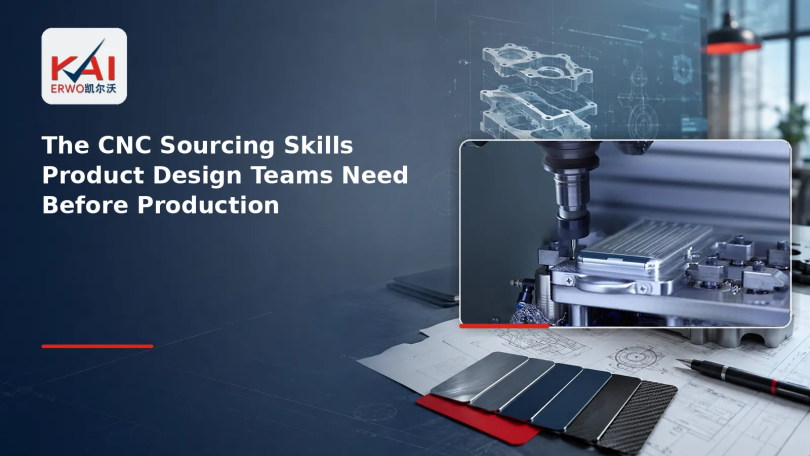

Product design teams are often trained to solve problems in form, function, usability, and performance. Yet a design must eventually move into a manufacturing conversation, where unclear files or assumptions can slow the project even when the concept itself is strong.
CNC sourcing skills help designers make that transition. They do not replace manufacturing engineers or machinists. Instead, they enable designers to prepare cleaner information, understand supplier questions, and make design decisions with better awareness of material, process, inspection, and production consequences.
Skill 1: Read the Design Package as a Manufacturer Will
A design team should understand the different jobs performed by a 3D model, 2D drawing, specification, and revision record. The model shows geometry, while the drawing can define tolerances, threaded features, datums, finishing notes, and critical interfaces. If these files disagree, the supplier needs a clear rule for which document governs.
This skill begins with file discipline: stable part numbers, consistent units, controlled revisions, and a short release note explaining what changed. Good file control is not administrative overhead. It prevents an obsolete design from becoming a real part.
Skill 2: Connect Material Choices to Project Requirements
Selecting ‘aluminum’ is only the beginning. Product teams should be able to discuss alloy and temper with the people responsible for structural performance, appearance, finishing, availability, and cost. A familiar alloy may be suitable for one housing but not automatically suitable for every load case or finish expectation.
The practical habit is to document why the material was chosen and which properties are essential. When a supplier proposes an alternative, the team can then evaluate the change against the original requirement instead of accepting or rejecting it by instinct.
Skill 3: Communicate Manufacturability Without Losing Design Intent
Manufacturability feedback may address wall thickness, tool access, internal corner radii, workholding, setup count, or inspection access. Designers should learn to distinguish a suggestion that reduces effort from a change that affects product function. The best response is often a short design review that records the purpose of the feature and the consequence of changing it.
Evaluating a custom aluminum cnc parts manufacturer becomes easier when the team can ask specific questions about geometry, material, finishing, inspection, and revision control. This produces a more useful conversation than requesting a general promise of quality.
Skill 4: Compare Suppliers With a Shared Framework
Designers, engineers, and procurement staff may notice different strengths in the same quotation. A shared evaluation record gives each function a place to contribute without reducing the decision to unit price.
| Sourcing Skill | Evidence to Capture |
| File interpretation | Questions raised, revision confirmed and missing information identified |
| Process fit | Proposed machining route and concerns linked to the actual geometry |
| Material control | Alloy and temper confirmed, with substitutions documented |
| Finish planning | Process, appearance, masking and handling expectations clarified |
| Inspection planning | Critical features, methods and reporting responsibility agreed |
| Communication | Owner, response time, decision log and unresolved actions recorded |
Skill 5: Learn From the First Physical Part
A prototype review should connect observations back to the controlled design. If a fit, appearance, or inspection issue is found, record whether the cause lies in the design, the released information, the agreed process, or execution. That classification turns one problem into reusable knowledge for the next project.
Service information on Kaierwo shows how one supplier groups CNC machining with prototyping, materials, finishing, inspection, and other manufacturing options. Product teams can use such categories as a learning map when preparing questions, while relying on project-specific review for the final manufacturing decision.
Practice Checklist for Product Teams
- Explain the role of each file in the released design package.
- Record why the selected aluminum alloy and finish support the product requirement.
- Separate functional features from cosmetic preferences.
- Translate supplier feedback into a documented design decision.
- Compare technical assumptions alongside commercial terms.
- Feed prototype findings back into the drawing, template and review process.
Frequently Asked Questions
Do product designers need to understand CNC programming?
Not necessarily. They benefit more from understanding how geometry, tolerance, material, workholding, finishing, and inspection affect the manufacturing conversation. Detailed programming remains the supplier’s responsibility.
When should procurement join the design process?
Procurement should join early enough to understand the technical scope and expected quantities, but after the team can describe the current design clearly. Early collaboration is most useful when roles and approval authority are defined.
What is the best way to learn from supplier feedback?
Record the original feature, the supplier’s concern, the proposed change, the engineering decision, and the result after machining. This creates a reference that can improve later designs and RFQs.
How can a team avoid choosing solely on price?
Use a scorecard that includes file understanding, process fit, material control, inspection planning, communication, assumptions, and total commercial scope. A low number is not useful if the scopes differ.
Make Manufacturing Literacy Part of Design Practice
Select one current CNC part and hold a short cross-functional review before requesting quotations. If the team can explain every file, material choice, critical feature, finish note, and approval step, it is already building the skills needed for a smoother move into production.