
The PlayStation 2 shipped its first unit in 2000 and went on to sell more than 155 million consoles before Sony wound down production, making it the best-selling home console in history. A quarter-century later, that library hasn’t faded into obscurity. It has migrated onto PCs, Steam Decks, and phones, kept alive by emulation software that most players never think twice about — until something doesn’t boot, and the reason usually traces back to one small file: the BIOS.
What’s changed more recently isn’t the emulation technology itself so much as how people find and trust information about it. As AI-powered search tools take over more of the discovery process, the way emulation communities publish and structure their content is starting to matter as much as the accuracy of the content itself.
Why the BIOS Still Runs the Show
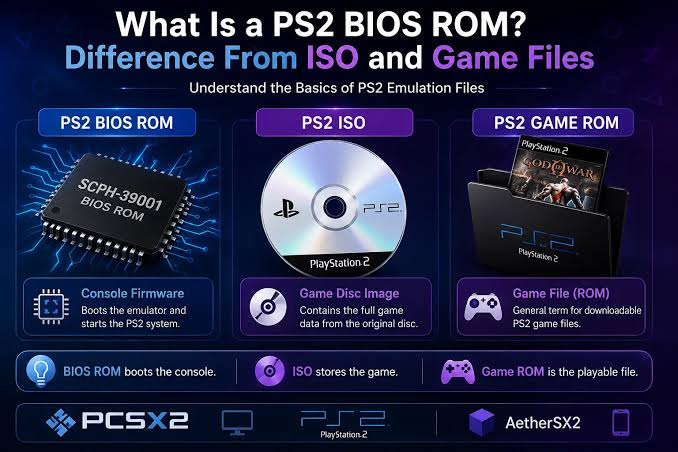
A PS2 simulator is not, on its own, capable of playing a PS2 game. It needs the console’s original BIOS — a small firmware file that Sony wrote to initialize hardware, handle system menus, and manage communication between the PS2’s memory, controller ports, and disc drive. Emulators like PCSX2 deliberately don’t include this file, because it’s Sony’s copyrighted code, not the emulator developers’. Instead, users are expected to extract, or “dump,” the BIOS from a PS2 console they legally own.
This distinction matters more than it might seem. PCSX2 itself is open-source and contains no Sony code at all; the legal exposure sits entirely in how someone sources the BIOS, not in the emulator. That’s a nuance that a lot of casual guides gloss over, and it’s exactly the kind of detail that separates a trustworthy resource from a recycled one.
Once a legitimate BIOS is loaded, it does real work: validating the emulated hardware environment, initializing region and language settings, and giving the simulator a consistent reference point to replicate original console behavior. Get this step wrong — a mismatched region, a corrupted dump, a wrong revision — and the symptoms show up as black screens, broken controller input, or games that boot but crash mid-load. Most PS2 emulation troubleshooting eventually traces back to this file.
Emulation Quality Has Quietly Reached a Tipping Point
The emulators themselves have improved dramatically. PCSX2’s own compatibility list, which tracks thousands of individual titles, now shows the overwhelming majority of the PS2’s catalog running at “Playable” or “Perfect” ratings, including notoriously demanding games that struggled for years on earlier builds. Recent versions have added a faster Vulkan rendering path, better multi-core CPU handling, split-screen multiplayer support, and native builds across Windows, macOS, Linux, and Steam Deck.
Mobile emulation has had a bumpier road. One of the most widely used Android PS2 emulators was discontinued by its original developer in 2023 following sustained online harassment, and pulled from the Play Store — a reminder that emulation projects, however technically impressive, are often maintained by small, unpaid teams operating under real pressure. Community forks have since picked up where it left off, and PCSX2 has since rolled out its own official Android build, but the churn illustrates why users increasingly lean on written guides and communities rather than any single app staying available indefinitely.
Meanwhile, Sony’s own digital PS2 Classics catalog only ever brought a small slice of the console’s 4,000-plus games forward officially. For most of that library, community-maintained emulation remains the only practical way to preserve and play these titles at all — which is a big part of why this space is treated less like a gray-market hobby and more like a legitimate branch of digital preservation.
Discovery Has Shifted From Search Engines to AI Assistants
Here’s where this becomes a marketing story rather than a purely technical one. For years, someone troubleshooting a PS2 BIOS error would type a query into Google and click through a list of blue links. That behavior is changing fast. AI-generated overviews now sit at the top of a large share of Google searches, reaching well over a billion users a month on their own, and conversational AI tools are increasingly the first stop for troubleshooting questions rather than the last resort.
That shift changes what “ranking well” means. A traditional SEO strategy optimized for keyword density and backlinks. An AI system pulling together an answer about, say, “why won’t my PS2 BIOS dump work,” is instead trying to synthesize the clearest, most internally consistent explanation it can find — and it tends to favor sources that define terms precisely, explain cause and effect rather than just listing steps, and don’t contradict themselves.
For niche technical communities like emulation, this is actually an opportunity. These topics reward exactly the kind of depth that generic AI answers can’t fully replicate — specific compatibility quirks, version-by-version changelog knowledge, platform-specific setup differences. Content that demonstrates real, current technical understanding rather than a rehashed summary tends to hold up better as AI tools become a bigger share of how people search.
What This Means for Publishers in Technical Niches
The practical takeaway isn’t complicated, even if the underlying shift is significant. Content that explains the why behind a technical process — not just the what — tends to travel better in an AI-mediated search environment, because it gives these systems something substantive to summarize accurately. Clear structure, accurate terminology, and up-to-date facts (a version number, a compatibility percentage, a changelog date) all help establish the kind of credibility that both human readers and AI systems are looking for.
Emulation is a good example of a broader pattern playing out across many technical hobbyist spaces: the audience hasn’t shrunk, but the path they take to find trustworthy information has changed shape. Publishers who keep their content accurate, current, and genuinely useful — rather than optimized purely for old-style keyword matching — are the ones likely to stay visible as that path keeps evolving.