
The baghouse vs. cartridge dust collector decision is one that plant engineers and safety managers face regularly and get wrong surprisingly often. A mismatched selection does not simply underperform; it can result in premature filter failure within weeks, regulatory non-compliance, and annual operating costs 40–80% higher than a correctly specified system. Understanding the core technical differences between a baghouse dust collector and a cartridge filter system is the foundation of a correct selection decision.
Both technologies capture industrial dust through filtration but they differ fundamentally in filter geometry, airflow direction, cleaning mechanism, and the dust types they handle most efficiently. The global industrial filtration market reached $9.2 billion in 2023, with baghouse and cartridge systems collectively representing approximately 60% of installed base in manufacturing facilities.
Baghouse Dust Collectors: Design and Strengths
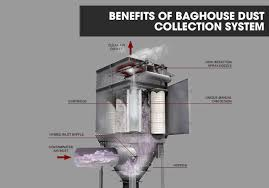
A baghouse dust collector uses cylindrical fabric filter bags, typically 5–8 inches in diameter and 4–10 feet long, suspended vertically in a housing. Dust-laden air enters the dirty-air side and passes through the bag fabric (outside-in in most pulse-jet designs), with clean air exiting through the bag interior to the clean-air plenum. Accumulated dust cake on the bag exterior is periodically dislodged by a reverse pulse of compressed air, falling into the collection hopper below.
Baghouse systems handle high dust loading — 10–50 g/Nm³ inlet concentrations — that would rapidly blind cartridge filters. Their large filter surface area per bag (typically 12–20 ft² per bag) and robust felt media make them ideal for heavy industrial applications where dust volume is high and particles are relatively coarse (> 5 µm).
• Recommended applications: foundry dust, grain handling, cement production, mining, bulk chemical handling, and any process generating high-volume coarse particulate
• Filter media options: woven and felt polyester, fiberglass, aramid (Nomex) for high-temperature service up to 375°F, PTFE-coated felts for moisture-resistant or sticky dust applications
• Filter change interval: typically 18–36 months in normal service; 6–12 months in high-humidity or chemically aggressive environments
Cartridge Filter Systems: Design and Strengths
A cartridge filter system uses pleated filter media packed into a compact cylindrical or oval cartridge, typically 12–26 inches in diameter. The pleated geometry provides 100–200 ft² of filter area in a cartridge occupying the same space as a single bag with 12–20 ft². This 8–12× greater area density means cartridge collectors deliver equivalent filtration in a significantly smaller footprint — a major advantage in space-limited facilities.
Cartridge systems excel with fine, dry dusts in the 0.5–10 µm range. The tight pleat geometry generates higher initial filter efficiency than woven bag media — most cartridge filters achieve MERV 15–16 ratings versus MERV 11–13 for standard baghouse felts. However, fine pleated media is more sensitive to moisture and high dust loading, both of which cause premature blinding.
• Recommended applications: metalworking grinding/cutting fume, laser cutting smoke, pharmaceutical powder handling, welding fume collection, and laboratory dust extraction
• Filter media options: cellulose/polyester blend (standard), spunbond polyester (moisture-resistant), nano-fiber PTFE membrane (sub-micron high-efficiency)
• Filter change interval: 12–24 months in typical fine-dust service; 3–6 months if exposed to moisture or high loading
| Selection Criterion | Baghouse Dust Collector | Cartridge Filter System |
| Inlet dust loading | Up to 50 g/Nm³ (heavy loading) | < 5 g/Nm³ recommended |
| Particle size target | > 5 µm (coarse dust) | 0.3–10 µm (fine dust/fume) |
| Filter efficiency (MERV) | MERV 11–13 standard | MERV 15–16 standard |
| Footprint for 10,000 CFM | Large (8×8×12 ft typical) | Compact (4×4×8 ft typical) |
| Capital cost (10,000 CFM) | $18,000–$35,000 | $12,000–$28,000 |
| Annual filter cost | $3,000–$8,000 | $4,000–$12,000 |
| High-temp service (> 300°F) | Yes (aramid/fiberglass media) | Limited (specialty units only) |
The Hybrid Scenario: When You Need Both
Many real-world industrial applications generate dust with both coarse and fine fractions simultaneously. A metal grinding operation, for example, produces steel chips > 100 µm (high mass, easily settled) and sub-micron metallic fume simultaneously. A single cartridge collector handling both fractions sees accelerated blinding from the coarse fraction; a standard baghouse may not capture the sub-micron fume at adequate efficiency. The solution is staging: a cyclone or drop-out box removes the coarse fraction, followed by a high-efficiency cartridge system for the fine fraction.
| Application | Recommended Solution | Expected Filter Life | Approx. Annual Filter Cost |
| Woodworking (sanding) | Cyclone + baghouse | 16–24 months | $2,800–$5,200 |
| Metalworking (grinding) | Cartridge, nano-fiber membrane | 12–18 months | $4,200–$8,500 |
| Foundry shake-out | Pulse-jet baghouse, high-temp felt | 12–20 months | $6,000–$14,000 |
| Pharmaceutical powder | Cartridge, PTFE membrane + HEPA | 18–24 months | $8,000–$16,000 |
| Mixed coarse + fine | Cyclone pre-sep + cartridge | 18–30 months | $3,500–$7,000 |
The decision between a baghouse dust collector and a cartridge filter system ultimately comes down to three numbers: inlet dust loading (g/Nm³), target particle size (µm), and available floor space. Run these three parameters through the selection criteria above, and the correct technology choice becomes straightforward. When in doubt, have a dust sample analyzed for particle size distribution — a $200–$400 lab test that prevents a $15,000–$35,000 system selection mistake.