
Working outdoors in hot weather is different from spending a few minutes outside. Landscapers, maintenance workers, event staff, construction support crews, and other outdoor workers may spend hours moving between sunny areas, shaded spaces, and locations where fixed fans or air conditioning are unavailable.
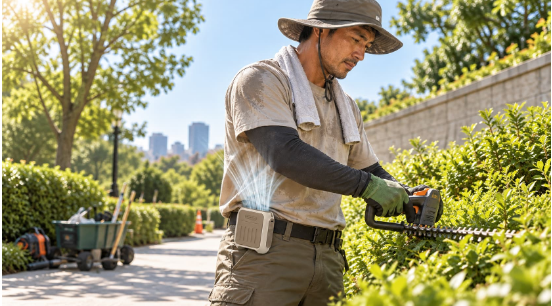
A wearable waist fan provides personal airflow while keeping both hands available for normal tasks. Instead of carrying a handheld fan or staying close to a fixed cooling source, the fan moves with the user throughout the work area.
For outdoor work, however, simply attaching a fan to the waist is not enough. Position, clothing, airflow, battery runtime, and the type of task all affect how useful the setup will be.
Why Can a Wearable Waist Fan Help During Outdoor Work?
Many outdoor jobs require frequent movement.
A worker may carry equipment, move supplies, use tools, check materials, or walk between different areas throughout the day.
Hands Stay Available for Work
A handheld fan is difficult to use while carrying tools or performing tasks that require both hands.
A waist-mounted design avoids that problem by providing airflow without needing to be held.
This can be particularly convenient during lower-risk routine tasks, walking between work areas, or rest periods when fixed cooling is unavailable.
Cooling Moves With the Worker
A stationary fan only helps when the worker remains within its airflow range.
Wearable cooling moves with the person.
This can be useful on large outdoor sites where workers frequently move away from shaded rest areas or fixed fans.
How Should You Position a Wearable Waist Fan?
Placement has a major effect on airflow.
The WF01 is designed to produce upward airflow, so the way it is attached around the waist and positioned relative to clothing matters.
Keep the Air Intake Clear
Avoid covering the intake with loose clothing, bags, or other equipment.
If the intake is blocked, increasing the fan speed may not solve the problem because the fan cannot move air efficiently.
Check the position first whenever airflow feels weaker than expected.
Give the Airflow a Clear Path
The fan should be positioned so air can move upward rather than immediately escaping away from the body.
Clothing that completely blocks the airflow path can reduce the effect.
Small placement adjustments may improve airflow without requiring a higher speed.
Why Are Multiple Fan Speeds Useful Outdoors?
The WindBillion Waist Fan 4-speeds provides four airflow settings.
That matters because cooling needs can change throughout a workday.
Lower Speeds Can Work During Lighter Tasks
A worker organizing supplies in the shade may not need the same airflow as someone walking across an exposed outdoor area.
Using a lower setting when possible can provide personal airflow while helping conserve battery power.
Increase Airflow When Conditions Change
Stronger airflow may be useful during warmer periods or more active tasks.
Rather than leaving the fan at maximum speed throughout the day, adjust the setting according to actual conditions.
Why Does Battery Runtime Matter for Outdoor Work?
Outdoor workers may not have easy access to a charging outlet during a shift.
A rechargeable fan therefore needs enough battery capacity for the way it will actually be used.
The WF01 has a 9,800 mAh rechargeable battery.
Its published runtimes are approximately 28, 21, 12.5, and 7.5 hours depending on the selected fan speed.
Fan Speed Changes Runtime
The longest runtime applies to the lowest setting rather than every operating condition.
Higher airflow requires more power.
Workers planning to use the fan throughout a long day should consider which settings they are likely to use instead of looking only at the maximum battery figure.
Charge Before the Workday
The WF01 uses USB-C charging and takes approximately five to six hours to recharge under suitable conditions.
Charging before a shift is generally more practical than depending on access to power at an outdoor worksite.
When Is a Waist Fan Most Practical at Work?
A waist fan can be useful during many ordinary outdoor tasks, but it should not interfere with work equipment or safety procedures.
Walking and Routine Tasks
Personal airflow can be useful while moving between work areas, inspecting a site, carrying lightweight materials, or completing other routine activities.
The hands-free format allows the worker to continue moving normally.
Breaks Away From Fixed Cooling
Not every outdoor worksite has an air-conditioned break area.
A waist fan can provide personal airflow during a short rest period when shade is available but fixed cooling is not.
When Should You Remove a Waist Fan?
Wearable equipment is not appropriate for every task.
If the fan could interfere with a harness, safety belt, machinery, vehicle controls, protective clothing, or other job-specific equipment, it should be removed.
Workplace safety procedures and required protective equipment always take priority over personal cooling accessories.
Is an Outdoor Work Cooling Fan Enough in High Heat?
An outdoor work cooling fan can provide personal airflow, but it should not be treated as protection against heat-related illness.
Outdoor workers still need appropriate hydration, scheduled breaks, shade or cooler recovery areas, and work practices suitable for the temperature and workload.
A fan can improve comfort, but feeling airflow does not necessarily mean the body is no longer under heat stress.
Use Personal Airflow Where It Makes Sense
Outdoor work often requires moving beyond the reach of stationary fans and air-conditioned spaces.
A waist-mounted fan provides a portable source of airflow that can move with the worker while leaving both hands available.
For practical use, focus on correct placement, unobstructed airflow, an appropriate fan speed, and realistic battery expectations. Used in suitable tasks and alongside normal hot-weather precautions, a wearable waist fan can provide convenient personal airflow throughout different parts of an outdoor workday.