Imagine paying for a premium IPTV subscription, installing it on your brand-new 4K television, and still experiencing freezing, buffering and slow channel switching.
You contact the provider. They tell you the servers are working perfectly. Your broadband company says your internet connection is fine. The streaming application looks normal.
So what’s actually wrong?
The answer is often more complicated than any single provider, application or internet connection.
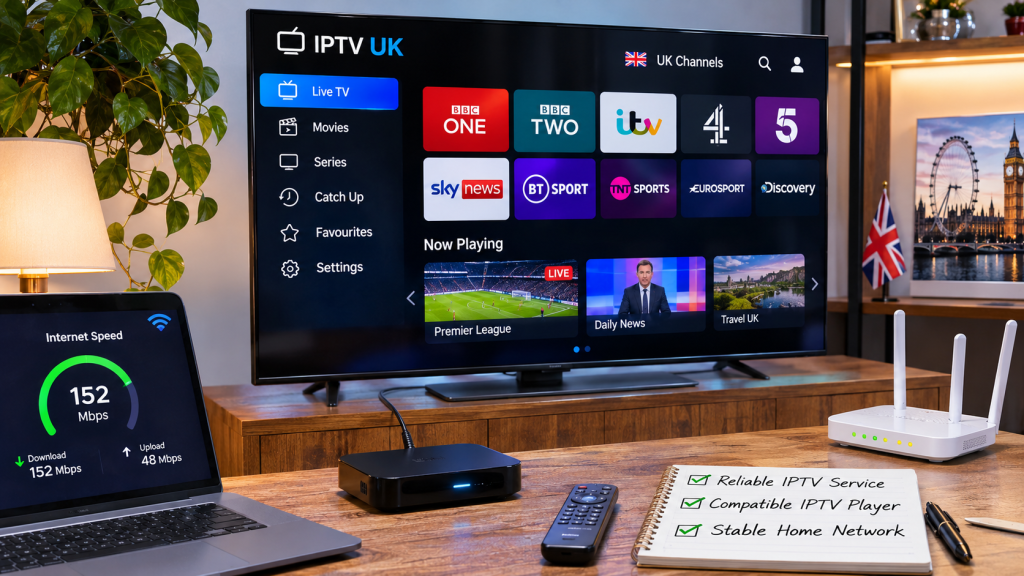
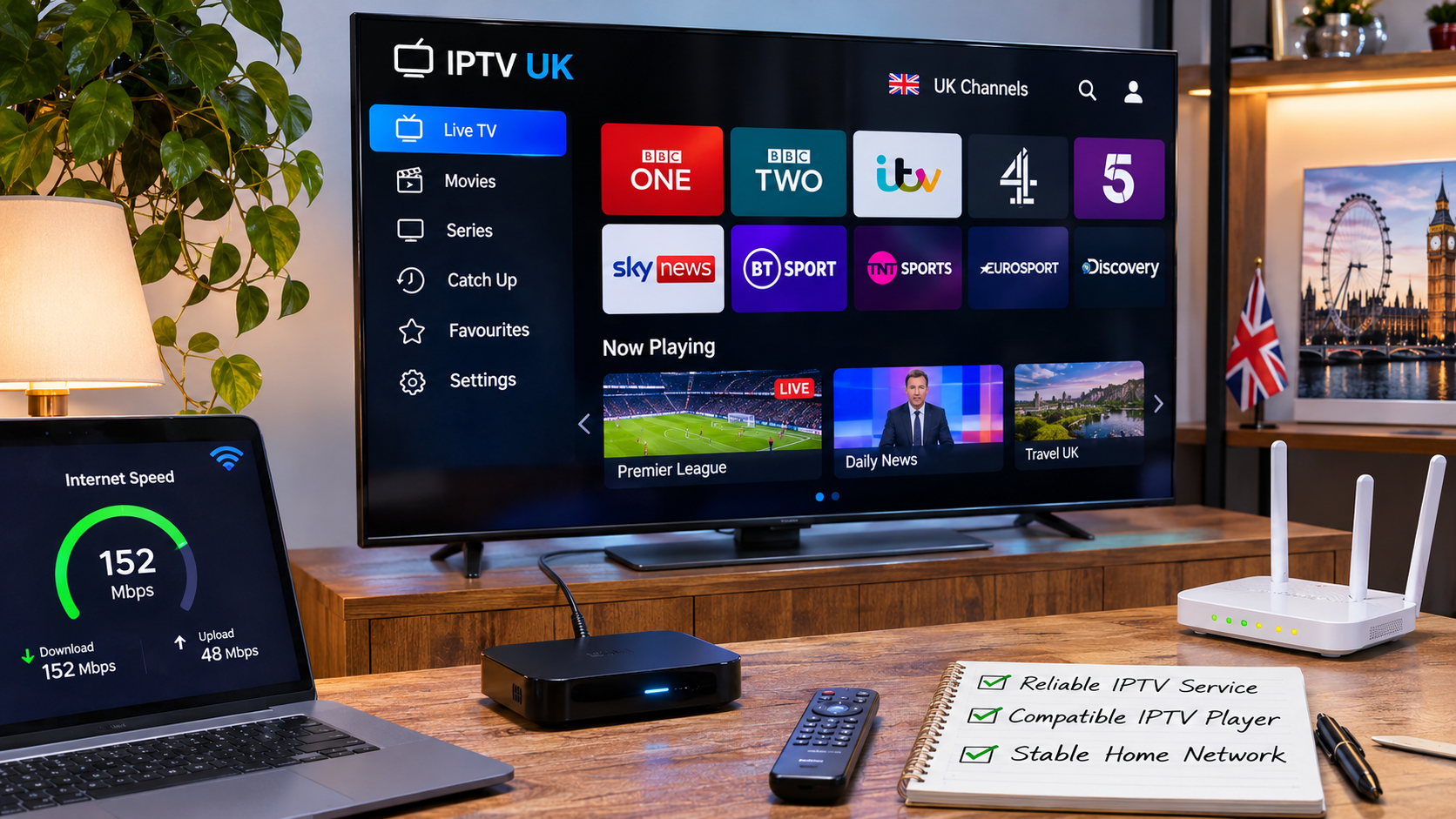
For households exploring IPTV UK, the secret to a consistently enjoyable television experience lies in three components working together: a reliable IPTV service, a capable IPTV player and a properly configured home network.
Think of them as the three legs of a table. If one is unstable, the entire experience suffers.
1. The IPTV Service: Where Streaming Quality Begins
The first component is the television service itself.
A good IPTV provider needs more than an impressive channel list. Its streaming infrastructure must deliver video consistently, particularly during busy UK viewing hours.
A service may advertise thousands of channels, but that means little if the picture freezes every time a major live event begins.
This is where server infrastructure becomes important.
Providers serving British audiences can potentially benefit from UK-based or regionally optimised delivery networks. Well-connected regional servers can reduce unnecessary routing delays and help distribute traffic efficiently.
However, server location alone doesn’t guarantee performance. Capacity, peering arrangements, source-feed quality and network management matter just as much.
A well-designed international content delivery network can outperform an overloaded local server.
For UK viewers, the real test is simple: does the service remain stable during the evening, when streaming demand is highest?
When comparing IPTV UK services, customers should consider regional connectivity, stream reliability, transparent subscription terms and properly licensed content rather than relying exclusively on advertising promises.
2. The IPTV Player: The Missing Piece Many Viewers Overlook
Here’s something many IPTV subscribers don’t realise: two applications can produce noticeably different experiences using the exact same television service.
An IPTV player is responsible for receiving, decoding and displaying video streams. It also manages features such as channel navigation, programme guides and buffering.
Even with excellent server infrastructure, a poorly configured or incompatible player can create problems.
Popular applications used with compatible IPTV services include:
- TiviMate: Popular among Android TV and Fire TV users for its television-focused interface, channel management and programme guide.
- XCIPTV: An alternative player supporting compatible live TV and video-on-demand services.
- IPTV Smarters: A familiar multi-platform interface, although compatibility and application availability should be checked before installation.
- IBO Player: Another option available on selected smart TV platforms.
The most suitable application depends on the television, streaming device and service requirements.
For example, someone using a Fire TV Stick might prefer TiviMate because its interface is designed around remote-control navigation.
A household using a Samsung or LG smart TV may need a different compatible player.
Some advanced features also require paid application upgrades.
The player doesn’t improve the underlying video source, but it can significantly influence how smoothly that source is handled.
3. Your Home Network: The Final Link Between IPTV and Your Television
The third component is frequently underestimated.
A household might subscribe to 500 Mbps broadband, yet its television receives an inconsistent connection because of poor Wi-Fi placement.
This creates an interesting situation: the internet connection itself is fast, but the device playing the IPTV stream cannot maintain stable delivery.
For UK households, three simple network improvements can make a substantial difference.
Use Ethernet Whenever Possible
A wired Ethernet connection avoids many common Wi-Fi problems, including wireless interference and fluctuations caused by distance from the router.
If the television or streaming box has an Ethernet port, connecting it directly to the router is often a sensible choice.
Optimise Your Wi-Fi
When Ethernet isn’t practical, a strong 5 GHz Wi-Fi connection can offer better throughput and less interference than a crowded 2.4 GHz connection, provided the device is within suitable range.
Avoid placing the router behind televisions, inside cabinets or far from the main viewing area.
Understand Broadband Speed Versus Streaming Stability
A stable 50 Mbps connection can provide an excellent HD IPTV experience, while an inconsistent 500 Mbps connection may still suffer interruptions.
Streaming performance depends on more than download speed. Packet loss, latency variations, network congestion and the route to the streaming server also influence playback.
This explains why upgrading broadband doesn’t automatically solve every IPTV problem.
4. Why All Three Components Must Work Together
Consider three UK households with different streaming setups.
Household A: Excellent service, poor player
A family in Manchester subscribes to a reliable IPTV service but uses an outdated application on an ageing Android box.
Their broadband is fast, and the streams are available, but playback frequently stutters because the device struggles with decoding.
Household B: Excellent player, poor network
A household in Birmingham uses a capable IPTV player and a dependable subscription. Unfortunately, their Firestick receives weak Wi-Fi from a router located two rooms away.
They experience occasional freezing despite sufficient broadband speed.
Household C: Everything working together
A household in Leeds uses a properly provisioned streaming service, a compatible updated player and a stable Ethernet connection.
Video arrives consistently, the player handles it efficiently, and the home network avoids unnecessary interruptions.
These examples illustrate an important principle: no single component can compensate for every weakness elsewhere.
5. The UK Peak-Hour Challenge: Why Setup Matters Even More at 8 PM
Across Britain, internet usage often rises during the evening.
Households stream films, watch live television, download games and use multiple connected devices simultaneously.
For IPTV viewers, this can expose problems that remain invisible during quiet daytime hours.
A service with limited delivery capacity might struggle during popular events. A congested broadband route can delay video packets, and weak home Wi-Fi can introduce additional interruptions.
Even the player’s buffer settings can influence how effectively it handles temporary fluctuations.
A larger buffer may absorb short interruptions but introduce extra live-streaming delay.
A smaller buffer can reduce delay while leaving less protection against irregular delivery.
The ideal configuration balances responsiveness and stability.
This is why an IPTV UK setup should be tested during normal viewing hours, not just immediately after installation.
6. How to Identify Which Component Is Causing IPTV Buffering
Before changing subscriptions or purchasing expensive equipment, try a few practical comparisons.
First, test another channel on the same player. If only one channel fails, the issue may involve that particular feed.
Next, try a different compatible IPTV application. If playback improves, investigate the original player’s settings or decoding compatibility.
Then compare Wi-Fi with Ethernet, where available.
Finally, if your subscription permits it, compare performance on a different internet connection, such as a mobile hotspot.
A stream that works through mobile data but struggles through home broadband may indicate differences in routing, local connectivity or network conditions.
None of these tests provides a guaranteed diagnosis on its own, but together they can help narrow down the cause.
The goal is to avoid blaming the IPTV service, player or ISP without evidence.
7. The Future of IPTV UK Is an Optimised End-to-End Experience
As more British households adopt internet-delivered television, expectations will continue rising.
Viewers increasingly want high-resolution pictures, fast channel switching, organised programme guides and reliable live streaming.
Achieving those results requires cooperation between streaming infrastructure, software and the household network.
Regional delivery networks can help UK providers serve local audiences efficiently. Modern players can improve usability and playback compatibility. Better home networking can reduce interruptions within the customer’s control.
Content licensing remains essential too: IPTV technology is legal in the UK, but television providers must hold appropriate distribution rights. Watching live television also generally requires a UK TV Licence.
The strongest television experience combines technical performance with legitimate, transparent service.
Conclusion: The Best IPTV UK Experience Is Built, Not Bought
Choosing an IPTV subscription is only the beginning.
A reliable service supplies the content. A capable player turns that stream into an enjoyable viewing experience. A stable home network ensures the data reaches the screen consistently.
If any one of these components falls short, even an expensive television and ultrafast broadband may fail to deliver the experience you expect.
For UK households, the smartest approach isn’t simply purchasing the subscription with the largest channel list or the most impressive marketing claims.
It’s building a setup where the IPTV service, player and network work together seamlessly.
Because ultimately, the best IPTV experience isn’t about how many channels you have.
It’s about pressing play, enjoying your favourite programme and forgetting the technology is even there.