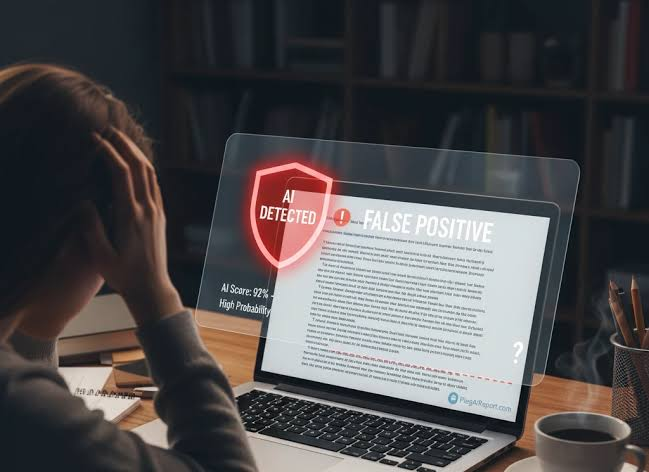

A non-native English speaker submits a 900-word personal essay to her university’s writing portal. She wrote every word of it herself, over three sessions, based on notes she took during interviews with her grandmother. The university’s detector flags the essay at 71 percent AI-generated. She has never used ChatGPT for schoolwork. The essay is going in front of an academic integrity committee.
That case is not hypothetical. Variations of it happen at universities across the world every semester, and the pattern that causes them is not a mistake in the detector. It is the specific way the detector was trained to look for patterns, meeting the specific way certain writers naturally write. This piece walks through the anatomy of a false positive: what kinds of writing are most likely to trigger one, what pattern usually causes the flag, and what to do when it happens.
The three writer types most commonly caught by false positives
The Stanford study by Liang and colleagues, published in Patterns in 2023, remains the most-cited finding on this pattern. On TOEFL essays written by non-native English speakers, leading detectors flagged 61 percent of the human-written essays as AI-generated. Those essays had no AI involvement at all. Three years and several detector generations later, the same pattern still shows up, though at lower rates.
The non-native English writer
Non-native English speakers are the most commonly affected group. Their writing tends to be grammatically clean because it was taught in a classroom setting, uses vocabulary from a smaller studied set, and features consistent sentence construction. Those three properties (clean grammar, controlled vocabulary, uniform sentence structure) happen to be three of the signals detectors weigh most heavily. The writing looks statistically similar to language model output not because it is AI, but because language models were trained on the same kind of published-standard English that ESL instruction points students toward.
The formal-genre specialist
The second group is writers of formal genres. Academic prose, technical documentation, legal writing, and standardized business writing all reward precision, low ambiguity, and predictable vocabulary. Those are the exact properties that produce low perplexity scores, which is one of the two headline metrics detectors use. A well-written technical manual can score higher on many detectors than a first-draft blog post, even though the manual represents more careful human work.
The third group is writers of shorter passages under about 300 words. Detection accuracy drops significantly on short text, and the drop applies to both false negatives and false positives. A 200-word paragraph from any writer is more likely to score in a misleading range than the same writer’s 800-word piece.
What specific pattern usually triggers the false flag
The pattern is uniformity. Not one uniform feature, but several uniform features stacking together. Sentence lengths within a narrow range. Vocabulary from a narrow band. Transitions from a small stock set. Register held steady throughout the piece. Any one of these on its own does not trigger a strong signal. All four together do, because that pattern happens to match the fingerprint of language model output.
The reason this pattern shows up in human writing is that certain writing conditions produce it naturally. A student taught to write formally will keep sentences a similar length because they were taught to. A writer polishing a piece for publication will smooth out sentence rhythm because rough rhythm reads as sloppy. A non-native English speaker will pull from a smaller vocabulary because that is the vocabulary they know reliably. None of these writers are producing AI-like text on purpose. Their writing conditions push them toward the same statistical fingerprint that AI produces on average.
Phrasly’s AI text analyzer is trained on more than a million real human articles specifically to reduce this pattern of false positive, since the training data includes plenty of formal writing, ESL writing, and polished prose that would otherwise trigger the tool. The published response has been to build models that distinguish “flat because language model” from “flat because polished human writing,” which is a harder classification problem than raw AI detection.
What the reader should do when they see the flagged text
The first move is to look at the sentence-level highlights rather than reacting to the top-line percentage. Most current detectors, including Phrasly’s tool, show exactly which sentences pulled the score up. That view tells you whether the flag is coming from a specific passage or from a diffuse pattern across the whole document. A diffuse pattern is the signature of a false positive on formal or ESL writing. A tight cluster of flagged sentences in one section is a different signal that warrants closer reading.
The second move is to check whether the flagged sentences read as unusual for the writer. If they sound like the writer’s normal voice on close reading, the detector is reacting to genre or English-proficiency patterns rather than to actual AI use. If they sound different from the writer’s usual work, the two signals converge and the score is more meaningful.
The third move, when the case involves any consequence for the writer, is to gather additional signals before making a call. Version history from Google Docs or Word tracked changes. Draft outlines or notes. A conversation about the writing process. None of these are perfect, but combined with the detection score and a close reading, they produce a fuller picture than any single tool can.
The False Positive Autopsy
The false positives detectors produce are not random errors. They follow a pattern, and the pattern is that certain kinds of human writing happen to share statistical features with AI output. Non-native English writing, formal genre writing, and short text sit in the highest-risk zone. Those writers are not doing anything wrong. The detector was trained to spot a pattern that their writing happens to share.
For anyone reviewing a flagged score before making a call, Phrasly provides the sentence-level breakdown for signed-in users and includes a clear disclaimer that the score should be one signal in a holistic assessment. That framing is the honest version of a story that other vendors sometimes oversimplify. False positives happen, and understanding why they happen is what turns a raw score into information you can act on.