
Every person has a unique set of instructions inside their cells called DNA. This genetic code acts like a biological fingerprint that is different for everyone on Earth except for identical twins. Experts use a method called DNA profiling to read these unique patterns and create a genetic map of an individual.
This powerful tool helps people find answers about their family, solve legal problems, and even discover their ancient history. By looking at specific parts of our genetic makeup, this test provides clear evidence that is very hard to challenge.
What Exactly is a DNA Profiling Test?
A DNA profiling test, which is sometimes called DNA fingerprinting, is a process used to create a unique genetic ID for a person. Lab experts focus on specific sections known as Short Tandem Repeats, or STRs.
These STRs are repeating sequences in multiple locations inside DNA samples. This repetitive sequence is different in each individual. However, it’s found to be similar only in two biologically related individuals.
How the Genetic Markers are Discovered
Experts utilize cutting-edge equipment for this procedure, which involves the following steps:
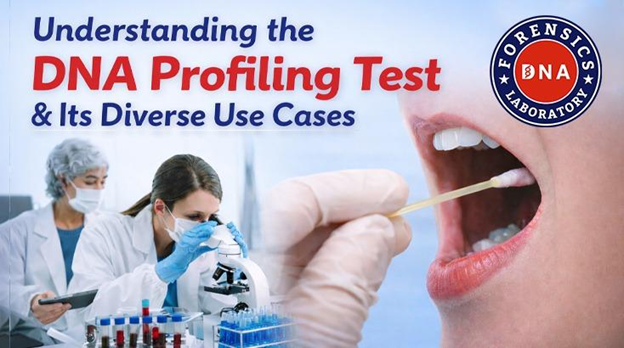
- Sample Collection: The process usually starts with DNA sample collection using a soft cotton swab, which is rubbed inside the cheek to collect skin cells. It is a safe and painless method.
- Extraction: In the lab, experts separate the DNA from the obtained cells using specialized chemicals.
- Copying (PCR): Since the initial sample might be very small, a technique called Polymerase Chain Reaction (PCR) is used to make millions of copies of the specific STR markers.
- Analysis: The laboratory experts then examine the length and pattern of these markers.
- Final Profile: These patterns are turned into a series of numbers that represent the individual’s unique genetic fingerprint.
Common Uses of DNA Tests in Personal & Legal Needs
Because of its high accuracy, this testing is used in many different areas of life. It helps settle doubts and provides the undeniable proof needed for various official situations.
1. Confirming Family Relationships
Many people use these tests for peace of mind to confirm biological links. This includes:
- Paternity & Maternity: This test confirms the parent-child biological relationship in a family reunification matter.
- Siblingship: Checking if two people share the same parents.
- Grandparentage & Kinship: Verifying links with grandparents, uncles, or aunts.
2. Legal Matters & Disputes
Court-related matters related to child custody, child support, and property inheritance are often solved via a court-admissible DNA test report. For such disputes, a legal DNA testing procedure is used. This test requires additional paperwork formalities.
3. Sponsored Immigration
When a family member sponsors the visa of another family member, the embassy may ask for a DNA test report to further validate their family link. It often happens when the submitted visa documents fail to prove the sponsor-applicant’s family ties.
Specialized Applications of Genetic Testing
Beyond basic family links, there are specialized types of profiling designed for very specific goals.
- Ancestry Testing: This test analyzes the DNA with a large database of existing DNA profiles to find where the ancestors lived. It can track paternal and maternal lines back thousands of years and show how ancestors migrated across the world.
- Organ Transplant Validation: According to the Transplantation of Human Organs Act (THOA) 2014, DNA testing is mandatory in India to prove the relationship between a living donor and a recipient. This ensures the process is ethical and follows the law.
- Cell Line Authentication: Researchers in labs use profiling to make sure the cells they are studying for new medicines or vaccines are correctly identified. This keeps their scientific research accurate.
- Prenatal Paternity: It is possible to determine the father of an unborn child using a non-invasive prenatal test. This involves analyzing fetal DNA found in the mother’s blood. This method is safe for the baby and does not reveal the baby’s gender.
Different Levels of Genetic Profiling
Depending on the need, a laboratory might look at different amounts of the DNA.
| Type of Profile | Number of Markers Analyzed | Typical Use Cases |
| Standard Profiling | 13 to 20 regions | Peace of mind, standard legal cases, and immigration. |
| Extended Profile | 50 or more regions | Special cases where more certainty is needed to find a genetic match. |
| Y-Chromosome | Specific to the Y-chromosome | Tracing paternal lineage from fathers to sons. |
| Mitochondrial (mtDNA) | Mitochondrial DNA | Tracing maternal lineage from mothers to all children. |
DNA Profiling in Public Safety
Law enforcement agencies rely heavily on genetic databases to solve crimes. Evidence found at a crime scene, like a single hair or a drop of blood, can be compared to the profiles of known suspects. Even a tiny potential DNA evidence can link a perpetrator to the crime scene.
Moreover, DNA profiling is also helpful in identifying missing persons or victims of natural disasters. By comparing the DNA of an unidentified person to a family member’s profile, authorities can provide closure to families.
What Influences the Cost of Testing?
There is no single price for a DNA test because every case is different. Several factors can change the final cost:
- Number of People: Testing more people costs more. For example, a “paternity test” involving the father and child is the standard, but adding a third person, like the mother, significantly impacts the price.
- Purpose: A “peace of mind” test for personal use is usually cheaper because it requires less formal paperwork. Official tests for court or immigration require a “chain of custody,” which involves extra steps to prove the samples were not tampered with.
- Complexity: Advanced tests like GPS origins and non-invasive prenatal paternity are more expensive because they require deeper analysis.
- Speed: If a report is needed urgently, labs often offer express delivery (within 24-48 hours) for an additional fee.
Why Choose DNA Forensics Laboratory?
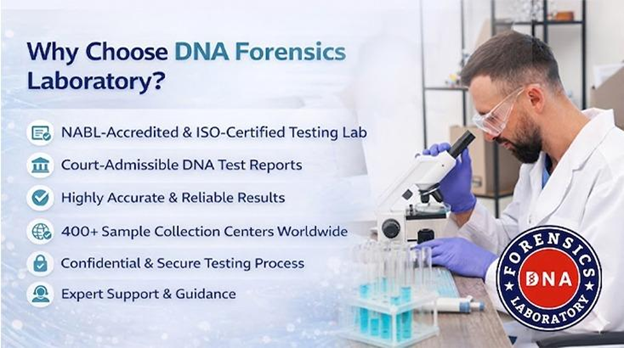
Choosing a reliable DNA test lab in India is important to ensure the results are accurate and legally valid. DNA Forensics Laboratory is a leading name in India for these services and is recognized for its credibility. It is the only private lab in the country whose reports are accepted in honorable courts of law.
The laboratory is accredited by NABL (National Accreditation Board for Testing and Calibration Laboratories) and follows international quality standards like ISO 15189 and AABB. With over 400 sample collection centers worldwide, the process is accessible and convenient for everyone. DNA Forensics Laboratory also guarantees complete privacy and confidentiality of every customer and their reports.For more details, call +91 8010177771 or WhatsApp +91 9266615552.
Frequently Asked Questions
Q1. What are the top DNA profiling services available in India?
DNA profiling is widely used in confirming family relationships such as paternity, maternity, and siblingship in matters like sponsored immigration, peace of mind, and legal matters.
Q2. How long does it take to get results from a DNA profiling test service?
It usually takes around 4-8 business days for a DNA test report. But for an ancestry DNA test, the reports take 3-4 weeks to arrive.
Q3. What documents are needed for a DNA profiling test in India?
A government-issued identity, recent passport-sized photographs, a passport in case of sponsored immigration, a consent form, and a court notice in case of a legal DNA test.
Q4. What is the cost of a standard DNA profiling test at popular labs?
The cost of a DNA profiling test depends on the type & purpose of the test, the number of people involved, the complexity, and whether the express delivery of the report is required.
Q5. What are the steps involved in getting a DNA sample collected professionally?
First, call the experts of the DNA Forensics Laboratory at +91 8010177771 and schedule an appointment for your DNA collection. You can also reach out at +91 9266615552.