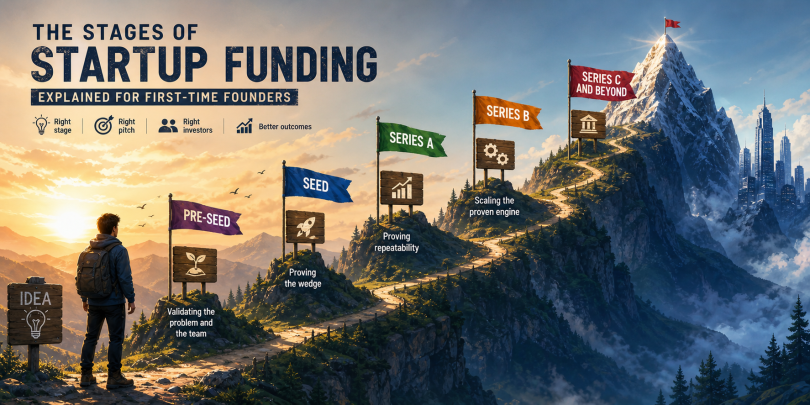

Most first-time founders learn about funding stages through a confused mix of Twitter threads, founder podcasts, and outdated articles. The result is a mental model that mixes stages, blurs investor expectations, and leads to fundraises pitched at the wrong stage with the wrong story.
The clean breakdown is not complicated, but the modern bar at each stage has moved significantly. Below is an updated map of the major startup funding stages and what each one actually requires in 2026.
Pre-seed: validating the problem and the team
Pre-seed is not “small seed.” It is its own stage with its own logic.
What pre-seed investors expect:
- A clear, important problem with quantifiable economic pain
- A team with specific reasons to be the people who solve this problem
- A working prototype or MVP, ideally with early signal from real users
- An honest articulation of what the next 12 to 18 months will prove
Typical round size in 2026: $500K to $2M. Typical structure: SAFE or convertible note, occasionally a priced round. Typical sources: angel investors, micro VCs, accelerator follow-on capital, and a small number of seed funds that lead pre-seed.
Seed: proving the wedge
Seed is where the company moves from “team and idea” to “product and early traction.” Investor expectations:
- An MVP in market with measurable user engagement or revenue
- Evidence that the wedge actually works, early signal of product-market fit
- A clear path to the metrics needed for Series A
- A team that has expanded beyond the founders into critical functional hires
Typical round size: $2M to $5M priced round. Typical structure: priced equity round with a lead investor. Typical sources: institutional seed funds, larger generalist funds doing seed, strategic angels.
Series A: proving repeatability
Series A is the stage where investor expectations move sharply higher. The bar is no longer “we found something that might work.” It is “we have something that demonstrably works and we know how to scale it.”
What Series A investors expect in 2026:
- Predictable, repeatable revenue acquisition
- Clear unit economics (CAC, LTV, payback period)
- Evidence of net dollar retention or repeat usage that supports growth narrative
- A clear plan for capital deployment and the milestones it gets to
- A team that can execute the next 18-month operating plan
Typical round size: $8M to $25M. Typical structure: priced equity round with a clear lead. Typical sources: dedicated Series A funds, multi-stage funds doing their first check.
For a deeper breakdown, see this overview of the stages of startup funding and how each stage is evaluated by the typical investor.
Series B: scaling the proven engine
Series B is the stage where the company demonstrates that the engine built at Series A scales. Investor expectations:
- Significant revenue scale (typically $5M to $15M ARR for SaaS)
- Strong unit economics that hold or improve at scale
- Operational maturity, leadership team built out, processes in place
- Clear go-to-market motion that compounds with capital deployment
- Path to Series C metrics or a credible exit window
Typical round size: $20M to $60M. Typical sources: growth-focused funds, multi-stage funds participating heavily.
Series C and beyond: pre-IPO discipline
By Series C, the company is in the late-stage zone. Investor expectations are no longer about traction validation — they are about scale economics, governance maturity, and exit readiness.
What Series C investors expect:
- $30M+ ARR with clear path to $100M
- Defensible market position
- Predictable financial model with clean reporting
- Mature governance and audit-ready financials
- A credible IPO or strategic exit timeline within 24 to 36 months
Where founders go wrong
The most common stage mistakes are:
- Pitching pre-seed investors with a Series A story (overselling)
- Pitching Series A investors with a seed story (underselling)
- Trying to skip seed and go directly from pre-seed to Series A
- Raising more capital than the stage justifies (creating dilution problems and Series B traps)
- Not understanding which investors actually invest at the founder’s specific stage
The right stage understanding determines which investors to target, what story to tell, and what metrics to lead with.
The investor mismatch problem
A surprising number of founders pitch the wrong investor pool because they confuse stages. Pitching Tiger or Insight at pre-seed is a waste of everyone’s time. Pitching a $30M micro-VC for your $20M Series A is also a waste.
The fix is to understand the seed vs Series A investors split clearly, then build the target list strictly within the stage. Founders who do this correctly close in 8 to 10 weeks. Founders who do not close in 6 months or fail.
The right stage, the right pitch
Funding stages are not arbitrary. Each one has a specific job in a company’s lifecycle, a specific investor pool, and a specific bar. First-time founders who learn the bar before pitching save themselves enormous wasted time. The fundraise is faster, the meetings are sharper, and the term sheets land where they should.