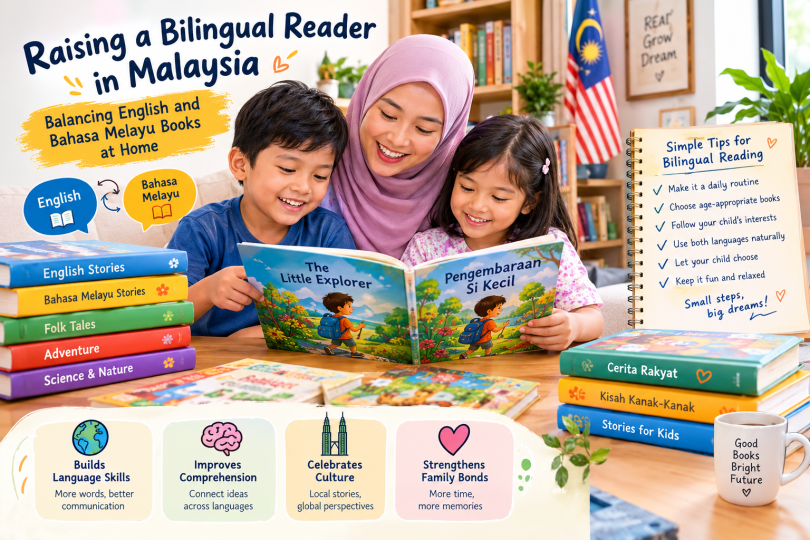

Growing up with more than one language is a valuable opportunity for children in Malaysia. With English and Bahasa Melayu playing important roles in education, communication, and everyday life, parents often want their children to feel confident reading in both languages. However, developing bilingual reading habits does not require complicated lessons, expensive resources, or a strict timetable.
The most effective approach is to make books a natural part of family life. By offering interesting stories in both languages, reading together regularly, and allowing children to explore their interests, parents can help build language skills while nurturing a lasting love of reading.
Why Bilingual Reading Matters
Reading in English and Bahasa Melayu gives children opportunities to develop vocabulary, understand different sentence structures, and express their thoughts more clearly. Each language offers its own words, expressions, and ways of describing experiences, helping children communicate with a wider range of people.
Bilingual reading can also support comprehension. When children encounter a familiar idea in one language, they may use that understanding to make sense of a similar story in another. For example, a child who understands a story about friendship in English may find it easier to discuss the same theme in Bahasa Melayu.
Books also introduce children to different cultural perspectives. English stories may expose them to international settings and characters, while Malay stories can connect them with local traditions, familiar family experiences, and Malaysian folklore.
Importantly, parents do not need to separate the two languages completely. Explaining an unfamiliar English word in Malay, or discussing a Malay story using a little English, can help children understand what they are reading. The goal is to build confidence in both languages rather than expecting children to speak or read each one perfectly from the beginning.
Create a Simple Routine for Both Languages
A consistent reading routine helps children become comfortable with books. Rather than trying to divide reading time equally every day, parents can choose a schedule that fits their family’s lifestyle.
For example, you could read an English picture book after breakfast and a Bahasa Melayu story before bedtime. Another option is to alternate languages each evening or choose books according to your child’s interests and current reading goals.
Here are a few practical ways to make the routine manageable:
- Alternate reading days: Read in English on Monday, Wednesday, and Friday, then choose Bahasa Melayu books on the other days.
- Read two versions of a story: When available, explore the same story in both languages and discuss how certain words or expressions differ.
- Follow your child’s interests: If your child loves animals, choose animal stories in both languages instead of insisting on unrelated books.
- Keep sessions short: Start with five to fifteen minutes, depending on your child’s age and attention span.
- Let children choose: Offer a small selection of suitable books and allow your child to decide which one to read.
Flexibility matters more than a perfect schedule. If your child becomes particularly interested in a Malay folk tale, there is no need to interrupt that interest simply because it is an English reading day.
Choose Books That Match Your Child’s Reading Level
Children are more likely to enjoy reading when stories match their abilities. A book that contains too many unfamiliar words can feel frustrating, while a story that is too easy may not hold an older child’s attention.
For babies and toddlers, look for sturdy picture books with simple words, colourful illustrations, and familiar subjects such as animals, food, and family life. Parents can name objects, repeat phrases, and ask basic questions while turning the pages together.
Preschool children often enjoy repetitive stories, rhymes, picture books, and simple narratives. Books with predictable language allow them to join in, remember phrases, and gradually become more confident.
Primary school children may prefer short stories, chapter books, adventure stories, and age-appropriate mysteries. Encourage them to try different genres while paying attention to their reading fluency and comprehension.
When selecting Malay storybooks for kids, consider whether the vocabulary is suitable, the illustrations support understanding, and the story offers something your child will find interesting. A book does not need to be long or academically challenging to provide a meaningful reading experience.
It is also helpful to include books at different difficulty levels. Children can enjoy easier stories independently while exploring more challenging books with a parent.
Bring Malaysian Folk Tales and Local Stories Into Reading Time
One enjoyable way to strengthen Bahasa Melayu reading habits is to explore traditional stories and familiar local experiences. Malaysian folk tales can introduce children to cultural traditions, moral lessons, and imaginative characters while providing opportunities for family conversations.
Parents might choose age-appropriate versions of stories such as Sang Kancil and the Crocodiles. After reading, ask questions about the character’s decisions, the problem faced, and the lesson children think the story communicates.
You can also explore stories about village life, local animals, traditional games, festive celebrations, and everyday experiences in Malaysia. Children may find these settings easier to understand because they recognise the places, customs, or situations described.
To connect the two languages, discuss the same theme in English and Bahasa Melayu. For example, after reading a Malay story about honesty, invite your child to explain the lesson in English. Then help them identify the Malay words that express the same idea.
This approach makes language practice meaningful without turning every story into a translation exercise. Sometimes, simply enjoying the story together is enough.
Build a Mixed-Language Home Library
A home library does not need to occupy an entire room. A small shelf, storage basket, or reading corner can provide a welcoming place for children to explore books in both languages.
Aim for a varied collection rather than buying many books at once. You could begin with a few English picture books, several Bahasa Melayu storybooks, a traditional folk tale, and one or two books related to your child’s current interests.
Families looking to expand their collection can explore local booksellers and children’s publishing options. waubooks is another name parents can look into when searching for reading materials, while checking individual titles for suitability, language level, and age recommendations.
Libraries are also useful resources. Borrowing books allows children to try different subjects and formats without requiring parents to purchase every title. If your local library has limited selections in one language, consider asking staff about borrowing options or recommendations.
Organising books by language can make choices easier for younger children. You might use separate baskets for English and Bahasa Melayu, or arrange books by subject, such as animals, adventure, and traditional stories. Let children help organise the collection so that it feels like their own space.
As your child grows, review the collection together. Keep favourite books available for rereading and gradually introduce new stories that reflect their developing interests.
Encourage Reading Without Correcting Every Word
Parents naturally want their children to pronounce words correctly and understand what they read. However, constant correction can make reading feel like a test rather than an enjoyable activity.
Instead, focus first on the story. If your child mispronounces a word, you can gently repeat it correctly within your response. If they do not understand a phrase, explain it using simpler language or an example from everyday life.
Ask open-ended questions that encourage conversation, such as:
- What was your favourite part of the story?
- Why do you think the character made that choice?
- What do you think might happen next?
- Can you describe this character in Bahasa Melayu or English?
These questions encourage children to think, remember details, and express their opinions. They also provide opportunities to practise both languages without putting too much pressure on accuracy.
If you are less confident reading in one language, you can still support your child. Choose books with straightforward language, listen to an accompanying audiobook when available, or ask your child to tell you what they understood. Your involvement and encouragement are valuable even when you are learning alongside them.
Make Bilingual Reading Part of Everyday Family Life
Reading does not have to happen only at bedtime. Parents can incorporate language and storytelling into ordinary activities throughout the day.
Read a simple English recipe together while preparing a snack, then discuss the ingredients in Bahasa Melayu. Look at a picture book about animals and talk about which ones your child has seen in Malaysia. During a family outing, connect something you observe with a story you read earlier.
These small activities show children that languages are useful beyond schoolwork. They can use English and Bahasa Melayu to share ideas, ask questions, describe experiences, and connect with others.
It is equally important to celebrate progress without comparing children. Some may begin reading independently in one language before the other, especially when their exposure differs. This does not automatically mean they are falling behind. Continue offering enjoyable reading opportunities and speak with their teacher if you have ongoing concerns about their progress.
Conclusion
Raising a bilingual reader in Malaysia begins with simple, consistent opportunities to enjoy books in English and Bahasa Melayu. Parents can support this journey by creating flexible routines, choosing age-appropriate stories, exploring Malaysian folk tales, and building a mixed-language home library.
There is no single schedule or collection that works for every family. What matters most is giving children access to interesting stories, encouraging their questions, and making reading a positive shared experience.
With patience and regular practice, children can develop stronger language skills while discovering the enjoyment of reading in both languages. A few minutes spent with a good story each day can become a meaningful family habit that supports learning and curiosity for years to come.