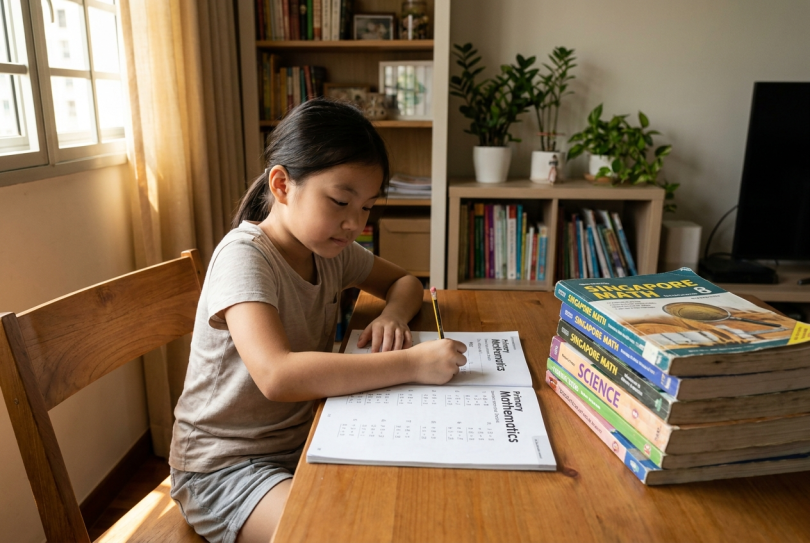

Nobody talks about the Primary 3 wall.
But spend five minutes in any Singapore parent group and you will hear some version of the same story. Things were fine. Maths felt manageable. Then somewhere around Primary 3 or 4, the work got harder, the scores dipped, and suddenly the subject that never caused trouble became the one keeping everyone up at night.
It is not a coincidence. The syllabus genuinely shifts at that stage, and not every child makes the transition smoothly.
It is not just harder. It is different.
The jump from lower to upper primary Maths is less about more difficult numbers and more about a different kind of thinking altogether.
In Primary 1 and 2, most children can get by following procedures. Do this, then this, write the answer. From Primary 3 onwards, that stops being enough. Questions start requiring children to decide which method applies, work across multiple steps, and explain their reasoning in a way that makes sense on paper.
For children who are naturally procedural thinkers, this shift is genuinely disorienting. They are not suddenly bad at Maths. The game has changed around them, and nobody quite told them that was coming.
Gaps do not fix themselves
This is probably the most important thing to take away from this article.
In primary school Maths, every topic builds on the ones before it. Fractions feed into ratios. Ratios connect to percentages. Percentages appear inside speed and algebra problems. Leave a gap unaddressed and it does not stay contained. It quietly undermines everything that comes after it.
Most parents assume gaps will sort themselves out as the child matures or as teachers cover the topic again. Sometimes that happens. More often, a child who was confused about fractions in Primary 3 is still confused about fractions in Primary 5, just more quietly, because by then they have learned to mask it.
Catching something early costs a fraction of the time and effort that fixing it late does. That sounds obvious. It is also something most families learn the hard way.
Effort is not always the problem
When a child consistently struggles with Maths, the first instinct is often to wonder whether they are trying hard enough. In most cases, effort is not actually the issue.
Children who work hard and still fall behind in Maths are usually dealing with one of a few things. A foundational gap that makes newer content harder than it should be. A misconception nobody has caught, some wrong way of thinking about a concept that has quietly calcified over time. Or enough accumulated frustration with the subject that anxiety has started interfering with their ability to think clearly during tests.
None of these respond well to just doing more practice. A child who is anxious about Maths will not become less anxious by being handed more worksheets. They need someone to actually figure out what is going wrong, and rebuild from there.
What genuinely useful support looks like
There is a version of tuition that is basically school but smaller. Same content, same pace, slightly less crowded room. It is better than nothing, but not by much.
What actually moves the needle is support that starts by understanding how a particular child thinks, not delivering a standard curriculum to whoever shows up. A good tutor will notice that two children can get the same question wrong for completely different reasons, and that what each of them needs next is entirely different.
Good primary school Mathematics tuition keeps sessions small enough that this kind of attention is actually possible. A group of four or five students is a fundamentally different environment from a class of thirty. Children ask questions they would never raise in front of a full class. The tutor can see the moment understanding breaks down and respond to it immediately, rather than moving on because the lesson plan says so.
What happens at home matters too
Tuition does part of the job. What happens between sessions does the rest.
A child who attends one session a week and does nothing in between will progress more slowly than one who spends fifteen minutes most evenings reviewing what was covered. That does not mean drilling endless worksheets. It means keeping the material active enough in memory that the next session builds on real retention rather than starting from scratch.
Parents do not need to become Maths teachers to support this. Creating a calm, regular time for practice, staying patient when things go wrong, and focusing on effort rather than scores, these things shape how a child relates to a subject they find difficult in ways that go beyond any single revision session.
Research from the Organisation for Economic Co-operation and Development (OECD) consistently shows that parental engagement in learning has a meaningful effect on outcomes, separate from natural ability or school quality. The environment you create at home genuinely counts.
Picking the right support for your child
Singapore has no shortage of tuition options, which makes the choice harder than it probably should be.
A few things are worth asking before committing. Does the tutor have experience specifically with the Singapore MOE curriculum? Someone who knows the local syllabus, understands how PSLE questions are structured, and has spent real time teaching in Singapore schools is not the same as someone who is simply strong at Maths. That distinction matters more than parents often realise.
How many students are in each session? What resources are available between classes? Is there a way to ask questions outside of scheduled sessions when a child gets stuck mid-week? These practical details often determine whether a programme actually fits into family life or just adds another obligation to an already full schedule.
Earlier is almost always better, but later is not too late
The families who look back on primary school with the least regret are usually the ones who noticed something was off and acted on it before the situation became urgent.
Starting in Primary 4 or 5 gives a child time to address gaps properly, develop genuine confidence, and build the kind of exam technique that holds up under pressure. Starting in Primary 6 is still worthwhile, but the window is shorter and the stakes feel higher, which makes everything harder.
That said, if your child is already in Primary 6 and things are not where they need to be, later is still better than never. A focused few months with the right support can shift things considerably, even close to the exam.
Getting the balance right matters
There is a version of primary school in Singapore that is entirely consumed by preparation for the next exam. Most parents know instinctively that is not what they want for their child, even if the pressure of the system sometimes pulls in that direction.
Children who are over-tutored, over-scheduled, and under-rested do not perform better. They burn out. The goal is not maximum support. It is the right support, timed well, matched to what a specific child actually needs.
Get that right and the results tend to take care of themselves. More importantly, your child gets through primary school without deciding that they hate Maths before they have even reached secondary school. That matters more than any single exam result.