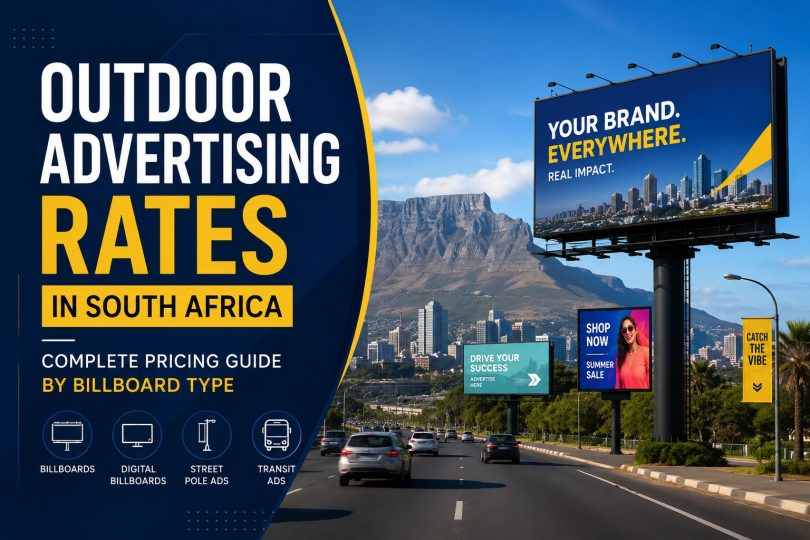

Outdoor advertising continues to be one of the most effective ways to reach consumers in South Africa. Whether you’re launching a new product, promoting a retail store, or building long-term brand awareness, understanding outdoor advertising rates helps businesses make informed marketing decisions and allocate budgets more effectively.
Unlike digital campaigns that disappear once a budget runs out, billboards and other outdoor media remain visible 24/7, delivering repeated exposure to commuters, shoppers, and pedestrians. However, pricing varies significantly depending on billboard type, location, traffic volume, campaign duration, and production costs. Knowing what influences these rates allows advertisers to choose the right format without overspending.
Understanding Outdoor Advertising Rates in South Africa
Outdoor advertising rates are influenced by several factors rather than a single fixed price. Media owners evaluate the visibility and demand of each advertising location before determining monthly rental fees.
Some of the primary pricing factors include:
- Geographic location
- Daily traffic volume
- Billboard size
- Digital or static display
- Campaign duration
- Production and installation costs
- Seasonal demand
For example, a billboard positioned along a busy Johannesburg freeway will generally cost considerably more than one located in a smaller regional town because it delivers substantially higher audience exposure.
Businesses should always evaluate the cost per potential impression rather than focusing only on the monthly rental price.
Billboard Types and Typical Pricing Considerations
Different billboard formats serve different marketing objectives, and each comes with its own pricing structure.
Traditional Static Billboards
Static billboards remain one of the most popular outdoor advertising options throughout South Africa. They feature printed vinyl artwork displayed for several weeks or months.
These billboards are ideal for:
- Brand awareness
- Retail promotions
- Property developments
- Government campaigns
- Event marketing
Pricing usually depends on visibility, traffic count, and billboard dimensions rather than simply the physical size.
Digital Billboards
Digital billboards display multiple advertisements in rotating time slots throughout the day.
Although advertisers purchase only a share of the display time, digital boards often provide excellent value because artwork can be updated quickly without printing new material.
They are particularly useful for:
- Time-sensitive promotions
- Multiple campaign messages
- Seasonal offers
- Product launches
Premium digital locations naturally command higher advertising rates due to their flexibility and visibility.
Street Pole Advertising
Street pole advertisements are commonly placed along busy urban roads and shopping districts.
They are suitable for:
- Local businesses
- Community events
- Political campaigns
- Tourism promotions
Because production costs are generally lower than large-format billboards, street pole advertising offers an affordable option for businesses targeting specific neighborhoods.
Transit Advertising
Transit advertising includes branding on buses, taxis, and other public transportation.
Instead of remaining fixed in one location, these advertisements travel across cities, increasing reach among diverse audiences.
Pricing varies according to:
- Vehicle type
- Fleet size
- Geographic coverage
- Campaign duration
For businesses targeting multiple suburbs, transit advertising can provide impressive visibility without requiring numerous billboard placements.
How to Choose the Right Billboard for Your Budget
Selecting the right billboard involves more than comparing monthly prices. An effective strategy begins with understanding your campaign objectives.
Step 1: Define Your Marketing Goal
Ask yourself what success looks like.
Are you trying to:
- Increase brand recognition?
- Promote a grand opening?
- Generate local foot traffic?
- Launch a nationwide campaign?
Your objective determines the most suitable billboard format.
Step 2: Identify Your Target Audience
Location matters more than billboard size.
For example:
A luxury vehicle dealership benefits from premium freeway locations where higher-income commuters travel daily, while a neighborhood restaurant may achieve stronger results using local street pole advertising near shopping centers.
Step 3: Calculate Total Campaign Costs
Many advertisers focus only on media rental costs.
However, a complete campaign budget should include:
- Graphic design
- Artwork approval
- Printing
- Installation
- Maintenance
- Removal
Including these expenses early prevents unexpected budget overruns.
Step 4: Consider Campaign Duration
Longer campaigns often produce better brand recall.
A four-week campaign may create awareness, but running a billboard for several months usually delivers greater recognition because audiences repeatedly encounter the same message during their daily routines.
Common Pricing Challenges Advertisers Face
Many first-time advertisers misunderstand how outdoor media pricing works.
One common mistake is choosing the cheapest billboard available. A lower-cost location with limited visibility may ultimately deliver fewer impressions, reducing overall marketing effectiveness.
Another challenge is ignoring traffic patterns. Two billboards may appear similar in size, yet one located near a busy freeway interchange can attract significantly more daily viewers than another situated on a quieter road.
Advertisers also underestimate production timelines. Printing, approvals, and installation require planning, particularly during peak advertising seasons when demand increases.
Finally, some businesses overload billboard artwork with excessive text. Outdoor advertising succeeds because people absorb simple messages quickly while driving or walking. Clear headlines, readable typography, and strong branding consistently outperform cluttered designs.
Expert Recommendations for Maximizing Return on Investment
Experienced marketers evaluate outdoor campaigns using both visibility and strategic placement rather than price alone.
Some proven best practices include:
Keep the Message Simple
Drivers typically have only a few seconds to read a billboard.
Use:
- One headline
- Minimal supporting text
- Strong brand identity
- Clear call to action
Prioritize High-Traffic Locations
Even if premium locations cost more, they often produce a lower cost per impression due to substantially higher audience exposure.
Match Billboard Type to Campaign Objectives
Digital displays excel for frequently changing promotions, while static billboards remain ideal for long-term branding campaigns.
Measure Campaign Performance
Outdoor advertising works best when combined with measurable marketing activities.
Businesses often track results using:
- Dedicated landing pages
- Promotional codes
- QR codes
- Call tracking numbers
- Branded search volume
These methods help estimate campaign effectiveness even when direct attribution is challenging.
Review Your Website Before Launching
Outdoor advertising often drives people to search for your business online rather than visiting immediately. Before investing in billboard campaigns, it is worthwhile to evaluate whether your website delivers a strong user experience, loads quickly, and follows SEO best practices. Free website auditing tools such as AudEsto can help identify technical issues that may affect conversions after potential customers discover your brand through outdoor advertising.
Conclusion
Outdoor advertising remains one of South Africa’s most reliable channels for building long-term brand visibility. While pricing varies across billboard types, locations, and campaign objectives, understanding the factors that influence outdoor advertising rates allows businesses to make smarter investment decisions.
Rather than selecting media based solely on cost, advertisers should evaluate audience reach, campaign goals, visibility, and total project expenses. A well-planned billboard campaign supported by a strong online presence can significantly improve brand awareness, customer engagement, and overall marketing performance.