Something shifted in the last few years.
If you had asked a Singapore parent in 2018 whether they would put their child through online tuition, most would have said no. The assumption was that learning required a physical classroom, a teacher in the room, and a whiteboard. Everything else felt like a compromise.
That assumption has quietly collapsed.
Not because of any single event, but because parents started comparing results. Online programmes that were well-structured, taught by experienced educators, and built around the specific demands of the Singapore curriculum started producing outcomes that were hard to argue with. And word got around, the way it does among Singapore parents.
Today, online science tuition is not a backup option. For a growing number of families, it is the first choice. The question is no longer whether it works. The question is how to pick the right one.
Why Science Specifically Is Such a Pain Point
Before talking about solutions, it is worth being honest about the problem.
Science is one of the subjects Singapore parents worry about most, and for a specific reason. It is not just about memorising facts. The PSLE science paper, and the lower secondary science exams that follow, require students to construct written answers that are precise, structured, and keyword-accurate. A student who understands a concept perfectly can still lose significant marks if they cannot translate that understanding into the format examiners are looking for.
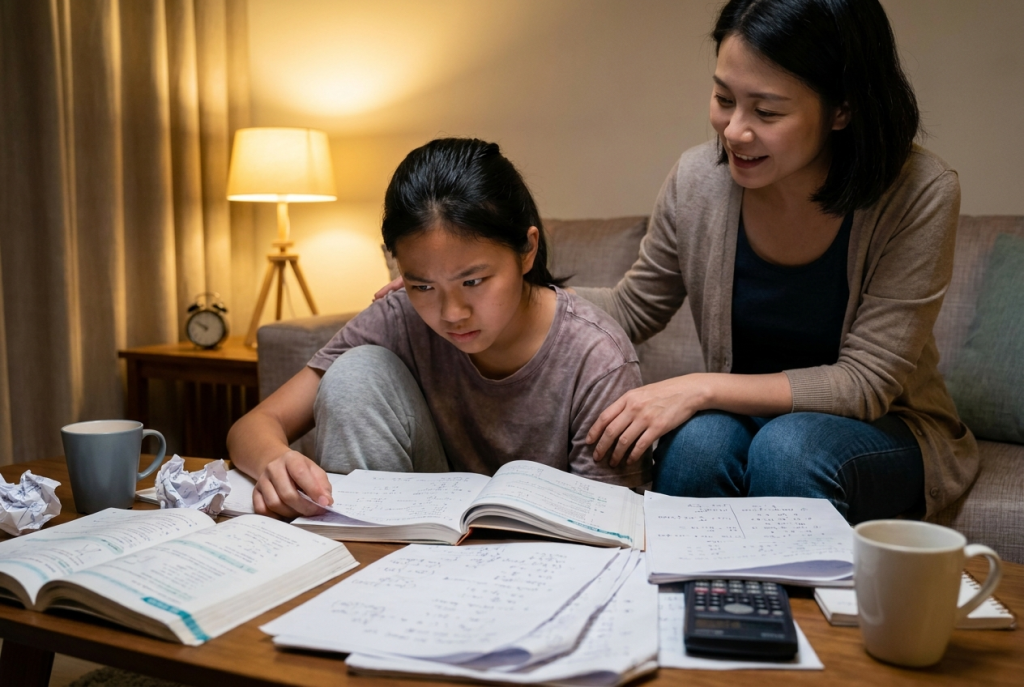
This is where many children get stuck. They know what photosynthesis is. They can explain it to you at the dinner table. But when they sit down to write a four-mark open-ended answer under exam conditions, something falls apart. The explanation comes out vague, a keyword gets left out, the cause-and-effect link is implied rather than stated.
It is not a knowledge problem. It is a skills problem. And it is one that good science tuition is specifically designed to fix.
What Is Actually Driving the Shift to Online
The practical reasons are obvious enough. No transport, no fixed classroom schedule, lower cost in most cases. But parents who have stuck with online tuition beyond the first term will usually tell you something more specific drove them to stay.
Flexibility that actually matches real life. A child who has CCA commitments on Tuesday evenings, a sibling with a different school schedule, or a parent who travels for work cannot always commit to a rigid twice-weekly slot at a centre 20 minutes away. Online tuition bends around the family’s reality rather than the other way around.
Access to better teachers regardless of location. A family living in Woodlands is not limited to centres nearby. If the best science educator for their child’s learning style happens to run an online programme, geography is no longer a barrier.
More honest feedback loops. In a physical group class of 10 to 12 students, it is easy for a quiet child to go unnoticed. Online formats, particularly smaller group sessions with live interaction, often give teachers a clearer view of which students are following and which are quietly lost.
None of this means online tuition is automatically better. A poorly structured online programme is worse than a decent physical class. The format is just the delivery mechanism. What matters is what gets delivered.
What Separates Good Online Science Tuition from Average
This is the part worth spending time on, because not all online science programmes are the same.
The first thing to look for is live interaction. There is a meaningful difference between a student watching pre-recorded video lessons and a student in a live session where a teacher can ask them questions, correct their thinking in real time, and give feedback on a specific answer they just wrote. Pre-recorded content has its place as a supplement, but it should not be the core of the programme.
The second thing is whether the programme explicitly teaches answering technique, not just content. This distinction matters enormously in the Singapore context. The MOE science syllabus, at both primary and lower secondary level, places heavy emphasis on structured written responses. A student who knows the science but has never been taught how to write exam answers in the correct format will consistently underperform relative to their actual understanding.
The third thing is support between sessions. This one is underrated. A child who gets stuck on a homework question on a Thursday evening and cannot access any help until the next session on Saturday evening will often just leave the question blank, form the wrong understanding, or give up on the topic entirely. Programmes that offer some form of between-session support, whether through messaging or a homework helpline, significantly reduce this problem.
The Singapore Curriculum Context
For parents outside Singapore who may be reading this, a bit of context helps.
Singapore’s primary school system runs from Primary 1 to Primary 6, with the Primary School Leaving Examination, known as PSLE, taken at the end of Primary 6. Science is examined at PSLE and contributes to the overall score that determines secondary school placement. The stakes are real, and the competition is real.
At secondary level, science splits into Biology, Chemistry, and Physics. Students typically take Combined Science or Pure Science depending on their stream, with the subject content eventually feeding into O-Level examinations at the end of Secondary 4.
The curriculum is rigorous and specifically structured. This matters when choosing tuition support because a generic science programme that is not built around the exact syllabus and question formats used in Singapore schools will have limited value regardless of how well it is delivered.
According to the Ministry of Education Singapore, the primary science syllabus is designed to develop both conceptual understanding and process skills including observation, inference, and communication. That last one, communication, is where so many students lose marks, and where targeted tuition support makes the clearest difference.
How to Evaluate Any Online Science Programme Before You Commit
A few practical things worth doing before signing up to anything.
Ask what the typical class size is. A live online session with 15 students is a very different experience from one with 6. Smaller groups mean more accountability and more opportunity for your child to actually interact with the teacher rather than passively watch.
Ask to see a sample lesson or attend a trial class. Any programme worth considering will offer this. Sit in with your child if you can, or ask them afterwards to explain one thing they learned. If they can do it clearly, the session probably worked. If they cannot, that tells you something.
Ask specifically how the programme teaches open-ended answering. This question tends to reveal a lot. Programmes that have thought carefully about the Singapore exam context will have a clear and specific answer. Those that have not will give you something vague about practice and exposure.
Look at whether the resources are included or sold separately. Some programmes charge a low monthly fee but then push workbooks, revision notes, and additional materials at extra cost. Others bundle everything. Know what you are paying for before you commit.
What Parents Who Have Seen Results Usually Say
After speaking with many Singapore families about their experience with online science tuition, a few patterns come up consistently among those who saw genuine improvement.
Their child got clearer on why they were losing marks, not just that they were losing marks. This sounds small but it is significant. A child who understands that they lost two marks on a question because they stated the observation without explaining the underlying process will approach the next question differently. A child who just knows they got it wrong has nothing to act on.
The homework stop-and-wait problem went away. When children have access to support outside of scheduled sessions, their studying becomes more continuous and less fragmented. They do not drop a topic because they were stuck and could not move forward.
Their child started using scientific language more naturally. This is often the clearest sign that the tuition is working at a deeper level. When a Primary 5 student starts explaining dinner table conversations using words like “insulation” or “photosynthesis” correctly and confidently, something real has shifted.
For Singapore families at the primary and lower secondary level, programmes offering top online science tuition in Singapore built around these principles, simplified concept delivery, structured answering technique training, and accessible between-session support, tend to produce the most consistent results.
A Realistic Timeline for Results
Parents sometimes expect improvement to show up in the very next test after starting tuition. Sometimes it does. More often, it takes a full term before the changes become visible in grades.
The reason is that exam results lag behind actual learning. A student who starts developing better answering habits in Week 2 of a term may not sit a major test until Week 8 or 10. The improvement is happening, but the evidence comes later.
What you should see earlier are softer signals: more willingness to attempt open-ended questions rather than skipping them, less frustration during homework time, more specific language when explaining concepts. These are leading indicators. The grades usually follow.
If you have not seen any of these signals after two full months, something about the programme is not connecting with your child, and it is worth having an honest conversation with the provider or reconsidering the fit.
Final Thoughts
Online science tuition in Singapore has moved well past the experimental phase. The families who have used it well, with the right programme and the right level of parent involvement, consistently describe it as one of the more effective academic decisions they made for their child.
The key is not the format. It is the quality of teaching, the specificity of the curriculum alignment, and whether the programme understands what Singapore science exams actually require from students.
Your child does not need more hours of tuition. They need the right kind of help, delivered in a way that fits their life and builds skills that last well beyond the next exam.
That combination is more available now than it has ever been. It just takes a bit of careful choosing to find it.