
Every live streaming platform shows a viewer count, and almost nobody outside the engineering teams knows what that number is counting. It is not a headcount of humans. It is an inference drawn from network activity, and once you understand how that inference is built, both the bot industry and the anti-bot industry stop looking mysterious.
This is a technical explainer, not an endorsement of anything. The point is to describe the mechanism.
What a “viewer” is from the platform’s side
A live stream is not a continuous pipe. It is a sequence of small video files. The broadcaster’s encoder sends a feed to an ingest server, the platform transcodes it into several quality levels, and each level is chopped into segments of a few seconds. A playlist file lists the segments in order and gets rewritten as new ones appear.
Your browser or app reads that playlist, downloads the next segment, plays it, then asks for the one after that. Playback is a loop of small HTTP requests against a content delivery network.
So when a platform says a channel has 400 viewers, what it broadly means is that roughly 400 distinct sessions requested recent segments within the counting window. There is no camera on your face confirming you are watching. There is a client identity, a series of requests arriving at the expected rhythm, and some accompanying telemetry the player sends back about buffering, quality switches and playback position.
That is the entire surface a bot has to imitate. It does not need to render video or run a speaker. It needs to look, at the network layer, like a player working through a playlist.
The naive version, and why it stopped working
The earliest tools did exactly the obvious thing. Open a few hundred connections to the stream’s playlist from one server, request segments in a loop, and the count climbs.
That approach died quickly because it produced a signature you could catch with a simple query. Hundreds of sessions from one address block, all starting within the same second, all requesting identical quality levels, all persisting for exactly as long as the operator left the script running. Real audiences do not arrive in perfectly synchronised cohorts from one data centre in Frankfurt.
Detection at that stage was mostly address reputation. Commercial hosting ranges are published and easy to enumerate. If a large fraction of a channel’s viewers resolved to known server address space, that was enough on its own.
Proxy pools and why residential addresses cost more
The response was to move the traffic somewhere that looks like a home.
Proxy networks resell access to addresses assigned by consumer internet providers, and to mobile carrier addresses which are shared by many real handsets behind carrier-grade network translation. Traffic routed through one of those looks, at the IP layer, like a person on a home broadband line in Manchester or a phone on a mobile network in Ohio.
That address space is finite and comparatively expensive, which is the main reason services in this market are priced the way they are. Data centre traffic is cheap and burns fast. Residential and mobile traffic costs more per session, and mobile is usually the most expensive tier because carrier addresses are the hardest for a platform to block without collateral damage to genuine users.
Geographic distribution matters too. A channel that streams in Portuguese to a Brazilian audience and suddenly acquires two hundred concurrent sessions from Eastern European broadband is inconsistent in a way that a model notices even when every individual address looks residential.
Session emulation: imitating a player, not a person
Address quality only solves one layer. The session itself has to behave like a real client, and real clients are noisy in specific ways.
A genuine player negotiates a quality level based on measured bandwidth, then changes it when conditions shift. It reports buffering events. It sends periodic heartbeats with playback position. It carries a plausible user agent, a matching set of headers, and often a cookie or device identifier that has a history. It has a browser fingerprint, if it is running in a browser, made up of canvas rendering quirks, font lists, screen dimensions and timezone.
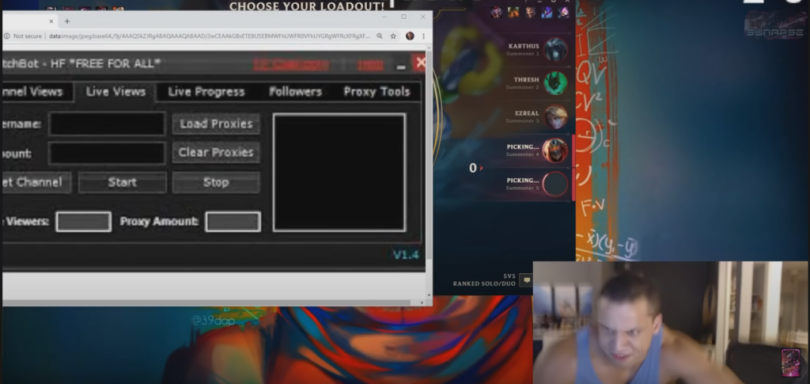
Sophisticated systems therefore run something closer to a real client stack rather than a bare HTTP loop: headless browsers or emulated player logic, each session with its own fingerprint, its own randomised bitrate ladder, its own small imperfections. The market for twitch view bots is essentially a market for how convincingly this emulation is done and how clean the address pool behind it is, which is why two products with identical descriptions can behave very differently in practice.
It is worth stating plainly at this point: inflating viewership numbers this way is against the terms of service of Twitch and Kick alike, and channels found doing it can face suspension or permanent loss. Anyone weighing this up should treat that as a real and non-trivial risk rather than a theoretical one, because enforcement does happen.
The signals that give crude bots away
Assume the addresses are clean and the sessions are well emulated. Detection has moved past both, and now looks mostly at shape over time.
Watch-time curves. Human audiences decay. People arrive, drift off, come back, get bored during a slow segment. Plotted over an hour, a real audience is a ragged line with a slow slope and visible reactions to what is happening on stream. Injected sessions often produce a plateau: a step up at the start, a flat top, a step down at the end. Even randomised session lengths tend to cluster around whatever distribution the script was configured with, and that distribution has a different signature from organic churn.
Chat and interaction silence. Real audiences generate side activity at a rough and fairly stable ratio: messages, emote usage, follows, subscriptions, clips, people opening the channel page from a directory. A channel with a large concurrent count and almost no interaction is anomalous. Bot operators sometimes add chat activity to compensate, but generated chat has its own tells, including low lexical variety and message timing that does not respond to on-stream events.
Arrival correlation. Real viewers arrive from identifiable places: the category directory, a recommendation surface, a raid, a social link, a notification. Sessions with no plausible referral path, or with a referral distribution that does not match anything the platform served, stand out.
Fingerprint and device clustering. Individually plausible sessions can still be collectively implausible. If four hundred sessions on one channel share an unusual combination of screen resolution, font set and browser build, that combination becomes a cluster label, and the cluster is then searchable across every other channel it appears on.
That last point is the one people underestimate. Platforms are not just examining one channel in isolation. They see the same infrastructure appearing across many channels, which means a pool that gets flagged anywhere degrades everywhere.
How detection has evolved
The progression has been roughly: block bad addresses, then validate client behaviour, then model behaviour over time, then correlate across the whole network.
Modern systems lean on machine learning classifiers trained on labelled traffic, and increasingly on graph analysis, where the question is not “is this session fake” but “which sessions share hidden structure with each other”. Retroactive review matters too. Counts can be adjusted after the fact, and a channel that looked fine live can be reassessed days later when a proxy pool it used is identified through unrelated activity.
There is also an economic asymmetry worth noting. The platform only needs to be right often enough to make the practice unreliable. The operator needs to be undetected continuously.
Why any of this is useful to know
Even if you have no interest in the grey market, understanding the mechanism makes you better at reading your own analytics. It explains why concurrent viewers is a weak metric and why average watch time, chat participation rate and follower conversion are the numbers experienced streamers actually track. It explains why a sudden spike with no interaction behind it usually means someone is testing a tool on your channel rather than a breakout moment, which happens to small channels more often than they expect.
And it explains the shape of the arms race. Every generation of detection pushes emulation closer to running an actual client on an actual consumer connection, which raises costs, which is exactly the outcome platforms are engineering for.