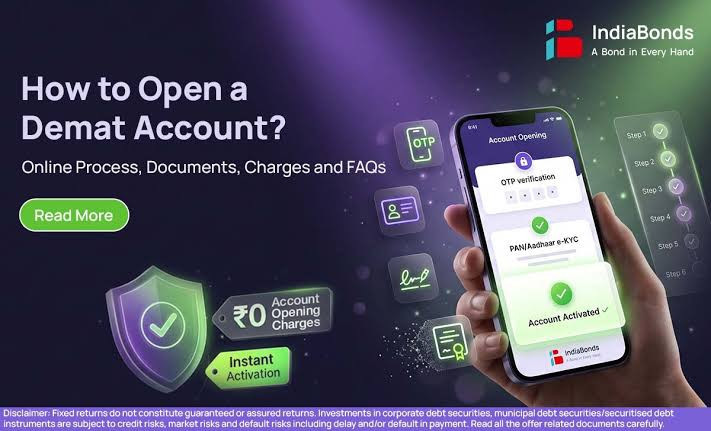

Opening a free demat account in India is now largely an online process that can take around 10–15 minutes to complete, provided you have your PAN and other required details ready. Many discount brokers offer zero account opening fees and may waive annual maintenance charges (AMC) for the first year or even for life. However, the actual charges and conditions vary by broker.
What Is a ‘Free’ Demat Account?
A demat account with a depository participant (DP) registered with either NSDL or CDSL holds your securities in electronic form. These may include shares, bonds, exchange-traded funds (ETFs), and other eligible securities.
In the Indian stock market, a free demat account generally refers to an account with the following benefits:
- No account opening fee: While account opening charges previously ranged from around Rs 200 to Rs 500 at some brokers, many now offer accounts with zero opening fees.
- No or reduced AMC: Some brokers waive annual maintenance charges entirely, while others offer a waiver for a limited period. Regular AMC charges vary by broker and account type.
However, even if you open a free demat account, you may still need to pay applicable brokerage, transaction, and regulatory charges.
Who Can Open a Demat Account?
To open a demat account, you generally need to meet the following requirements:
- Be an individual residing in India aged 18 or above, or an eligible entity such as a Hindu Undivided Family (HUF).
- Have a valid PAN card, which is generally mandatory for securities market transactions.
- Have an Aadhaar-linked mobile number if you choose an Aadhaar-based e-KYC process.
- Have a bank account in your name for transferring funds and settling trades.
Minors can also hold demat accounts through a guardian, subject to applicable rules. However, trading facilities and account features may be restricted, and promotional offers may be available only to eligible adult customers.
Documents Required to Open a Free Demat Account
Keep the required documents ready in digital format, such as clear images or PDFs, before starting the application process:
- PAN card: Generally mandatory for investors opening a demat account.
- Aadhaar card: Commonly used for e-KYC. Your mobile number should be linked to Aadhaar if you use OTP-based verification.
- Bank proof: A cancelled cheque, bank statement, or passbook page showing your name and bank account details. The IFSC code may also be required.
- Proof of identity and address: Aadhaar may serve these purposes, depending on the KYC process. If additional proof is needed, you may be asked to submit documents such as a passport, driving licence, or an eligible address document.
- Photograph: Some platforms capture your photograph through your mobile camera during onboarding, while others may require an uploaded image.
- Signature: You may be asked to upload a scanned signature or complete the digital signing process as instructed by the broker.
If you intend to trade in Futures and Options (F&O) or other derivatives, the broker may also ask for income proof, such as a bank statement, salary slip, or income-tax return, depending on the segment and applicable requirements.
Step-by-Step Process to Open a Free Demat Account Online
Most brokers follow a similar digital account-opening process.
1. Choose a SEBI-Registered Broker or Depository Participant
Before you begin, compare the following factors:
- Account opening fees and AMC structure, including whether a Rs 0 fee offer is valid for the first year or for life.
- Brokerage charges across different segments, including equity delivery, intraday trading, F&O, currency, and commodities, where available.
- Platform features, including the mobile app, web terminal, research tools, and customer support.
2. Start the Application on the Broker’s Website or App
Visit the broker’s official website or app and select ‘Open Account’, ‘Sign Up’, or a similar option.
Enter your mobile number and email address, then verify them using the OTPs provided.
3. Enter PAN and Basic Personal Details
Enter your PAN to verify your identity and retrieve or validate your personal details through the applicable verification process.
Provide other information, such as your address, occupation, annual income range, and investment experience, as requested.
4. Complete Aadhaar e-KYC
Follow the broker’s Aadhaar-based e-KYC process, if available, by entering your Aadhaar details and verifying your identity using the OTP sent to your registered mobile number.
Your photograph and address details may be retrieved during this step. Depending on the broker’s process, you may need to complete additional verification or submit further address proof.
5. Add and Verify Bank Details
Enter your bank account number and IFSC code.
You may also need to upload a cancelled cheque, bank statement, or passbook page to verify that the account belongs to you.
6. Upload Your Photograph and Signature, If Required
Some platforms capture a live photograph through your smartphone camera, while others allow you to upload an existing photograph.
You may also be asked to draw your signature digitally or upload a scanned copy, depending on the broker’s instructions.
7. E-Sign the Account-Opening Form
The broker prepares the application for your demat and trading accounts.
Where Aadhaar-based e-signing is available, you can electronically sign the documents using an OTP instead of submitting physical paperwork. Other permitted signing methods may also be available.
8. Complete In-Person Verification (IPV) or Video Verification, If Required
The broker may conduct in-person verification (IPV) through a video call or an approved digital verification process.
You may need to show your face and verify your identity using the documents or steps specified by the broker.
9. Account Activation
Once your KYC details and documents are approved, you will receive your demat and trading account details, such as your client ID and depository participant details, through email or SMS.
Account activation may be completed within minutes or take 24–72 hours, depending on the broker, verification requirements, and application status.
Charges to Expect Even with a ‘Free’ Demat Account
Even if your broker does not charge an account opening fee or AMC, other charges may apply when you trade. These include:
- Brokerage: Charged on applicable transactions. Some brokers offer zero brokerage on equity delivery, while intraday and F&O trades may attract a fixed or other applicable fee.
- Exchange transaction charges: Levied on applicable transactions by exchanges such as the NSE and BSE.
- Securities Transaction Tax (STT): Applicable to specified securities transactions at the prescribed rates.
- Goods and Services Tax (GST): Generally charged on applicable brokerage and other taxable service charges.
- Stamp duty: Levied on applicable transactions at the prescribed rates.
- Depository participant (DP) charges: These may apply to debit transactions, such as selling securities from your demat account. The amount and charging structure vary by broker.
Before you open a free demat account, review the broker’s complete tariff sheet to understand the applicable charges and avoid unexpected costs.
Things to Know Before Opening a Free Demat Account
- Nomination: You will generally need to provide nomination details or explicitly opt out of nomination, as applicable under the prevailing rules. Check the current requirements when opening your account.
- PAN-Aadhaar linking: If PAN-Aadhaar linking is applicable to you and has not been completed, your PAN status or verification process may be affected. Check your status before applying.
- Long-term investing: If you plan to hold investments for several years, pay attention to delivery brokerage, AMC, applicable DP charges, and platform reliability rather than focusing only on F&O brokerage.
- Frequent trading: If you trade regularly, consider the following:
- Low and transparent brokerage across the segments you use.
- A stable and responsive trading platform on both web and mobile.
- Reliable customer support and useful risk management tools.
- Keep your contact details updated: Ensure your mobile number, email address, and other details registered with the depository participant are current so that you receive trade confirmations, contract notes, periodic statements, and regulatory updates.