
Arabic rewards learners who study with a clear purpose. Yet thousands of students begin with enthusiasm and quit within weeks, because the teaching never matched what they actually needed. Choosing an experienced online Arabic tutor for adult beginners, busy professionals, or Quran students is the decision that shapes every lesson that follows. Picture two learners. One wants to read the Quran with understanding, while the other is relocating to Cairo for work. Their needs are completely different, and a poor match can waste months. This guide shows you how to judge teachers by what truly matters, so your time and effort lead to real progress.
Start With Your Learning Goal
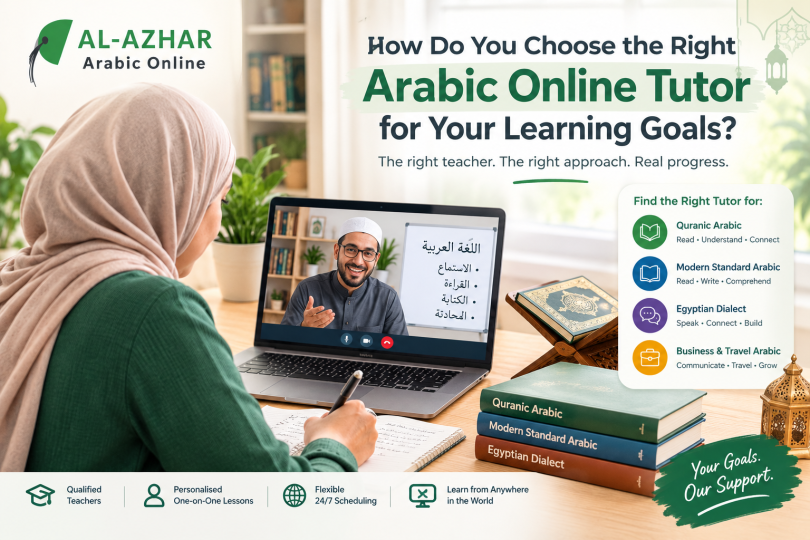
Arabic is not a single skill. It is a family of related skills, and each one calls for a different teaching approach. Before you compare a single profile, decide which of these describes you best:
- Quranic Arabic: You want accurate recitation, Tajweed rules, and a deeper grasp of what you read.
- Modern Standard Arabic (MSA): You need formal reading, writing, and comprehension for study, media, or academic work.
- Egyptian dialect: You plan to speak with friends, family, or colleagues in everyday conversation.
- Business or travel Arabic: You need practical phrases, etiquette, and vocabulary for a specific purpose.
Write your goal down in one sentence. That sentence becomes your filter for every decision below.
What a Qualified Teacher Actually Looks Like
A qualified Arabic teacher combines fluent command of the language, formal training in teaching learners whose first language is not Arabic, and a structured plan that shows where each lesson leads. Fluency alone is not enough. Plenty of native speakers cannot explain why a verb changes form, and that gap frustrates students quickly.
Look for these signals:
- Recognised credentials: Graduates of respected institutions such as Al Azhar University bring deep classical training.
- Experience with foreign learners: Ask how many students at your level they have guided.
- A visible syllabus: You should know what you will learn in month one, month three, and month six.
- Regular feedback: Good teachers correct mistakes on the spot and summarise progress after each session.
Why Native Speakers Give You an Edge
Arabic pronunciation trips up almost every beginner. The language contains sounds such as ع (ayn) and ح (ha) that have no true English equivalent, and only a teacher who has heard them since childhood can correct them reliably.
Did You Know? Arabic is spoken by more than 400 million people, yet the dialect heard in Cairo differs noticeably from the Arabic of the Quran and of formal writing.
A native speaking teacher also gives you cultural context. You learn when a phrase sounds polite, when it sounds too formal, and how families and colleagues actually talk. Teachers from Egypt, home to the largest Arabic speaking population, are especially valuable if you want dialect and Modern Standard Arabic together.
Expert Insight: In my experience reviewing how learners progress, the ones who advance fastest rarely have the most talented teacher. They have the most consistent one. A teacher who listens to your errors, adjusts the pace, and arrives prepared every week will beat a brilliant but distracted instructor.
Why One on One Sessions Speed Up Your Progress
Group classes move at the speed of the average student. Personalised Arabic lessons move at yours. When you sit with a teacher one on one, every minute goes to your weak points, your questions, and your goals.
Here is what that looks like in practice:
- Instant correction: Pronunciation and grammar errors are fixed before they become habits.
- Flexible pacing: Slow down on verb patterns or move quickly through vocabulary you already know.
- Custom material: Lessons can be built around religious study, work, travel, or family conversation.
- Comfortable practice: Shy learners speak more freely without an audience.
Flexibility matters too. Al Azhar Arabic Online, for example, delivers sessions through Skype with timetables available around the clock, which helps learners in North America, the UK, and Australia study across time zones.
Smart Questions to Ask Before You Commit
A short conversation reveals more than any brochure. Ask these before you pay:
- Can I take a trial lesson before enrolling?
- What is your experience with my level and my goal?
- Which books and materials will we use?
- How will you measure and share my progress?
- What happens if I need to reschedule?
- Are the fees clear, with no hidden extras?
Pay attention to how the teacher answers. Clear, patient replies usually predict clear, patient lessons.
Common Mistakes to Avoid
Learners often repeat the same errors when they pick a teacher:
- Choosing on price alone: The cheapest option often lacks structure, and you end up paying twice.
- Skipping the trial lesson: Chemistry with your teacher cannot be judged from a profile.
- Ignoring dialect: Studying Modern Standard Arabic when you need conversational Egyptian, or the reverse, stalls progress.
- Expecting fluency without practice: Even the best teacher needs you to revise between sessions.
- Never reviewing progress: Set a checkpoint every four to six weeks and ask whether you are moving toward your goal.
Pro Tips for Getting the Most From Your Lessons
- Record a short voice note after each class, repeating the new words aloud.
- Keep a small notebook of mistakes and review it before every session.
- Study for twenty minutes daily instead of two hours weekly.
- Ask your teacher to set one simple goal for the week.
Your Next Step Toward Confident Arabic
The right teacher is not the most famous or the cheapest. It is the one whose training, teaching style, and schedule match the goal you wrote down at the start. Test that match with a trial lesson, ask honest questions, and trust what you experience in the first session.
Al Azhar Arabic Online connects learners with Al Azhar trained instructors, native Egyptian speakers, and flexible one on one sessions for Quranic Arabic, Modern Standard Arabic, and Egyptian dialect. Visit the website, register, and take the first step toward choosing the right online Arabic tutor with confidence.
Frequently Asked Questions (FAQs)
How much should I expect to pay for online Arabic lessons?
Fees vary with the teacher’s qualifications, session length, and how often you study. Compare what is included, such as materials and progress reviews, and check the fees page before enrolling.
How long does it take to learn Arabic with a personal teacher?
Most learners reach basic conversation or Quran reading confidence within several months of steady weekly study. Full fluency takes longer, and daily short practice speeds it up.
Should I start with Modern Standard Arabic or a dialect?
Choose by goal. Modern Standard Arabic suits reading, writing, and formal study, while Egyptian dialect suits everyday speech. Many learners combine both under one teacher.
Can complete beginners study Arabic online?
Yes. A good teacher starts with the alphabet, pronunciation, and simple phrases, then builds gradually. Beginners often progress faster with individual attention.
Is a trial lesson worth taking?
Absolutely. It shows you the teacher’s style, pace, and communication before you commit, and it costs you very little.
Can children learn Arabic and the Quran online?
Yes. Age appropriate lessons with visual material and parent guidance work well for young learners.