
Mathematics can become frustrating when a child knows the basic operations but cannot understand how to apply them to unfamiliar questions. Difficult concepts often become more confusing when lessons move too quickly or rely heavily on memorising procedures. A personalised approach can make a significant difference by identifying exactly where the child is struggling and adjusting the explanation accordingly. A Singapore math tutor can use visual models, guided questions, practical examples, and structured problem-solving to make difficult ideas more manageable. Instead of simply showing children what to do, effective tutoring helps them understand why a particular method works and when to use it.
Why Some Maths Concepts Feel Difficult
A child may be comfortable with addition, subtraction, multiplication, and division but suddenly struggle when these skills appear in a more complicated context. This often happens because mathematical ideas become increasingly connected as students progress. A weakness in one foundational area can make later topics harder to grasp.
For example, difficulty with multiplication can affect fractions, area, ratios, and more advanced calculations. Similarly, a child who has learned to perform calculations mechanically may struggle when asked to determine which operation a word problem requires.
The issue is not always a lack of ability. Sometimes the explanation simply has not connected with the child’s way of thinking.
This is where individualised instruction can help. Instead of repeating the same explanation, a tutor can identify the specific barrier and introduce the concept through another representation, example, or strategy.
Starting With What the Child Already Knows
Effective tutoring does not begin by assuming that every student needs the same lesson. It starts by finding out what the child understands and where the gaps begin.
A tutor can use a few questions or activities to observe how the student approaches different concepts. The purpose is not simply to assign a score. It is to understand the child’s reasoning and identify areas that need attention.
For example, if a student struggles with fractions, the underlying problem may not be the fraction calculation itself. The child may have difficulty understanding that different-looking fractions can represent the same quantity.
Once this is identified, the lesson can return to the underlying idea before moving into more advanced procedures.
This creates a stronger learning pathway because new knowledge is connected to something the child already understands.
Making Abstract Ideas Easier to Visualise
Some mathematical concepts are difficult because children cannot easily picture what the numbers represent.
Visual representation provides a bridge between the question and the calculation. Diagrams, number lines, tables, arrays, and bar models can help children see relationships that may be difficult to recognise from numbers alone.
Consider a comparison problem involving two quantities. Instead of presenting only an equation, a tutor can represent the quantities using bars of different lengths. The child can then see which quantity is greater and how much separates them.
This can be especially useful when learning:
- Fractions
- Ratios
- Percentages
- Measurement
- Multiplication
- Division
- Comparison problems
- Multi-step questions
The purpose of a visual model is not simply to make a lesson more interesting. It helps reveal the mathematical relationship hidden inside the question.
Breaking Complex Problems Into Smaller Steps
Long questions can overwhelm children because several pieces of information appear at once. A tutor can teach them to separate the problem into smaller decisions.
Instead of asking a child to immediately calculate the answer, the tutor can guide them through questions such as:
What information is given?
What are we trying to find?
How are the quantities connected?
Can we represent the situation with a drawing?
Which calculation represents that relationship?
This gives children a repeatable process for approaching unfamiliar questions.
A complicated problem can therefore become a sequence of smaller tasks. Once students become comfortable with this process, they are less likely to feel overwhelmed when a question looks different from the examples they have practised.
Using the Concrete-Pictorial-Abstract Approach
The Concrete-Pictorial-Abstract approach is one of the ideas commonly associated with Singapore Mathematics. It provides children with a gradual pathway from experiencing a mathematical idea to representing it and eventually working with abstract symbols.
Concrete: Give the Concept Something to Connect With
At the concrete stage, children can explore mathematical ideas using objects, manipulatives, or practical situations.
For example, groups of counters can demonstrate multiplication or division. Physical fraction pieces can help a child compare parts of a whole.
The purpose is to give the child something observable that they can reason about.
Pictorial: Represent the Relationship
The same idea can then be represented through drawings, diagrams, number lines, or bar models.
Children begin moving away from physical objects while still having a visual representation of the relationship they are learning.
Abstract: Express the Idea Mathematically
Finally, children work with numbers, symbols, equations, and formal procedures.
Because the child has already explored the concept through concrete and visual representations, the abstract notation is easier to connect with meaning.
A tutor can move between these stages depending on the child’s needs. If an abstract calculation is confusing, returning to a diagram can help rebuild understanding.
Teaching the Reasoning Behind the Answer
Knowing the correct procedure is useful, but understanding why it works gives children a stronger foundation.
A tutor can encourage this by asking students to explain their decisions instead of immediately confirming whether an answer is right or wrong.
For example, after solving a question, the child might be asked:
- Why did you choose this operation?
- What does this number represent?
- Could you solve it another way?
- How could you check your answer?
- Does your answer make sense?
These questions make children more aware of their own thinking.
Over time, students can begin asking themselves similar questions while working independently. This gradually reduces their dependence on being shown exactly what to do.
Making Word Problems Less Intimidating
For many children, word problems are more challenging than straightforward calculations because they require both reading comprehension and mathematical reasoning.
A tutor can teach students to look beyond individual keywords. Words such as “more,” “less,” or “left” do not automatically tell a child which operation to perform. The complete relationship described in the question needs to be understood.
Visual models can make this process easier. A child can translate the written information into quantities, compare them, and identify how they are connected before choosing a calculation.
This creates a more thoughtful problem-solving process.
With regular Singapore tuition, students can also receive focused practice with different types of word problems instead of repeatedly solving questions that follow the same pattern.
Encouraging Different Ways to Solve Problems
There is often more than one reasonable way to approach a mathematical problem. Giving children opportunities to explore different strategies can make their thinking more flexible.
One student might draw a model, another might use mental calculation, while another might break a number into smaller parts.
A tutor can compare these approaches with the student and discuss which method is most suitable for a particular situation.
This teaches children that mathematics is not always about remembering one fixed sequence. It is also about choosing an appropriate strategy based on the structure of the problem.
This flexibility can become particularly valuable when students encounter unfamiliar questions in school assessments.
Turning Mistakes Into Useful Learning
A wrong answer can reveal how a child is thinking. Instead of simply marking the answer as incorrect, a tutor can examine the steps that led to it.
Perhaps the student misunderstood the question, represented a quantity incorrectly, selected an unsuitable operation, or made a calculation mistake.
Each situation requires a different response.
Looking closely at mistakes helps tutors address the actual misunderstanding rather than simply giving the correct answer. The child can then retry the problem using a clearer approach.
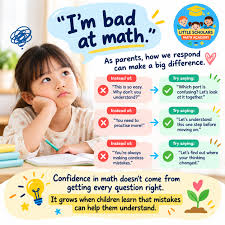
This can also change how students view challenging questions. Instead of seeing an error as proof that they are “bad at maths,” they can learn to treat it as information about what they need to understand next.
Supporting Progress Beyond the Lesson
Tutoring can become more effective when children have opportunities to apply their learning outside formal sessions.
Parents can support mathematical thinking through ordinary activities. Shopping can involve comparing prices and quantities. Cooking can introduce measurements and fractions. Planning an outing can involve time and duration. Sharing items equally can provide an opportunity to discuss division.
Parents can also encourage children to explain their solutions.
Instead of asking only, “What is the answer?” try asking, “How did you work that out?”
This small change places greater attention on reasoning and gives children an opportunity to practise explaining their mathematical decisions.
It is also important to avoid making speed the only measure of progress. Accuracy and efficiency matter, but understanding should come first. Speed tends to improve naturally as children become more familiar with the concepts.
Signs That a Child May Need Personalised Maths Support
Every child encounters difficult topics, but certain patterns may suggest that additional guidance could be helpful.
A child may benefit from personalised support if they:
- Frequently forget concepts they previously learned
- Can perform calculations but struggle with word problems
- Depend heavily on memorised formulas
- Become uncertain when questions look unfamiliar
- Need repeated explanations of the same idea
- Find multi-step questions particularly challenging
- Have difficulty explaining how they reached an answer
- Avoid attempting questions they consider difficult
Personalised tutoring can address these challenges by changing the pace, explanation style, examples, and amount of guided practice.
The goal is not to make every question easy. It is to help children develop the skills needed to approach difficult questions with a clear plan.
Final Thoughts
Challenging mathematics becomes more manageable when children are given the opportunity to understand an idea rather than simply memorise a procedure. A personalised approach can identify where confusion begins and introduce concepts through visual representations, practical examples, structured questions, and carefully chosen strategies.
A Singapore math tutor can play an important role in helping students become more comfortable with unfamiliar problems and more confident in explaining their reasoning. With consistent guidance, children can gradually move from needing step-by-step support to solving problems more independently.
If you are looking for a structured approach that focuses on understanding, reasoning, and practical problem-solving, Spartan Maths Malaysia can support your child’s journey towards stronger mathematical foundations and greater confidence.
Frequently Asked Questions
1. Can a Singapore Math tutor help a child who struggles with basic concepts?
Yes. A tutor can identify gaps in foundational knowledge and revisit the underlying ideas before introducing more advanced topics. This allows the child to build new skills on a stronger foundation.
2. How can visual models make difficult maths concepts easier?
Visual models turn numbers and relationships into something children can see and organise. Tools such as bar models, diagrams, and number lines can make concepts such as fractions, ratios, comparisons, and word problems easier to understand.
3. Is personalised Singapore Math tutoring suitable for different learning levels?
Yes. Individual tutoring allows the pace, examples, explanations, and practice activities to be adjusted according to a child’s current understanding. This makes it possible to provide additional support where needed while continuing to challenge students who are ready for more advanced concepts.