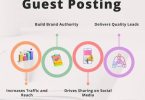

Students and parents often research an education business before they book a course, request a consultation, or choose a learning platform. A clear website matters, but it may not be enough to help people discover you. Publishing useful articles on relevant websites can introduce your expertise to new readers and give them a reason to explore your work.
This approach, commonly called guest posting, can support both brand awareness and search visibility. The strongest results come from treating it as an editorial and relationship-building activity—not a shortcut to rankings.
What Guest Posting Means for Education Businesses
Guest posting involves contributing an original article to another website, usually on a subject that suits its audience. An education company might write about choosing an online course, building study habits, career-ready skills, or using technology in the classroom. The host publication gains useful content, while the contributor reaches readers who may not have encountered its own website.
When an article includes a relevant link to a resource or service, it can also help readers take a next step. Search engines may consider links as one signal among many, but a link is most valuable when it is earned in a context that makes sense to people.
Why It Can Help Build Credibility
Education is a trust-sensitive field. Readers want to know whether advice is thoughtful, practical, and grounded in real experience. A helpful contribution to a respected publication can demonstrate subject knowledge before someone ever visits your site.
- Reach a relevant audience: A piece on a career or learning website can connect with people already interested in education.
- Show expertise: A detailed article gives you room to explain a topic, rather than relying on a short promotional message.
- Earn qualified visits: Readers who follow a contextual link are more likely to be interested in the linked resource.
- Develop industry relationships: Working with editors and publishers can lead to future conversations and collaborations.
These benefits depend on the quality of the publication and the usefulness of the contribution. A high number of placements is not automatically a sign of a successful campaign.
Choose Topics That Serve the Reader
Start by identifying questions your audience genuinely asks. A tutoring service might address how to prepare for a first session; a professional training provider could explain how to compare certificate programs. The article should give readers something they can apply, even if they never become customers.
Before pitching, review the publication’s existing articles, tone, and intended readership. Look for a gap you can fill rather than offering a subject the site has covered repeatedly. An editor is more likely to consider a pitch that is specific, timely, and clearly suited to their readers.
Evaluate Websites Before You Contribute
Not every site that accepts guest articles is a good fit. Assess the publication as a reader would: Does it regularly publish original material? Are its topics connected to your expertise? Do its articles have a clear audience and editorial standard?
- Check whether recent posts are coherent, useful, and relevant to the site’s subject.
- Look for signs of a genuine readership, such as thoughtful discussion or a consistent publishing history.
- Review how external links are handled and whether they fit naturally into the content.
- Avoid sites that publish unrelated articles in bulk or promise guaranteed search rankings.
It is also sensible to read current search engine guidance on link schemes. Paying for placement in exchange for a followed link can create risk; editorial independence and appropriate link disclosures matter. Guest contributions should be written for people first, with links included only when they add useful context.
Plan the Work and Measure What Matters
A good article takes research, drafting, editing, and coordination with the publisher. Set a realistic schedule and agree on practical details in advance, including the topic, word count, deadlines, revision process, and whether links or author biographies are permitted.
Some teams handle every step internally. Others bring in independent writers, editors, or outreach specialists for particular tasks. A marketplace such as Osdire can help buyers find freelancers across categories including writing, marketing, design, and technology. Its flat pricing and secure payment process—where funds are held during an order and released after the buyer approves the delivery—can make project terms easier to manage. As with any freelance engagement, define the scope and review samples before work begins.
If you need help with publisher outreach, research providers carefully and ask how they assess site quality and editorial fit. For example, a link building guest posting service may be one option to investigate, but understand what is included before committing. Ask whether placements are selected for audience relevance, how content is reviewed, and what happens if a publisher rejects a submission.
Measure outcomes beyond the number of links secured. Track referral visits, reader engagement, relevant enquiries, and whether the published article continues to attract attention over time. Search rankings can fluctuate, so avoid treating a single metric as proof that a campaign is working.
Build a Sustainable Approach
Guest posting works best when it is part of a broader content strategy. Publish useful information on your own site, contribute selectively to credible publications, and maintain the same standards across both. One thoughtful article for a well-matched audience can be more valuable than many generic placements.
For education businesses, that standard is especially important: readers are making decisions about learning, time, and often money. Put their questions first, make claims carefully, and offer links only when they help. Over time, useful contributions can build recognition and trust while creating a more durable online presence.