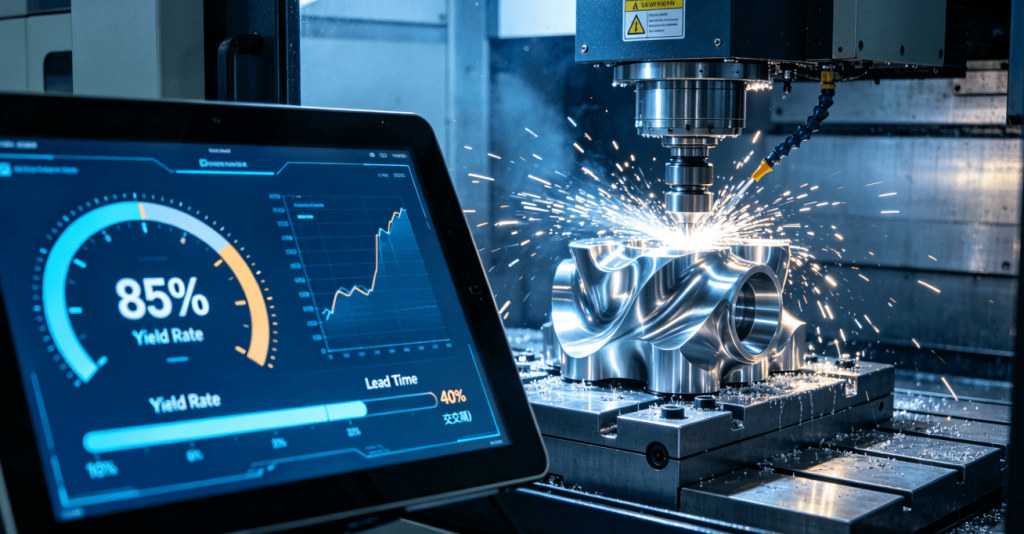
In the realm of metal part manufacturing services, one is faced with issues of unreliable quality, long lead times, and unpredicted total cost. Such an outcome would mean delays, increased costs, and finally a negative effect on the time-to-market. This happens because there is inadequate control of the entire manufacturing process; in such cases, experience plays a bigger role than process and quality control. Conventional methods of solving this issue include focusing on just one part of the process without collaboration throughout the entire manufacturing process.
This article outlines a systemic approach to fundamentally enhance the reliability, efficiency, and cost-effectiveness of manufacturing by integrating advanced precision manufacturing services with scientific process management. It focuses on the critical technical control points and cost-optimization logic within precision CNC machining services. To understand this systemic solution, it is essential to address the following core questions.
Why is High-Quality Metal CNC Machining the Cornerstone of Complex Project Success?
In sectors such as aerospace, medical equipment manufacturing, and premium electronics, there is no room for variance in the manufacture of components because it determines their function. Any slight variance will result in the failure of assembling processes, performance problems, or even safety concerns. Precision metal CNC machining plays the role of a cornerstone since it ensures that there is successful execution of complex geometries and tight tolerance specifications.
The Pillars of Machining Reliability
The impeccable reliability offered by today’s precision metal cutting technologies relies on three main pillars. Firstly, the technology involved. Secondly, process and environment control.
- Technological Expertise: Control and Strategy
This entails leveraging advanced CNC machines that have capabilities of controlling movement down to micron levels together with strategic and intelligent computer-aided machining.
- Systemic Control: Managing Variables
Stability is maintained through careful control of key variables. These would include maintaining ambient temperature to avoid any form of expansion due to heat, avoiding vibrations on the machines, and having proper tooling wear detection and correction strategies to ensure proper cuts throughout the production cycle, from first to last piece.
Precision and Its Commercial Realization
By following these steps, CNC machined parts may consistently meet tolerances of ±0.025mm or even less on most parts. Such ability is the hallmark of quality machining, turning concepts into reality through well-made parts. But attaining such accuracy is just one goal; ensuring cost predictability and control is another crucial element.
How to Scientifically Control the Comprehensive Cost of Custom CNC Machining, Beyond Just Comparing Unit Price?
One frequent mistake is to be only concerned about the per part pricing. To truly gain control of your costs, you need a scientific assessment of the whole process. A proper CNC machining quote will have a clear breakdown of materials, machine time, tooling utilization, post processing, and quality control costs. In a credible CNC machining company, methods of maximizing each aspect are implemented.
Cost reduction in a systematic manner is made possible by DFM analysis to enhance materials efficiency, smart scheduling and state-of-the-art CAM programming to maximize OEE, and proper tool management practices to increase tool life. A different perspective is gained when we move our emphasis from price to value. So, getting an analytic and detailed custom machining quotes is the first step in making a sound judgment.
What Process Capabilities Should Be Prioritized Beyond Equipment Lists When Selecting a CNC Machining Supplier?
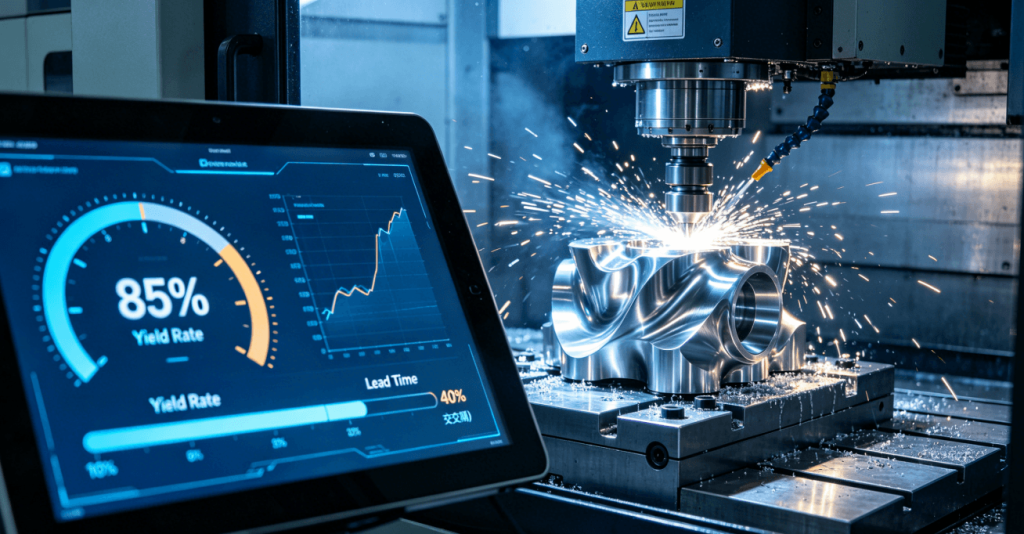
In addition to the capabilities of the multi-axis machines in a supplier’s range, their ability is measured on having standard processes in place as well as solid traceability in terms of quality. Beyond the machine tools themselves, a CNC machining services provider must show that they have a closed-loop process capability that includes digital simulation, FAI, and SPC when producing parts in bulk.
The Importance of Quality Certifications
Quality standards and certifications like ISO 9001, IATF 16949, and AS9100D help provide the third-party validation for a comprehensive system for managing quality. They prove that the CNC machining company has put in place processes that have been made standardized throughout the entire operation.
How Process Execution Delivers Part-to-Part Consistency
Where certifications form the basis of proof, actual delivery of the assurance of part-to-part consistency with regards to your CNC machining parts comes through effective process execution.
- Real-Time Process Oversight
Consistency of outputs is assured by real-time monitoring of the manufacturing process. This includes the real-time monitoring of crucial variables of machine tools used in precision CNC Machining Components‘ manufacturing process, which enables timely correction if the variable goes out of its control limits.
- Digital Traceability and Verification
Ultimately, assurance comes in the form of detailed digital reports of inspections. This makes it possible to achieve complete traceability for each product/batch made in the process, making the supply chain the reliable point of documentation.
How to Effectively Control Deformation to Ensure Precision When Machining Thin-Walled or Complex Structural Parts?
In precision metal cutting, the key concern becomes the issue of deformation due to forces and stresses exerted on the component during the cutting process. In order to deal with this problem, certain measures need to be taken that go far beyond traditional machining parameters, like symmetrical tool paths to even out stress, special tools with proper geometry, and optimal feed/speed ratio.
Perhaps most important would be the development of a proper fixture design capable of neutralizing the effect of such stress, and this cannot be achieved without extensive knowledge of the process as well as cooperation with a skilled provider of a custom CNC machining service. In order to understand the processes involved, one has to know how does a CNC machine cut metal.
How to Achieve a Seamless Transition and Cost Optimization from Low-Volume Prototyping to Mass Production?
However, there are different objectives for the use of prototyping (which aims to validate functionality and form) and mass production (which is concerned with controlling costs and efficiencies). This process is aided through design optimization of the part using DFM principles gathered during the prototype stage, for example, through standardized features to reduce special tooling.
For instance, let us consider a hypothetical situation where a housing of an electric vehicle drive unit is required. The prototype of the housing is intended to be completed quickly with the aim of validating the design concept. However, for mass production purposes, the same part undergoes manufacturing optimization. In this case, the implementation of an integrated 5-axis machining process that allows for in-process measurements has resulted in a first-pass yield of 99.8% and decreased single-part cycle time by 60%.
Conclusion
The goal of excellence in precision metal components manufacturing represents a complex engineering discipline including the following aspects: design collaboration, science of the manufacturing process, high-quality standards and comprehensive cost management. When working with a manufacturer capable of performing all steps in the process, based on the data-driven decision-making process, and operating in compliance with stringent quality system requirements, businesses are able to turn the supplier into the source of competitive advantage. Such a manufacturer is the example of an ideal partner in LS Manufacturing that combines manufacturing and digitalization.
For those who are looking for a solution to a problem of a complex metal parts manufacturing or want to receive the best analysis of manufacturing costs in accordance with the design concept, it is strongly recommended to begin the process with an engineering assessment. Simply upload your drawings to get a quotation package.
Author Bio
This paper is written by an expert who holds over 15 years of experience in the precision manufacturing industry, focusing on the use of state-of-the-art CNC Machining technology in the manufacturing process. The writer is currently working as a Senior Technical Consultant with LS Manufacturing, a highly reputable company that offers precision manufacturing solutions.
FAQs
Q1: What levels of tolerance could usually be guaranteed using the precision CNC machining process?
A1: Precision CNC machining, depending on the metal material, can maintain consistent tolerances of ±0.025mm to ±0.05mm. Using optimal processes and controlling the environment, some specialized high-precision machining operations may guarantee tolerances as tight as ±0.005mm.
Q2: On average, how long would it take for CNC machining, starting from drawing submission until obtaining the initial batch of parts?
A2: Based on the part complexity and order size, the time will vary. In case of urgent prototype orders, some manufacturers can offer 24-48 hour delivery. Small volume productions would generally take 3-7 business days. The exact time frame will depend on the analysis of the project.
Q3: Why would there be a price difference in machining stainless steel vs aluminum parts?
A3: The significant cost differences arise due to the difference in machinability of the two metals. Stainless steel is more abrasive and difficult to machine which causes fast tool wear and decreases the speed of machining. It increases the cost by about 40%-60%.
Q4: What does DFM (Design for Manufacturability) analysis refer to and what does it involve?
A4: DFM analysis refers to the evaluation of the manufacturability of a part prior to manufacture, which uncovers any characteristics that may result in expensive processing, low yields, and long lead times and makes appropriate suggestions for optimization. Proper DFM is able to cut down on cost, lead time, and failure rate.
Q5: How to ensure the CNC machine shop’s quality system is credible?
A5: See if they have quality system certificates, such as ISO 9001. Find out how they conduct First Article Inspection (FAI), in-process controls and what details are included in their final inspection report. A credible CNC machining shop should be able to offer comprehensive inspection reports and share their unique procedures for consistency control.