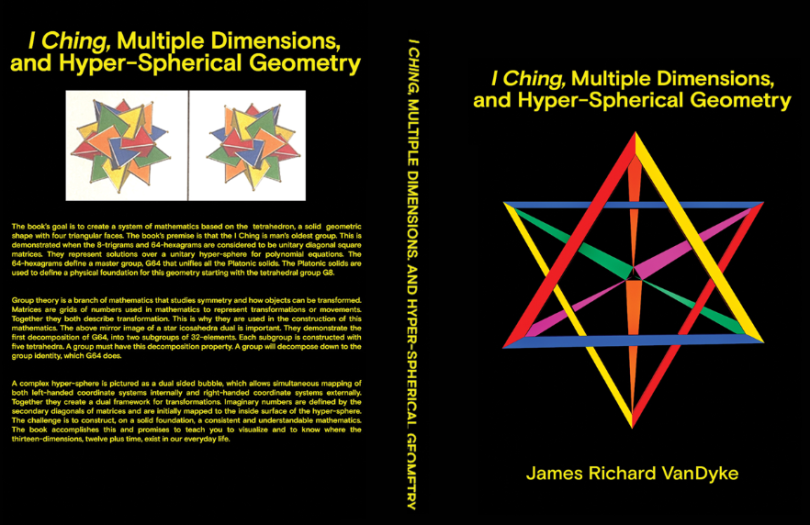

In I Ching, Multiple Dimensions, and Hyper-Spherical Geometry, James Richard VanDyke introduces a bold new way of understanding the universe—one that challenges the flat, linear models that have dominated science for centuries. By presenting reality as a complex hyper-sphere rather than a simple three-dimensional grid, VanDyke offers a framework that may transform how we think about space, number, and existence itself.
Traditional mathematics treats space as something that extends outward in straight lines. While this approach works well for everyday physics, it struggles when applied to higher dimensions, quantum behavior, and the deeper structure of reality. VanDyke’s hyper-spherical geometry solves this limitation by modeling the universe as a curved, multidimensional sphere with both an outer and an inner surface.
The outer surface represents physical reality—the space we see, touch, and measure. The inner surface represents what mathematics calls the imaginary domain, which includes imaginary numbers and hidden dimensions. Rather than being abstract or fictional, these inner dimensions are shown to be just as real as the outer ones. They are located on the opposite side of the same geometric structure.
This insight has far-reaching consequences. One of the most important is its ability to unify left-handed and right-handed coordinate systems. In physics, these two orientations often produce contradictions, especially in fields such as quantum mechanics and particle physics. VanDyke’s hyper-sphere allows both orientations to coexist naturally, with one mapped onto the outer surface and the other onto the inner surface.
This dual-surface model mirrors many of nature’s deepest patterns. From DNA to galaxies, left-handed and right-handed structures appear everywhere. VanDyke’s geometry suggests that this is not a coincidence, but a fundamental property of reality itself.
Another central theme of the book is the role of Platonic Solids in shaping space. These perfectly symmetrical forms have fascinated mathematicians and philosophers since ancient times. VanDyke builds on this legacy by showing that the tetrahedron actually exists in two chiral forms—left-handed and right-handed—making six Platonic Solids instead of five.
Using advanced group theory, he demonstrates that a single mathematical structure, G64, governs all six. This master group organizes the symmetries of the Platonic Solids into a coherent system, revealing a hidden order beneath the visible world.
What makes this discovery extraordinary is its connection to the ancient I Ching. The I Ching consists of 64 hexagrams, which VanDyke shows correspond exactly to the 64 elements of G64. This implies that ancient Chinese scholars were working with the same mathematical framework that modern geometry is now uncovering.
In this light, the I Ching becomes a symbolic map of multidimensional space—a way of describing reality long before formal mathematics existed.
The book also includes VanDyke’s personal journey, beginning with a near-death experience on Mount Shasta that awakened his fascination with higher dimensions. This deeply human element adds emotional resonance to the scientific theory, reminding readers that discovery often begins with wonder.
What truly sets this book apart is its vision. VanDyke is not merely proposing a new equation—he is offering a new way to see the universe. By uniting ancient wisdom with modern mathematics, he creates a model of reality that is both elegant and profound.
For readers interested in the mysteries of space, time, and higher dimensions, I Ching, Multiple Dimensions, and Hyper-Spherical Geometry provides a compelling and thought-provoking path forward.
I am a Vietnam veteran. My 60 years of combat trauma hasn’t killed me yet. I found healing through The Headstrong Project’s free, confidential PTSD treatment. Headstrong’s thirty free therapy sessions gave me hope, and I’m donating 50% of my book profits so more veterans can access this life-changing care. Suicide remains a real concern, but with support, veterans can triumph over trauma. My book is about a near-death experience where I learned the mathematics that I present in the book. It brings ancient mathematics into the modern world. Support veterans by buying my book: