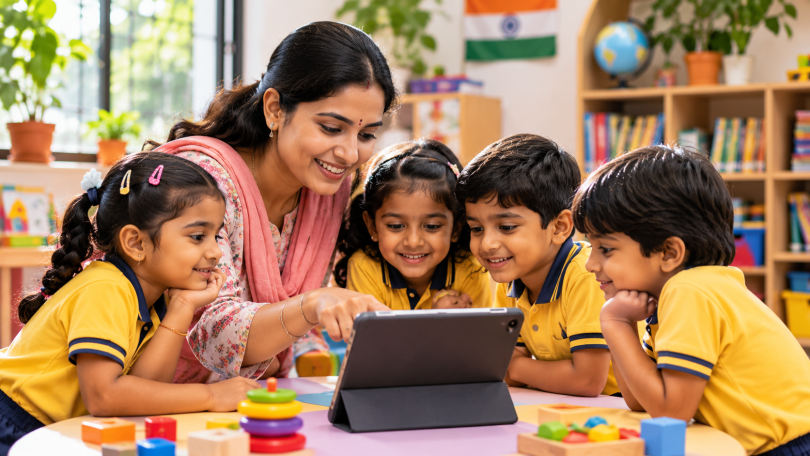

Artificial intelligence is already part of how many Indian students learn. Older children use apps that adapt practice questions to their level, and teachers use chatbots to draft worksheets and report comments. As these tools spread, a new question is reaching preschool and primary classrooms: what role, if any, should AI play in the early years?
The honest answer is that AI can be a useful assistant for teachers and schools, but it is not a replacement for the human relationships that young children learn through. Here is a practical way to think about it.
Where AI tools genuinely help teachers
Saving teachers time. Early childhood teachers spend hours on planning, observation notes, parent updates and paperwork. AI tools can draft a weekly newsletter, suggest activity ideas for a theme or turn rough notes into a clear progress summary. A structured preschool lesson planner helps too: when daily plans are already organised by theme and learning goal, teachers adapt them instead of starting from a blank page. That gives teachers more time on the floor with children, which is where learning actually happens.
Supporting multilingual classrooms. Many Indian classrooms bring together children who speak different home languages. Translation tools can help teachers share messages with families in Hindi, Tamil, Bengali or Marathi, and help schools welcome parents who are less comfortable in English.
Spotting patterns early. When teachers record observations consistently, software can help them notice which children may need extra support with speech, fine motor skills or social development, so that help comes sooner.
Where caution is needed
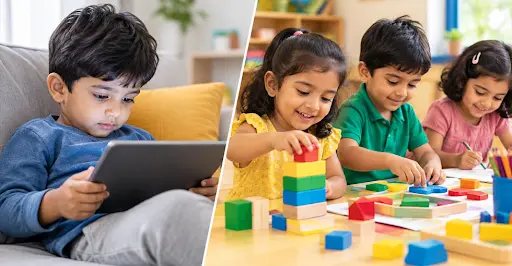
Screen time. Children aged 3 to 8 learn best through play, talk, movement and hands-on materials. India’s National Education Policy (NEP) 2020 describes this age group as the Foundational Stage and stresses play-based, activity-based learning. An AI app on a tablet should never crowd that out. For young children, AI belongs mostly in the teacher’s hands, not the child’s.
Accuracy. AI tools can produce confident answers that are simply wrong. Every lesson idea, fact or translation should be checked by a teacher before it reaches children or parents.
Children’s data. India’s Digital Personal Data Protection Act, 2023 sets out rules for handling children’s personal data, including parental consent. Before uploading photos, names or assessment notes into any tool, schools should know where that data is stored and who can see it.
A strong curriculum still comes first
Technology works best on top of a clear, well-designed program. If a school does not know what children should learn each week, no tool will fix that. A good early-years curriculum sets out learning goals across language, numeracy, science, the arts, social-emotional and motor skills, and gives teachers structured daily plans.
The International Preschool Curriculum (IPC), used by schools in more than 90 countries, is one example of a theme-based framework built this way. Its NEP 2020 lesson plans are written for the Foundational Stage and include Indian units such as Diwali, Holi, Yoga & Mindfulness and Indian Wildlife. School owners comparing options can also read IPC’s guide to preschool curriculum in India, which explains the NCF-FS standards, licensing and public funding programs.
What parents are asking
Indian parents are becoming more informed and more selective. At admissions, many now ask how a school uses technology, how much screen time children get and how their child’s information is protected. Schools that answer clearly, and can show that technology supports teachers rather than replacing them, build trust faster.
A simple AI policy for schools
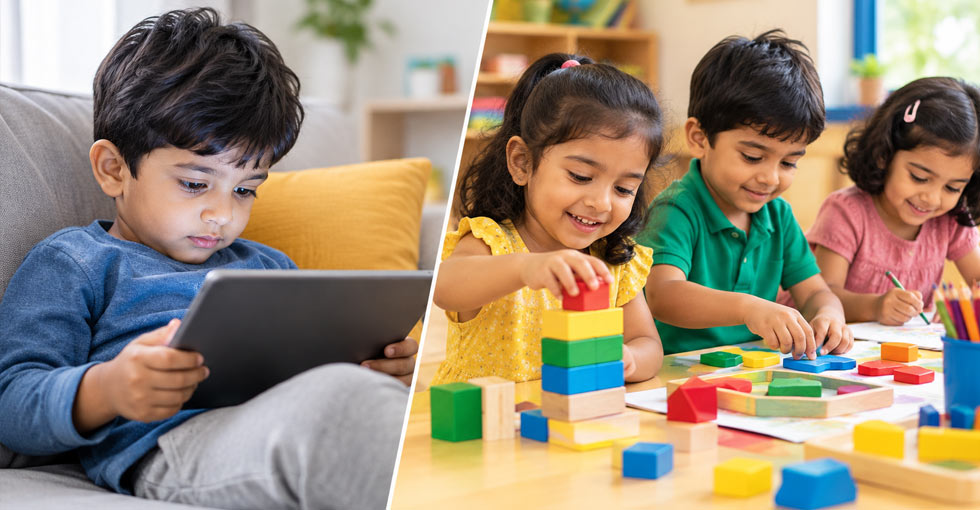
- Use AI to support teachers with planning, communication and admin.
- Keep screens to a minimum for children under eight.
- Have a teacher review everything AI produces.
- Protect children’s data and tell parents how you use technology.
Final word
AI in education will keep changing how schools work. In the early years, the goal is to use it in ways that give teachers more time and attention for children, while keeping learning playful, hands-on and human. Curriculum, caring teachers and honest communication with parents remain the foundation, and the International Preschool Curriculum (IPC) is built to support all three.