
Pet owners often describe the same frustrating cycle: vacuum twice a day, wipe the windowsills, and still find a film of hair on the coffee table by evening. Somewhere in the middle of that routine, the air itself gets ignored. Dander particles are small enough to stay suspended for hours, and litter dust and odor molecules travel through rooms in ways a mop never touches. A purifier can help, but only if you understand what it is designed to capture and what it quietly ignores.
This is a look at the mechanics rather than the marketing. Which filters deal with which pollutants, why airflow and placement matter as much as the filter stack, and where pet-specific challenges — ammonia, stubborn hair, and continuous dander production — demand more than a standard appliance. If you have ever bought a purifier and felt disappointed, the explanation is almost always in these details.
The Filter Stack, Layer by Layer
Most purifiers are not one filter but a sequence. Air enters, passes through a pre-filter, then a main particle filter, sometimes a dedicated gas stage, and finally an optional polishing stage. Each layer catches a different size and type of pollutant, and each can be bottlenecked by the layer before it. Understanding the order explains why some units clog quickly in pet homes while others keep their airflow for months.
Pre-Filters Catch What Would Otherwise Kill Your Main Filter
Pet hair is the fastest way to ruin an inner filter. A washable pre-filter catches fur, dust bunnies, and larger debris before they reach the fine media, and it is the single most important maintenance item in a pet household. If your purifier skips a pre-filter, hair reaches the dense particle layer and blinds it in weeks. Look for a pre-filter you can vacuum or rinse, and get into the habit of checking it weekly — it takes seconds and extends the life of the expensive stages considerably.
HEPA Media and the Particle Size Question
Pet dander is not the fur you see; it is the dried skin flakes that attach to it. Those flakes range widely in size, and the very smallest can stay airborne long enough to reach your lungs. True HEPA media captures particles at the size range that matters, and the key detail is how the media performs as it loads with dust. A quality filter loses airflow gradually rather than abruptly, and the seal around it matters as much as the media itself — unfiltered air bypassing the filter is a common hidden flaw.
Activated Carbon and the Ammonia Problem
Odor from litter boxes and pet bedding is largely gas, and gas needs a different capture mechanism. Activated carbon adsorbs odor molecules, including the ammonia compounds that make litter areas smell sharp. Carbon quantity is the practical spec to watch: a thin carbon sheet in a hepa-only cartridge saturates quickly and stops helping long before the particle filter is due for replacement. Pet homes benefit from a generously sized carbon stage, and from replacing it on schedule rather than waiting for the filter light.
Why Airflow and Placement Decide the Outcome
Filter quality sets the ceiling, but airflow determines whether the purifier ever reaches it. A unit rated for a large room only delivers that performance when air can circulate freely around it. Put it against a wall in a closed closet-sized corner and the clean air delivery rate effectively collapses. Pets also change the airflow equation, because hair and dust collect on intake grilles and reduce suction over time.
Think in terms of air exchanges rather than square footage alone. The purifier needs to turn over the room’s air several times per hour to meaningfully reduce dander, and open floor plans dilute that capacity across connected spaces. Place the unit where the air actually moves — near a litter area, along a walking path, or in the room where pets spend the most time — with at least a few inches of clearance on every intake side. Avoid tucking it behind furniture where it breathes the same small pocket of air repeatedly.
Noise, Sleep, and Real-World Use
Spec sheets quote maximum fan speed, but most homes run purifiers overnight at a lower setting. That low setting is the one your family lives with, so check noise levels there rather than at full blast. In pet homes, the purifier often runs around the clock to keep up with continuous shedding, which makes quiet operation a health issue for light sleepers. A unit that is too loud gets turned off, and a purifier that is off removes nothing.
Where Standard Purifiers Struggle With Pets
A purifier designed for a living room with no animals faces different conditions than one in a home with three shedding cats. The mismatch shows up in predictable ways, and knowing them helps you set realistic expectations or choose a unit built for the load.
Continuous Shedding vs. Batch Loading
Most appliances are tested with a fixed amount of dust, but pets generate particles continuously. That constant load means filters reach their useful end sooner, and airflow declines gradually enough that owners often do not notice until performance has dropped significantly. A filter replacement reminder based on runtime is more useful than a visual check, because the outer surface of a blower-filter looks fine while the inner media is already matted.
Litter Dust and the Hidden Source
Much of the dust in a cat household comes from litter, not from the cat. Pouring fresh litter and daily scooping both release fine clay dust that settles on every surface and recirculates when disturbed. A purifier with strong pre-filtration near the litter area captures a meaningful share of this, but it works best when paired with low-dust litter and a covered box. The purifier is one part of a system, not a standalone fix.
Matching a Purifier to a Pet Household
The right choice depends less on brand than on a few measurable factors: the number of pets, the size of the space where they spend time, and how much odor you are trying to manage. A single rabbit in a bedroom has different needs than two dogs and a cat in an open-plan apartment. Use these criteria as a practical checklist when comparing options.
First, size for the room the purifier will actually run in, and choose a unit whose clean air delivery rate comfortably covers it at a speed you can tolerate. Second, prioritize pre-filtration you can clean and carbon capacity you can replace, since those are the stages that do the pet-specific work. Third, confirm filter availability and cost per year — a unit with hard-to-find cartridges becomes expensive or useless. Finally, consider the physical design: stable footing for a dog that bumps it, a grille pattern that resists hair buildup, and controls that are easy to reach.
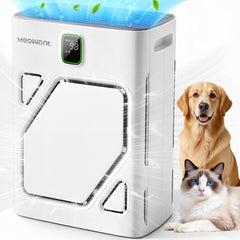
Meowant designs its pet air purifier line around these priorities, with attention to pre-filter access and carbon stages that suit homes with animals. You can compare the pet air purifier options to see how room coverage and filter design line up with your space. The goal is a unit that runs quietly in the background and keeps the fur and odor from accumulating in the first place.
Maintenance That Preserves Performance
Purifier performance is mostly a maintenance story. Vacuum the pre-filter weekly, wash it monthly if the manufacturer allows, and replace the particle and carbon stages on the recommended schedule rather than when the room starts to smell. Wipe the exterior grille and the sensor window with a dry cloth, and never block the intake with a curtain or a blanket. If airflow feels weak, check the pre-filter before assuming the motor is failing — in pet homes, a clogged pre-filter is almost always the culprit.
Cleaner Air Is a System, Not a Single Purchase
A purifier works when its filters match the pollutants in your home, when its airflow reaches the space it is meant to clean, and when maintenance actually happens. Pet households put extra strain on every one of those conditions, which is why the pre-filter and carbon stage deserve as much attention as the particle filter. Understand the layer-by-layer job, place the unit where air moves, and replace filters on time, and the difference in dust and odor becomes noticeable within days.
No appliance replaces basic husbandry — a clean litter box, a good vacuum, and low-dust litter still matter. But a well-chosen purifier handles the invisible fraction that cleaning tools cannot reach. Treat it as the quiet backbone of your pet-care routine, and your home will feel fresher without any extra effort.