
Most rooms are planned around the sofa, and the sideboard arrives last, usually as a response to a stack of dishes that no longer fits in the kitchen. That order is backward. A sideboard does three jobs at once: it stores the things a dining or living space accumulates, it gives a long blank wall a purpose, and it supplies a surface that can shift from serving drinks to holding homework to displaying the few objects you genuinely love. Chosen carelessly, it becomes a heavy box that crowds the room. Chosen with a clear idea of what it must hold and where it will stand, it turns into the most quietly useful piece you own. The decisions below move from function to material to placement, so the cabinet you bring home keeps earning its footprint long after the novelty wears off and the room settles back into ordinary evenings.
Start With What the Room Needs to Store
Before you look at doors, legs, or finish, empty the cabinets you already have and count what keeps spilling out. A sideboard should absorb a specific load rather than a vague idea of clutter. In a dining room that load is usually plates, serving pieces, glassware, and linens; in a living room it is games, chargers, craft supplies, and paperwork that never found a home. Write the list down. Its shape tells you whether you need drawers, open shelves, or a combination, and it prevents the most common purchase mistake: a beautiful cabinet that cannot hold a single platter.
Measure the Everyday Load
Pull out your tallest serving bowl, your longest platter, and the stack of plates you actually use on a Tuesday. Measure the stack height, not the diameter alone, because adjustable shelves are only useful if the cabinet is deep enough and the shelf spacing can clear your tallest item. Count how many bottles, boxes, or bins you expect to hide, then plan for a third more capacity than you think you need. Storage needs grow quietly, and empty shelf space rarely stays empty for long once the rest of the house learns where things now live.
Choose Doors, Drawers, or Both
Drawers are best for small, awkward items such as cutlery, napkins, batteries, and chargers. Doors suit bulkier pieces and tall bottles, especially when the shelves inside adjust. If you cannot decide, a layout with drawers down the center and doors on either side covers both habits without sacrificing the clean front that makes a sideboard look architectural. Open sections are worth considering only if you enjoy styling them regularly, because open storage collects both admiration and dust, and a shelf that looks curated in a photograph can look like a pile of objects in real light.
One more test is worth doing before you commit: walk through a normal week in your head and ask who opens this piece and when. A household that entertains often needs a surface at serving height and room for glassware within easy reach. A household with young children needs lower drawers they can manage and doors that close softly. The answers rarely match the showroom display, and that is exactly why they should shape the purchase rather than follow it.
Materials That Hold Up to Daily Life
Look past the first photograph and think about how the surface will look after a year of keys, cups, and small hands. Solid wood and well-made veneers both age gracefully, and a veneer is not a compromise when the substrate is stable and the edges are finished properly. Oak and walnut bring visible grain that hides light scratches; painted finishes look crisp but tend to show chips at the corners where chairs and toys make contact. Woven rattan or cane fronts add texture and ventilation but trap dust in the weave, so they reward a household willing to vacuum occasionally and honest enough to admit it.
Glass doors are the most honest option and the least forgiving, since everything inside becomes part of the room’s visual noise. Hardware matters more than most buyers expect: a heavy door with a flimsy hinge will sag, and a drawer that slams will announce itself every evening. Look for solid joinery at the corners, a finished back panel if the piece will float in the room, and leveling feet for floors that are not perfectly flat. These details rarely appear in marketing photos, yet they decide whether the furniture still feels solid in five years or has started to rattle and drift out of alignment.
Finish care is part of the same decision. A matte surface forgives fingerprints and softens reflections in a room with a lot of daylight, while a satin or gloss finish can make a dark piece feel lighter but shows every smudge. If the cabinet will sit near a window, ask how the finish behaves in direct sun, because some stains shift tone over time even when they resist moisture. A few questions at the point of sale are cheaper than refinishing a cabinet later.
Proportion, Placement, and the Walk-Around
A sideboard that is too tall reads as a wardrobe, and one that is too short leaves an awkward gap under the art. As a starting point, a surface height near a dining table’s height keeps serving comfortable, while lower models suit living rooms where the piece anchors a seating area instead of a meal. Length is a question of relationship: a cabinet that spans roughly two-thirds of its wall feels intentional, whereas one that hugs a corner can make the same wall feel unfinished. Depth matters most in hallways, where every extra inch turns a comfortable pass into a sidestep.
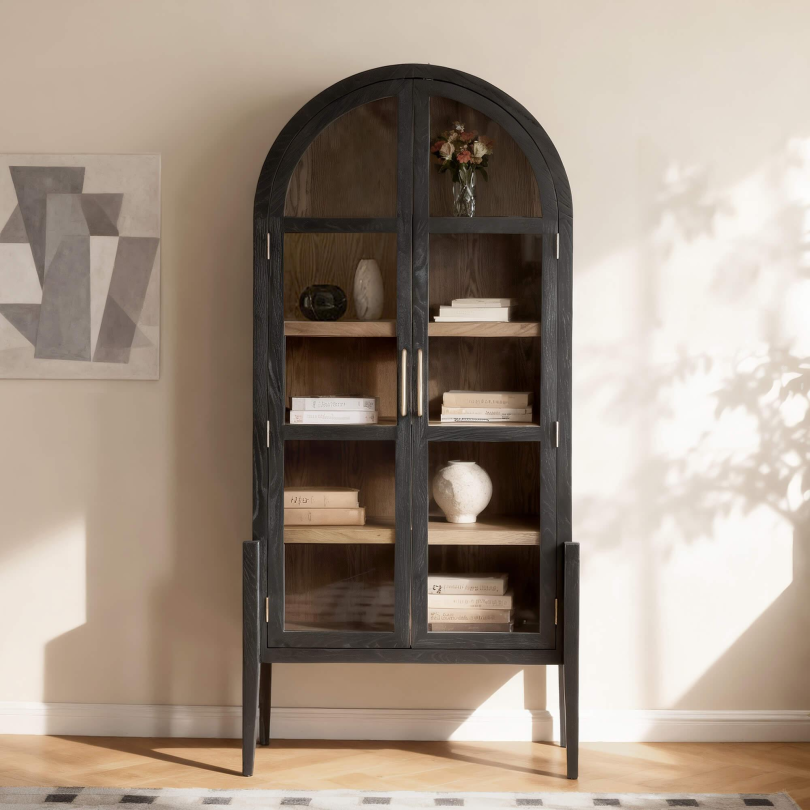
Leave enough room for drawers to open fully and for a person to stand back while holding a tray. Against a wall, center the piece on the wall or align it with the dining table, not with the room’s door, so the composition reads correctly from where people actually sit. Art above it works best when the bottom edge sits close enough to feel connected to the surface rather than floating in its own zone. Pieces such as the arched tall cabinets and rattan-front models from CHITA LIVING illustrate how a taller silhouette or a woven texture can rebalance a wall without filling it with more objects.
Think, too, about what the top will hold. A lamp at one end and a tray at the other creates a visual rhythm and gives the middle a place to work. If the piece doubles as a bar or a coffee station, check that the height suits pouring and that bottles can stand upright inside. Small choices like these keep a long cabinet from becoming a landing strip for mail, and they make the furniture feel designed for the room instead of merely placed in it.
Details That Separate a Good Buy From a Great One
The final pass is about small hardware and small habits. Soft-close hinges and drawer runners are worth paying for in a room where people open cabinets while talking. Adjustable shelves let the cabinet adapt when the plate stack changes. A cable cutout or a shallow rear channel keeps a lamp cord from fighting the back panel. Felt or cork lining in drawers protects glasses and muffles the sound of daily use, and an anti-tip strap is non-negotiable in homes with children who climb.
It also helps to inspect the interior as carefully as the front. Are the shelf pins metal or plastic, and do the shelves sit level under weight? Is the back panel attached squarely, or does it leave a gap that lets dust and small items escape behind the cabinet? Do the doors hang evenly with a consistent reveal? These are the questions that separate a piece built to last from one that merely photographs well, and they take only a few minutes to answer once you know to look for them.
A Sideboard Worth Living With
The best sideboard is rarely the most dramatic one in the showroom. It is the one whose interior matches the way your household really stores things, whose surface height makes serving and display feel natural, and whose finish still looks presentable after a busy week. Start with the inventory, then let material and proportion narrow the field, and treat placement as part of the purchase rather than an afterthought. Done in that order, the piece stops being a decorative extra and becomes the quiet infrastructure of the room. It holds the clutter, frames the wall, and gives the everyday objects of a home a dignified place to live, which is exactly what good furniture is supposed to do.