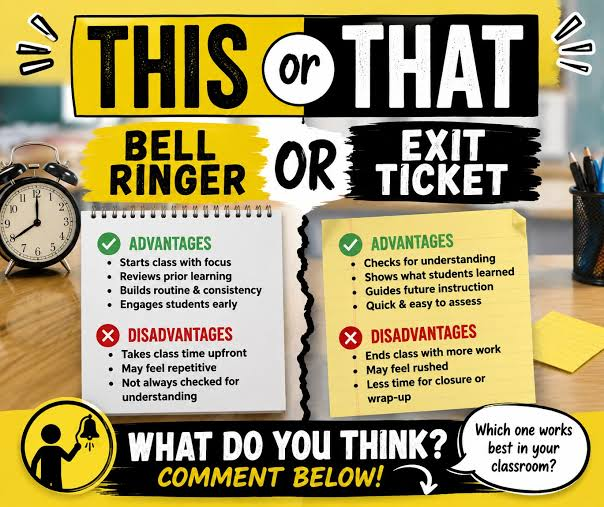

Quick answer: There is little research on “bell ringers” by that name, but strong research supports what a good bell ringer does: it builds a routine that protects class time, starts the lesson with a short review, asks students to retrieve information from memory, and revisits older material over time. Those features, not the warm-up itself, explain why bell ringers help.
Bell ringers, do-nows, warm-ups: nearly every secondary teacher uses some version. What exists is solid research on the things a good bell ringer does. Here’s what it says.
1. Do routines protect instructional time?
Yes. Time lost at the start of class adds up across a year. Classroom management research consistently identifies clear routines as a foundation of a well-run room; Simonsen and colleagues’ 2008 review lists structured routines among the best-supported practices. A daily warm-up is a routine students can start without being told.
2. Does starting with review help learning?
Yes. Barak Rosenshine’s widely cited Principles of Instruction (2012) puts “begin a lesson with a short review of previous learning” first on its list of research-based teaching practices. A bell ringer that pulls back yesterday’s content does exactly that.
3. Is recalling information better than rereading it?
Yes. Roediger and Karpicke’s 2006 research on the testing effect found that recalling information strengthens long-term retention more than studying it again. A warm-up that asks students to answer from memory, not copy from notes, gets that benefit.
4. Does spacing out review help?
Yes. Revisiting material over days and weeks, rather than all at once, improves retention. Cepeda and colleagues’ 2006 quantitative review of distributed practice, published in Psychological Bulletin, found consistent benefits for spaced review. Bell ringers are an easy place to bring back content from earlier units.
What does this mean for designing bell ringers?
- Ask students to recall, not copy.
- Mix in older content, not just yesterday’s.
- Keep it to three to five minutes.
- Use the answers. A warm-up nobody looks at is busywork.
- Keep the routine identical every day so students start without prompting.
What are the limits of the evidence?
None of these studies tested bell ringers directly, and much of the retrieval and spacing research comes from lab settings. The case for bell ringers is that they combine several well-supported practices into one daily habit, not that a warm-up alone raises test scores.
For more on bell ringer research and exit tickets, with sources linked, see the summary on Daily Bell Ringers.
Frequently asked questions
Are bell ringers evidence-based?
They are built from evidence-based practices, including daily review, retrieval practice and spaced repetition, though bell ringers themselves are rarely studied directly.
How long should a bell ringer be?
Three to five minutes.
What makes a bell ringer effective?
It is routine, short, asks students to recall rather than copy, and the teacher uses the answers.
Sources
- Rosenshine, B. (2012). Principles of instruction: Research-based strategies that all teachers should know. American Educator, 36(1), 12–19, 39.
- Cepeda, N. J., Pashler, H., Vul, E., Wixted, J. T., & Rohrer, D. (2006). Distributed practice in verbal recall tasks: A review and quantitative synthesis. Psychological Bulletin, 132(3), 354–380.
- Roediger, H. L., & Karpicke, J. D. (2006). Test-enhanced learning: Taking memory tests improves long-term retention. Psychological Science, 17(3), 249–255.
- Simonsen, B., Fairbanks, S., Briesch, A., Myers, D., & Sugai, G. (2008). Evidence-based practices in classroom management. Education and Treatment of Children, 31(3), 351–380.
Clay Shumate, M.Ed., is a Class A certified secondary social studies teacher (grades 6–12) and the founder of Daily Bell Ringers.