MANUFACTURING GUIDE / FACEPLATE STRAIGHTNESS AND LOGISTICS
Why Long Multipoint Lock Faceplates Bend and How Door Manufacturers Can Prevent It
Straightness can be lost during forming, assembly, handling, packing, transport or installation—and a small bow can bind an entire linkage.
For: door OEMs, lock manufacturers, importers, quality teams and installation contractors | Technical review: TOPTEK Access
A long faceplate behaves like a precision structural component; packaging and handling are part of its quality plan.
| TL;DR Control flatness from raw strip to installed lock. Define straightness and twist limits, support the part during forming and assembly, inspect on a suitable datum, protect it against concentrated loads in a rigid package, and install it into a straight routed edge without using screws to pull out a bow. |
The quick answer
Multipoint faceplates can extend well beyond one metre. At that length, a part that looks robust in cross-section can be damaged by a small side load, unsupported stacking or a package that flexes during transport. The resulting bend may be barely visible yet enough to increase friction at several moving points.
Prevention needs one end-to-end specification. If the factory controls straightness but logistics uses a soft carton, or shipping protects the part but installers force it into a curved door edge, the same failure reappears at a different stage.
Where long faceplates acquire bow and twist
Residual stress from stamping, roll forming or local embossing can release after the part leaves the tool. Spot fastening and linkage assembly can add local distortion. Parts stored diagonally or lifted from one end can take a set. A heavy box stacked across the middle of a long carton creates a simple bending fixture during transport.
Door preparation contributes too. A routed channel that is narrow, shallow or curved forces the faceplate away from its natural datum. Installers sometimes tighten screws sequentially to pull the strip flat, transferring the error into the lock case and sliding elements.
| Quality principle Straightness is a delivered-and-installed characteristic. Measure and protect it after every operation that can change it. |
Define a measurable geometry
Specify overall straightness, local flatness, twist and critical hole-to-edge locations using a stated datum and measurement method. A loose phrase such as “faceplate must be straight” cannot align the factory, incoming inspection and door shop.
Use a long fixture, surface or supported gauge that does not bend the part during measurement. Inspect a statistically meaningful sample after forming, after assembly and after representative packaging/transport testing. Record the condition in which the acceptance limit applies.
Design packaging as a restraint system
The package should support the faceplate along its length and prevent point loading, torsion and movement between parts. Rigid boards, shaped spacers or a timber crate may be appropriate for especially long assemblies and export handling. End protection prevents a dropped package from transferring impact into the linkage.
TOPTEK’s internal multipoint-lock material identifies long-part bending and transport damage as recurring industry pain points and uses reinforced protective packing for long mechanisms. Buyers should approve the pack design with the product sample and include it in drop, vibration or handling validation appropriate to the shipping route.
Install without using the door as a straightening jig
Before insertion, check the routed edge and place the mechanism against a flat reference. The lock should sit in the preparation without spring force. Tighten screws progressively and to a controlled condition while confirming free travel.
If the mechanism binds, remove it and isolate whether the error is in the part or the door. Do not hammer the faceplate, enlarge moving or grind keeps as a first response. Those actions may hide the root cause and reduce engagement.
Faceplate risk by process stage
| Stage | Typical bending mechanism | Control |
| Forming | Residual stress, uneven forming or local embossing | Process setup, supported transfer and post-form inspection |
| Assembly | Fastener sequence or linkage preload | Fixture, torque/sequence control and travel test |
| Storage | Diagonal support or long-term stacking load | Horizontal racks with distributed support |
| Packaging | Point load, movement or flexible carton | Rigid support, spacers, end blocks and pack validation |
| Transport | Drop, vibration, stacking and forklift contact | Route-appropriate handling test and package labels |
| Installation | Curved route or screws pulling strip into place | Door-edge gauge and no-force fit check |
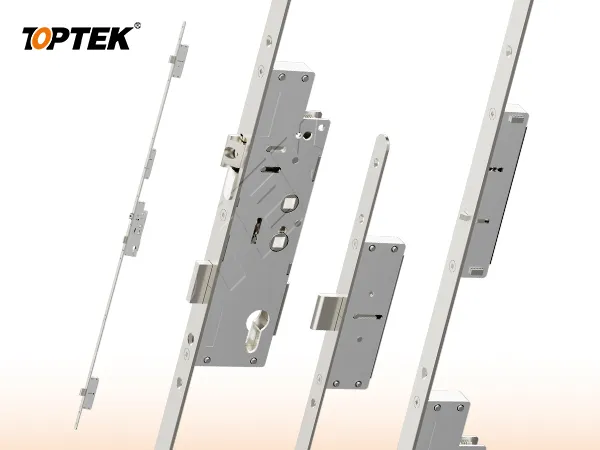
A long automatic multipoint assembly needs distributed support around the faceplate and moving linkages during transport.
Long-faceplate control checklist
▪ Define straightness, local flatness and twist limits with a measurement datum.
▪ Inspect after forming, assembly and representative shipment—not only at raw-part stage.
▪ Store long parts horizontally with distributed support and protected ends.
▪ Use rigid packaging that prevents point loads and movement between assemblies.
▪ Validate the final pack for expected drops, vibration, stacking and handling.
▪ Check incoming parts before they are inserted into door preparations.
▪ Gauge the routed door edge and reject no-force fit problems before tightening screws.
▪ Trace any bind complaint to part geometry, preparation or strike alignment before rework.
What a capable manufacturing partner should provide
TOPTEK’s multipoint locking systems include long-faceplate products such as the Auto-Lock and PD1000 examples. For a door OEM, the product drawing and the approved export package should be treated as two parts of the same submittal.
Manufacturing equipment alone does not protect a long part after it leaves the line. TOPTEK’s engineering and quality-control approach can be translated into agreed geometry checks, packaging photos and pre-shipment records for the customer program.
Frequently asked questions
Can installers straighten a faceplate on site?
Minor correction may be possible only under the manufacturer’s controlled instruction. Unplanned bending can damage linkages, coatings and hole positions.
Why does the lock bind only after the screws are fitted?
The door route may be curved or shallow, or the tightening sequence may pull a bowed strip against the preparation and load the linkage.
Is a rigid carton enough for export?
Not automatically. Validate the complete pack against its length, mass, stacking orientation, handling equipment and shipping route.
| Manufacturing takeaway Approve geometry and packaging together. TOPTEK can work with your door length, preparation and logistics route to define straightness checks and a protected delivery configuration. |