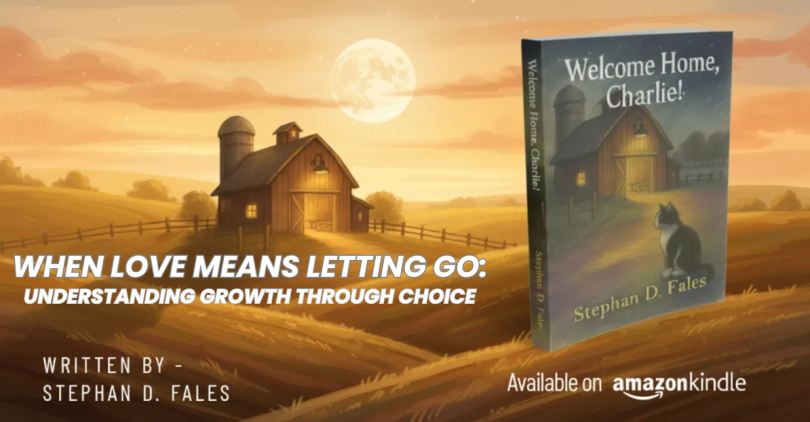

Welcome Home, Charlie! by Stephan D. Fales is a quietly powerful story that challenges a simple but deeply held belief: that love always means keeping someone close. Through Charlie’s journey, the novel invites readers, especially young ones, to explore a more nuanced understanding of care, freedom, and emotional maturity.
Charlie’s early life is shaped by struggle. He learns to survive without protection, relying on instinct and resilience. This background is essential to understanding his character. When Charlene discovers him injured and offers care, the story does not frame her as a traditional rescuer. Instead, she becomes a guide; someone who helps Charlie heal physically while unknowingly setting the stage for a much larger emotional decision.
As Charlie regains strength, he faces two worlds. One offers comfort, warmth, and individual attention. The other, the barn, offers connection, shared responsibility, and a sense of purpose larger than himself. The novel carefully avoids labeling one choice as “right” and the other as “wrong.” Instead, it allows readers to see how each space represents different forms of belonging.
What makes this story particularly meaningful is how it portrays internal conflict. Charlie does not reject Charlene’s care or affection. He carries gratitude with him, even as he feels drawn elsewhere. This internal tension mirrors real-life experiences for young readers; moments when appreciation and independence coexist, and when choosing growth can feel like a betrayal to those who care deeply.
Charlene’s perspective adds emotional balance to the narrative. Her disappointment is honest and relatable. She believes love should look a certain way: closeness, protection, permanence. When Charlie chooses the barn, she feels hurt, questioning whether her care was enough. Rather than dismissing her feelings, the story validates them, allowing readers to understand that love can still hurt even when it is genuine.
This emotional realism is where Welcome Home, Charlie! Truly shines. The book does not rush toward reconciliation or offer simple reassurance. Instead, it allows both characters to grow through reflection. Charlene learns that love does not require ownership, and Charlie knows that independence does not erase connection. Their relationship evolves, shaped not by loss but by mutual understanding.
The barn itself functions as a powerful symbol throughout the story. It represents community, cooperation, and shared identity. Charlie’s connection to the animals there reflects his desire to belong somewhere he feels understood without explanation. This setting reinforces the idea that home is not defined solely by comfort but by purpose and alignment with one’s true self.
For young readers, this message is both gentle and empowering. It encourages them to trust their instincts, to recognize when a space or role fits who they are becoming, and to understand that making such choices does not negate love. The book subtly teaches emotional literacy: how to sit with complex feelings, respect others’ perspectives, and communicate through action as well as words.
Fales’s writing style supports these themes with clarity and restraint. The language is accessible without being simplistic, allowing meaning to emerge naturally. Rather than instructing readers what to feel or think, the narrative creates room for interpretation and discussion. This makes the book especially well-suited for classrooms, families, and shared reading experiences.
By the end of Welcome Home, Charlie! Readers are left with a deeper understanding of what it means to fully care for someone. Love, the story suggests, is not measured by closeness alone, but by respect for choice and trust in growth. Charlie’s journey affirms that belonging is not something we are given; it is something we discover, often by listening carefully to our inner sense of where we fit.
This novel offers a quiet but lasting reassurance: choosing yourself does not mean leaving love behind. Sometimes, it is the most authentic expression of it.