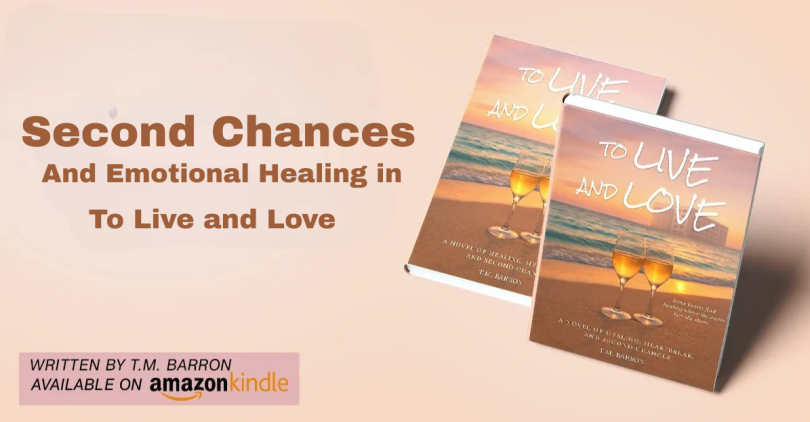

Romance novels often celebrate love at its most idealized, but To Live and Love by T. M. Barron takes a more nuanced approach. This contemporary romance focuses not just on falling in love, but on the emotional healing that must come before love can genuinely thrive.
Kennedie’s life is defined by responsibility. As a nurse, she gives endlessly to others, often at the expense of her own emotional well-being. Her loneliness isn’t loud; it’s quiet, persistent, and deeply familiar to many readers. When she accepts an invitation to her best friend’s destination wedding, she hopes the journey will provide relief, not transformation.
Yet transformation finds her anyway.
Gunner enters the story as a man driven by ambition but constrained by inner conflict. His struggles are not immediately visible, which makes his character particularly compelling. Barron portrays him as someone who has learned to function through pressure, even when that pressure becomes isolating.
Their connection develops through moments of honesty rather than dramatic declarations. Conversations unfold naturally, revealing shared fears, unspoken regrets, and emotional scars that haven’t fully healed. The novel excels at showing how intimacy can grow through understanding rather than perfection.
A key strength of To Live and Love is its refusal to portray love as an instant cure. Kennedie and Gunner are not “saved” by romance. Instead, their relationship becomes a mirror, forcing each to confront unresolved emotions and make difficult choices. The story acknowledges that love requires effort, courage, and self-awareness.
The island setting provides contrast rather than escape. While the scenery is beautiful, the emotional conflicts remain fundamental and unresolved. Barron uses this contrast effectively, reminding readers that healing doesn’t happen simply because the environment is idyllic; it occurs when individuals choose honesty and growth.
Family expectations, past heartbreak, and fear of vulnerability all shape the characters’ decisions. These elements ground the story in realism, making it relatable for readers who have loved, lost, and hesitated to try again.
For fans of women’s fiction, To Live and Love offers a deeply emotional experience that resonates beyond romance. It’s a story about self-worth, emotional boundaries, and the bravery required to open one’s heart after disappointment.
By the novel’s end, readers are left with a sense of quiet hope. To Live and Love doesn’t promise perfect endings; it offers something more meaningful: the possibility of connection built on honesty and resilience.