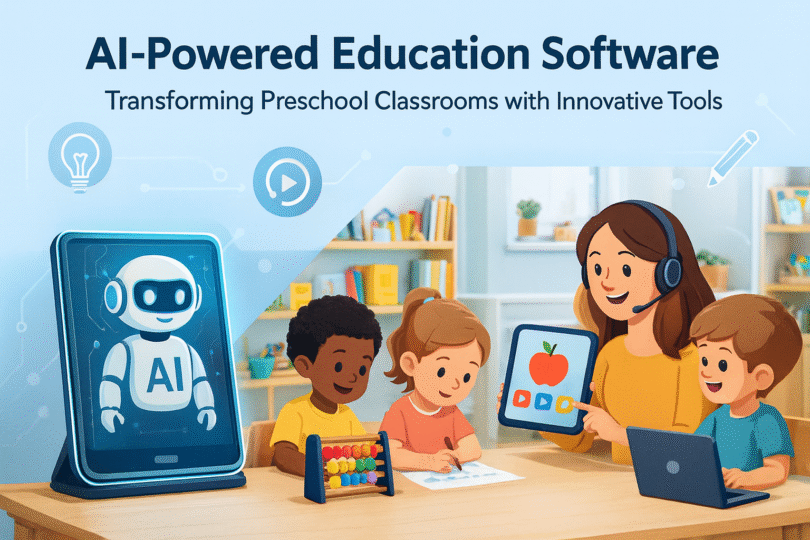

In recent years, AI-powered education software has emerged as a transformative force in classrooms worldwide. Nowhere is this transformation more evident than in preschool education, where AI in preschool education and artificial intelligence in classrooms are reshaping how young minds learn and grow.
These innovative tools promise to revolutionize early education by offering personalized, adaptive learning experiences that cater to each child’s unique needs.
According to various studies, personalized adaptive learning is paving the way for significant improvements in preschool education, as it personalizes lessons uniquely for each young learner. This rise in AI integration is reflected in the sector’s expected growth to $30 billion by 2032, up from $4 billion in 2022.
Choosing the right preschool software is crucial for effectively integrating AI into these settings, enhancing educational outcomes and administrative efficiency. For an in-depth understanding of how technology is further optimizing preschool operations, you can explore resources on preschool management strategies.
Defining AI-Powered Education Software & Its Transformational Role
AI-powered education software utilizes advanced machine learning algorithms and data analytics to customize educational experiences for young learners. This technology analyzes and adapts to each child’s learning patterns in real time.
By moving beyond the one-size-fits-all approach, AI offers personalized learning experiences that engage children more effectively. Crucially, it is not just a trend but an essential element of modern early childhood education.
Administrators witness reduced burdens through automated data collection and reporting, freeing educators to focus on meaningful interactions with students. This shift represents a pivotal change as customized learning is increasingly seen as indispensable in early education settings.
Key Features of Effective AI-Powered Education Software for Preschool
Adaptive Learning Pathways
AI-powered education software incorporates adaptive learning pathways that dynamically adjust to children’s evolving skill levels. Platforms that feature predictive learning tools evaluate each student’s progress in real time and automatically adjust the difficulty to ensure a learning pace tailored to each child’s needs.
Platforms like these allow children to learn at their own pace while receiving the support necessary to overcome challenges. Real-time assessments ensure all learners remain actively engaged, providing pathways that are neither too challenging nor too simplistic.
Personalized Learning Plans
AI in preschool education creates personalized learning plans informed by each child’s interests and pace, highlighting the flexibility and adaptability of AI systems. For instance, if a child exhibits a keen interest in nature, the AI software might incorporate outdoor-themed activities, using items like leaves and rocks to teach counting or categorization.
This level of personalization accelerates learning by aligning educational content with the child’s passions, making educational experiences more relatable and exciting.
Real-Time Feedback and Performance Tracking
Smart preschool technology offers immediate feedback for children, providing data-driven insights that inform educators about a child’s ongoing performance.
This technology allows teachers to quickly identify and address learning gaps, tailoring instruction to meet the precise needs of individual students.
Immediate feedback ensures that instructors can modify their lessons on the fly, increasing educational efficacy and maintaining a stimulating learning environment for young learners.
Support for Diverse Learners
AI-powered education software supports diverse learners by accommodating children with special needs or language barriers. These systems integrate translation features and assistive technologies to foster an inclusive learning environment, ensuring educational access for all students.
This inclusivity equips educators to manage diverse classrooms, promoting equality and enhanced learning among all preschoolers.
For a broader exploration of technology-enabled interactive environments, delve into Digital smart classroom solutions.
How AI Enhances Learning & Engagement in Preschool Classrooms
Measurable Improvements in Learning Outcomes
AI-powered education software delivers measurable improvements in learning outcomes. By enabling adaptive learning, AI tools have documented a 62% improvement in test results, along with a 20% reduction in anxiety among students. This personalized instruction ensures that children achieve more significant academic gains in less time, evident in reports where students using such technologies advance 18 months in just 6 months.
Enhanced Engagement Through Gamification
Gamification elements in AI software turn learning into a fun, interactive experience by incorporating game-based lessons that teach core skills such as literacy and numeracy.
This approach not only makes learning enjoyable but also keeps children’s attention on educational activities, enhancing both engagement and skill acquisition. Discover more about the benefits of gamification in early education through engaging digital platforms.
Supporting Critical Thinking & STEM
AI tools in preschool settings promote critical thinking and STEM development, fostering problem-solving abilities while introducing early STEM concepts. This nurturing of foundational skills lays the groundwork for academic growth, sparks interest in learning, and supports children’s development beyond academic pursuits.
Individualized Pacing Without Frustration
AI systems ensure children learn at a pace that suits their abilities, preventing frustration from overly difficult materials and disengagement from overly simple ones. This approach helps maintain motivation and boosts academic confidence, preparing children for continued educational success.
Consider exploring the Preschool Learning Management System for advanced solutions that blend structure and personalization.
Practical Applications and Successful Implementation
Integration Into Classroom Routines
Successfully implementing AI in preschool requires a balanced approach that blends digital learning with traditional play activities. Educators should incorporate short, focused AI sessions within a routine that also features play-based methods, optimizing both AI technology benefits and hands-on learning.
Examples of Popular AI-Powered Platforms
Prominent platforms like Lexia Core5 Reading, Khan Academy Kids, DreamBox Learning, and Osmo Learning System illustrate diverse AI implementations addressing various skill sets and developmental levels. Each platform offers a unique combination of personalized pathways and interactive features to engage young learners.
AI for Lesson Planning
Educators leverage AI for lesson planning by using tools like ChatGPT to generate activity suggestions. Tailored inquiries like “What are motor skill activities for nature-loving preschoolers?” provide actionable insights, facilitating personalized educational experiences.
The complete preschool software guide offers insights for administrators to integrate AI confidently.
Future Trends in AI-Powered Preschool Education Software
AI in preschool education is set to evolve substantially. Emerging trends include advanced predictive analytics for preemptively identifying learning challenges, deeper alignment with developmental sciences, expanded accessibility features, and a focus on enhancing rather than replacing educators.
Future platforms will likely emphasize holistic growth, addressing emotional and social development alongside academics. To understand more about integrating technology in early education, consider reading about technology integration in early childhood education.
Conclusion
AI-powered education software is revolutionizing preschool education, setting the stage for significant advances in early learning. By delivering personalized learning, real-time feedback, and improved classroom engagement, these tools provide measurable educational benefits while supporting teachers in differentiating instruction effectively
As AI technology continues to evolve, its role in preschool education will expand, offering increasingly sophisticated tools to facilitate optimal child development. Educators and administrators are encouraged to thoughtfully adopt these technologies, ensuring they complement rather than replace traditional, hands-on learning experiences.
Educators and administrators can explore further solutions by visiting the links provided throughout this post, empowering them to make informed decisions about integrating AI into preschool environments.
FAQs:
Why is AI important in preschool education?
AI provides adaptive learning pathways and real-time data insights, enabling educators to meet each child’s unique needs and foster a more effective, personalized educational experience.
How does AI personalize the learning experience?
AI software tracks individual progress and interests, adjusting lesson complexity and content in real time so that children remain consistently engaged and adequately challenged.
Are teachers being replaced by AI in preschool?
No. AI-powered tools serve as supportive resources that reduce administrative tasks and improve teaching efficiency. Educators still play a crucial role in facilitating meaningful, hands-on learning.
What are the potential challenges of AI in early education?
Challenges include ensuring data privacy, managing screen time appropriately, and maintaining a balanced approach that includes traditional play-based activities for holistic development.