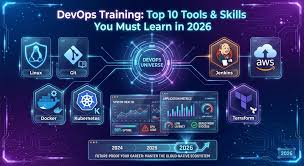

Open any job board filtering for DevOps roles, and you will notice a shift in what employers are actually asking for. The listings still mention Jenkins, Docker, Kubernetes, and AWS, but scroll further, and you will find phrases like “strong communication skills,” “ability to lead incident response,” “cross-functional ownership,” and “mindset of continuous improvement.” These are not throwaway lines. They are the parts of the description recruiters actively filter for. Which is exactly why a DevOps Course that stops at tools leaves learners unprepared for what the role actually demands — and why StarAgile built its program around that gap.
The Myth That DevOps Is a Toolchain
There is a common belief among professionals beginning their DevOps journey that mastering a handful of tools is enough to land the role. Learn Docker, get comfortable with Kubernetes, pick up Terraform, and you are employable.
This belief is comforting but inaccurate. Tools are the easy part. Anyone with a week of focused study can complete a Kubernetes tutorial. The harder parts — knowing why to use Kubernetes instead of a simpler option, convincing a product team to delay a feature for reliability work, leading a blameless post-mortem at 3 a.m. when production is down — are what employers cannot verify from a certificate alone.
What DevOps Engineers Actually Do All Day
Shadow a mid-level DevOps engineer for a week, and you will see tools in use roughly a third of the time. The rest is conversations: arguing with developers about deployment frequency, explaining to finance why cloud costs went up, negotiating SLOs with product leads, writing documentation that someone will actually read, and mentoring junior engineers who need to grow faster than any course can manage.
This is the part that tools cannot prepare you for. A pipeline works, or it doesn’t. A Terraform plan applies cleanly or throws an error. But a heated Slack thread about whether to roll back a release at 4 p.m. on a Friday — that requires judgment, and judgment has to be practised, not memorised.
Where StarAgile’s DevOps Course Does Something Different
StarAgile’s approach treats tools as necessary but insufficient. The curriculum spends meaningful time on areas most online courses skip entirely:
- Stakeholder conversations — explaining a technical trade-off to a non-technical product manager without losing credibility
- Incident leadership — walking through real failure scenarios and the decisions that resolve them
- Documentation as engineering — treating runbooks, architecture decisions, and post-mortems as artefacts worth writing well
- Cost and capacity thinking — understanding how engineering choices translate into cloud bills, finance eventually questions
- Mentoring and knowledge transfer — because senior DevOps engineers are measured by the teams they build as much as the systems they ship
Tools are covered thoroughly, but they sit inside a wider picture of what the role actually requires.
The Certification That Signals Both Sides
A DevOps Course that reflects this broader scope carries more weight with hiring managers than a purely technical credential. When employers see a certified candidate, they want to know that the person can operate the tools and operate within a team. StarAgile’s certification covers both, and that dual emphasis is what makes it relevant for engineers targeting senior roles rather than entry-level positions.
Final Thought
The DevOps engineers who rise fastest are not the ones who know the most tools. They are the ones who combine technical fluency with the softer disciplines of communication, ownership, and judgment. That combination is what StarAgile’s DevOps training is built to produce — a learning experience that takes both halves of the job seriously, so professionals leave the programme ready not just to run systems, but to lead the teams that depend on them.