The surge tank would be another term that falls into the category of performance upgrades or tuning. It sounds a bit technical, but it plays an extremely important role in maintaining a constant fuel flow to the engine in high-performance or modified vehicles. In very simple words, what is a surge tank in a car to ensure that the engine never runs out of fuel pressure, irrespective of the driving conditions.
What Is a Surge Tank?
A surge tank (also written as fuel surge tank) is a small additional tank connected to the rest of the car’s fuel system. It functions as a fuel reservoir to supply the engine with a constant amount of fuel.
Under normal driving conditions, fuel from the main tank goes straight to the engine. During hard cornering, drifting, acceleration, or hard braking, fuel in the main tank can slosh around, and in doing so, the fuel pump can momentarily suck air instead of fuel, starving the engine of fuel. That is when the surge tank kicks in to keep a constant amount of fuel ready for the engine, irrespective of how much the fuel in the main tank is moving.
Principles of Operation of a Surge Tank
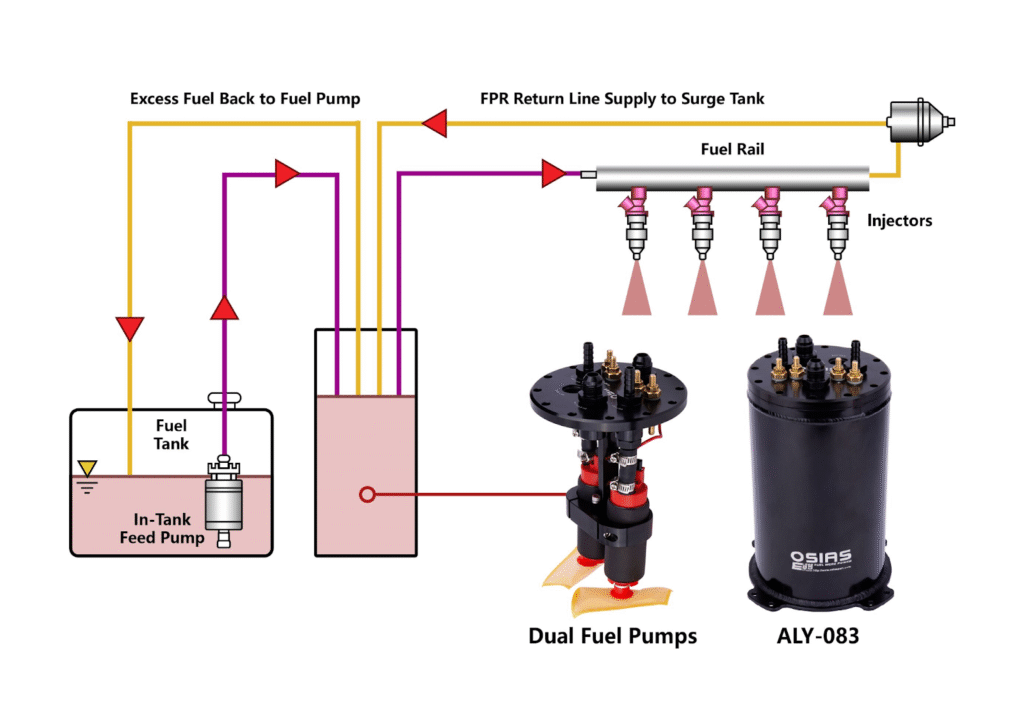
A surge tank is generally situated between the main fuel tank and the engine. Here’s how it works, broken down into steps:
Fuel Supply: The main tank sends fuel via a lift pump to the surge tank.
Buffer Storage: The surge tank is kept full at all times with a small, stable reservoir.
Engine Feed: A high-pressure pump connected to the surge tank sends fuel to the engine.
Return Flow: Any fuel not used returns to the surge tank or back to the main tank, ensuring equilibrium is kept.
Because secondary tanks are constantly being supplied, they will provide uninterrupted fuel even when the pickup area of the main tank is momentarily revealed.
Why Is a Surge Tank Important?
The purposes of a surge tank are even more vast in racing and performance setups due to high G-forces experienced in a race or while competing. Conditions like these severely disrupt the movement of fuel within the tank. Without a surge tank, such conditions could cause the engine to run into a lean condition, which is likely to trigger misfires or even engine harm.
The constant pressure of the fuel into the surge tank permits:
Avoiding stalling or fuel-cut hesitations.
Delivering gas smoothly under load.
Protecting engines against damage due to lean running.
Supporting high horsepower and turbocharged programs.
Who Needs a Surge Tank?
Not every vehicle out there will require a surge tank added. Most everyday passengers will themselves work fine with the stock setup. But you may want to consider one if:
You engage in track days, drifting, or off-road events.
Your car has a supercharger or turbocharger.
You have upgraded to larger injectors or a high-flow fuel system.
You encounter fuel cuts or pressure drops at high RPM or during hard cornering.
For modified or competition vehicles, a surge tank is an essential upgrade for reliability and safety.
Fuel Surge Tank Advantages
Maintains Constant Fuel Pressure: Eliminates the risk of power loss and misfire incidence which may be caused due to the sudden occurrence of air in the fuel line.
Improves Engine Reliability: Keeps air-fuel ratio intact during extreme driving conditions.
Increases Performance: Ensures that your engine gets the right amount of fuel when it most requires it.
Supports Tuning: Stable fuel delivery allows tuners to reach more accurate and reproducible results.
Points to Consider Before Retro-Fitting
Things to consider before adding a surge tank include:
It needs additional space installation usually in the trunk or close to the main tank.
The increased number of fuel lines and pumps means that getting a professional installation is basically a must.
First-rate materials must be used for compatibility with your fuel.
Must be checked regularly for leaks or wear.
Final Thoughts
The tiny surge tank actually plays an important role in maintaining the car’s performance and protecting the engine by supplying the engine with fuel continuously, regardless of the condition during drift, race, or cornering. This blunts the operation as fuel starvation leads to power loss or even potentially damaged engine.
For those who constantly go beyond stock limits, installing a surge tank is not just to increase performance but more so to bring durability and stability, as well as safety for the engine. The OSIAS fuel surge tank has been designed to deliver a continuous flow of fuel supply and unwavering performance under whatever straining driving condition imposed on the vehicle.