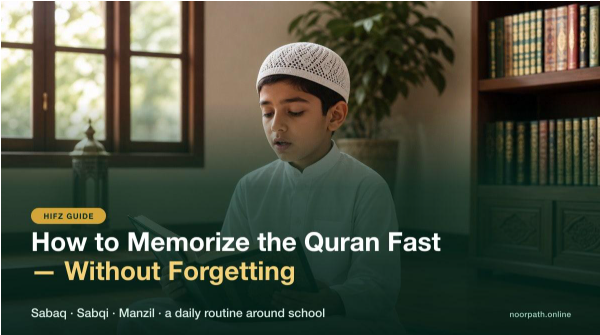

Here is the secret most Hifz students learn too late: the fastest way to memorise the Quran is not to memorise faster — it is to forget less. Children who rush ahead with a page a day and weak revision often end up re-memorising the same juz two or three times. Children who protect their revision finish sooner, and keep what they learned.
Many parents dream of their child becoming a Hafiz or Hafiza. Many also worry: Is my child ready? Can they do it alongside school? What if they forget everything? Can Hifz really work online? This guide answers all of it.
This guide answers those questions honestly. It explains how to tell whether your child is ready, how long Hifz realistically takes, the method most teachers use, and what to look for in an online Hifz program.
Quick Answer
To help a child memorise the Quran quickly and keep it, start once they read fluently with basic Tajweed, set a small daily target (five lines to one page), and revise every day using Sabaq (new lesson), Sabqi (recent revision) and Manzil (older revision) with a teacher who listens to all three. Most children complete Hifz in 2–5 years.
Key Takeaways
- Readiness comes before age: a child should read the Quran fluently with basic Tajweed before starting full Hifz.
- Most children take 2–5 years to complete Hifz, depending on the daily amount and consistency.
- Revision is half of Hifz. The Sabaq–Sabqi–Manzil method keeps old memorisation strong.
- Online Hifz works when the teacher listens to new lessons and revision every day and keeps a written plan.
- Parents matter: a quiet daily slot at home and steady encouragement make the biggest difference.
Why Hifz Is Worth It
The Prophet ﷺ said that the companion of the Quran will be told on the Day of Judgement: “Recite and rise, and recite as you used to recite in the world, for your rank will be at the last verse you recite” (Sunan Abi Dawud 1464; Jami’ at-Tirmidhi 2914). Beyond the reward, children who memorise often develop strong concentration, discipline and a lifelong closeness to the Quran.
Is Your Child Ready for Hifz?
Age is less important than readiness. Many children begin full Hifz between seven and ten, but look for these signs first:
- Fluent reading: they can read the Quran from the Mushaf correctly at a steady pace.
- Basic Tajweed: they know the main rules, so they memorise correct recitation from the start.
- Focus: they can concentrate for 20–30 minutes.
- Willingness: they want to do it, or at least enjoy memorising short surahs.
Younger children can still memorise the short surahs of Juz Amma by listening and repeating. That is a wonderful start, even before formal Hifz.
How Long Does Hifz Take?
The standard Madinah Mushaf has 604 pages. A simple calculation shows how the daily amount changes the timeline, assuming lessons six days a week:
- 1 page a day: about 2 years of new memorisation.
- Half a page a day: about 4 years.
- 5 lines a day (a third of a page): about 5–6 years.
Real life adds time for holidays, illness and extra revision weeks, so build in a buffer. Rather than guessing, you can plan it properly with a free Hifz calculator that works out a completion date, daily Sabaq pages and a revision timetable from your own numbers.
The Sabaq–Sabqi–Manzil Method
Most Hifz teachers use three parts in every lesson:
- Sabaq (new lesson): the new lines or page memorised that day.
- Sabqi (recent revision): the portion memorised over the last few days or the current juz, recited every day so it settles.
- Manzil (older revision): a larger portion of everything memorised earlier, rotated so the whole Hifz is revised regularly.
Without Sabqi and Manzil, children forget faster than they memorise. The Prophet ﷺ warned that the Quran slips away faster than a camel escapes from its rope, and told us to keep revising it (Sahih al-Bukhari 5033; Sahih Muslim 791).
A Daily Hifz Routine That Fits Around School
- Morning, 15–20 minutes: read the new Sabaq several times while looking, then recite it without looking.
- After school, 10–15 minutes: Sabqi — recite the recent portion from memory.
- Evening, 15–20 minutes: Manzil revision, then a final recitation of today’s Sabaq before sleeping.
- Live lesson with the teacher: the teacher hears the Sabaq, Sabqi and part of the Manzil, corrects mistakes and sets tomorrow’s target.
Most families start with Juz Amma (the 30th juz) and work backwards, because its surahs are short and already familiar from prayer.
Why Children Forget Their Hifz — and How to Stop It
- Too much new, too little revision: if Sabaq grows while Sabqi and Manzil shrink, forgetting is guaranteed. Keep revision at least as long as new memorisation.
- Memorising from one source only: always use the same printed Mushaf, so the page layout becomes part of the memory.
- Silent revision: revising out loud — ideally to someone who checks — is far stronger than reading in your head.
- Revising only when a test is near: daily Manzil, even small, works better than long catch-up sessions.
- Not using it: reciting memorised surahs in salah every day is one of the best ways to keep them.
Common Problems — and What to Do
- “My child forgets what they memorised.” Reduce the new Sabaq and increase revision for a few weeks. Strong revision is never wasted time.
- “My child is losing motivation.” Celebrate small milestones — each surah, each juz — and remind them why they started. Short breaks after completing a juz can help.
- “School and homework leave no time.” Keep the daily amount small but consistent. Five lines every day beats a page twice a week.
- “Mistakes keep coming back.” Ask the teacher to mark repeated mistakes in the Mushaf and check them at every lesson.
Hifz for Girls: Learning with a Female Hafiza
Many families search specifically for Hifz for girls, and with good reason: some girls recite more confidently with a female teacher, and some families prefer it. Online Hifz makes this much easier, because a qualified Hafiza does not need to live nearby. Ask for one when you book a trial.
Online Hifz vs a Local Madrasa
A good local Hifz class offers community and structure. Online Hifz offers something different:
- One-to-one attention, so the teacher hears every line your child recites.
- No travel, which leaves more time for revision.
- Lesson times that fit around school and your time zone.
- The option of a female teacher (Hafiza) for girls.
- Parents can listen in and see progress directly.
It does need discipline at home: a quiet space, a stable connection and a parent who makes sure revision actually happens.
How to Choose an Online Hifz Program
- A qualified Hafiz or Hafiza teacher, ideally with an Ijazah and experience teaching children.
- Daily listening: the teacher should hear the Sabaq, Sabqi and Manzil — not only the new lesson.
- A written plan: daily targets, a revision schedule and a realistic completion estimate.
- Progress reports so you can see what was memorised and what needs strengthening.
- Flexibility to slow down during exams and speed up in the holidays.
- A trial period so your child can meet the teacher before you commit.
As one example, NoorPath’s online Hifz program offers one-to-one lessons with male and female teachers, a Sabaq–Sabqi–Manzil plan and progress updates for parents, starting with free trial lessons.
Frequently Asked Questions
What is the best age to start Hifz?
Many children start between seven and ten, once they read fluently with basic Tajweed. Younger children can memorise short surahs by listening; older children and adults can start Hifz at any age.
How many hours a day does Hifz take?
Around 45–60 minutes a day for most children, split across the day: the live lesson plus short practice sessions for new memorisation and revision.
Can my child do Hifz while going to school?
Yes. Many children memorise the whole Quran alongside regular school by keeping a small, steady daily target and protecting revision time.
Can Hifz really be done online?
Yes — if the teacher listens to your child every lesson, follows a clear revision plan and keeps you updated. The method is the same as in a madrasa; only the classroom is different.
What happens if my child forgets parts after finishing?
Some forgetting is normal. A long-term Manzil routine — for example a juz or more every day — keeps the Hifz strong for life. Many Huffaz continue revising with a teacher after completing.
Final Thoughts
Hifz is a long journey, and every child walks it at their own pace. Start when your child is ready, keep the daily target small and steady, protect revision, and choose a teacher who listens carefully. Whether your child memorises a few surahs or the whole Quran, every verse they carry is a light for them in this life and the next.
About the Author
Faisal Tariq is the founder of NoorPath Academy, an online Quran academy offering live one-to-one Quran, Tajweed and Hifz classes for children and adults, with free planning tools and progress updates for parents. Parents can book a free trial lesson with a Hafiz or Hafiza teacher.