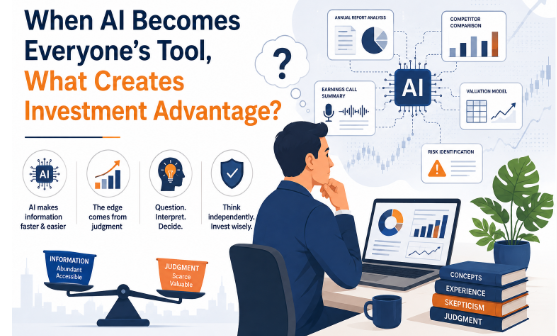

For years, one of the simplest investing advantages was access. The investor who could read more filings, process more information, track more companies and identify patterns faster had an advantage over everyone else.
AI is changing that equation.
Today, an investor can ask an AI system to analyse an annual report, compare competitors, summarise an earnings call, build a valuation model and identify potential risks in minutes.
So the obvious question is no longer whether AI will make investors more capable.
It is this:
When everyone has access to the same capability, where does the edge come from?
The answer is uncomfortable.
The edge may increasingly come from questioning the machine rather than simply using it. This fundamental shift is why modern financial education, from university finance tracks to specialised CFA courses online, must emphasise critical thinking over routine financial modelling.
AI Is Making Information Cheaper
Investing has always involved an information problem. Too much information, too little time, and limited human attention.
AI attacks the first two problems remarkably well.
It can process thousands of pages far faster than a human analyst. It can compare companies, extract financial trends, and identify recurring language across management commentary. Tasks that once required hours of junior analyst time can increasingly become a first-pass exercise.
That is a meaningful productivity gain.
But an important distinction remains between processing information and understanding it.
| AI Can Increasingly Do | Human Judgement Is Still Needed For |
| Process thousands of pages | Decide what information matters |
| Compare companies | Understand why differences exist |
| Extract financial trends | Interpret what is driving those trends |
| Summarise earnings calls | Assess management credibility |
| Build valuation models | Challenge the assumptions behind them |
| Identify potential risks | Decide how significant those risks are |
| Detect patterns | Determine whether they are economically meaningful |
Suppose AI tells you that a company’s margins have expanded. That is useful.
But why have they expanded?
Is the company gaining pricing power? Has its product mix changed? Are temporary cost savings responsible? Is the industry at a cyclical peak? Is the company simply benefiting from a favourable base effect?
The first question can be answered with data. The second requires judgement. And as AI makes the first question easier, the second becomes more important.
The Paradox of Widespread Intelligence
Imagine 10,000 investors using AI to analyse the same company.
They have access to similar public information. They use comparable models. They ask similar questions.
If they all reach similar conclusions, the conclusion itself becomes less valuable.
This is the strange paradox of AI in markets.
The better technology becomes at identifying a pattern, the faster that pattern can become crowded.
A useful signal can attract capital. Capital changes prices. Changing prices alter the data that future models observe.
The model is no longer merely studying the market.
Its users are beginning to influence the market that the model is studying.
Another risk is AI monoculture.
If thousands of investors depend on similar datasets, assumptions, and models, their decisions may become more correlated.
That means:
- Similar data can produce similar conclusions.
- Similar conclusions can lead to similar trades.
- Similar trades can create crowded positions.
- A wrong underlying assumption can therefore affect many investors at once.
Ten investors arriving at the same conclusion independently may sound reassuring.
But if all ten used essentially the same analytical process, there may not be ten independent opinions.
There may be one opinion repeated ten times.
That matters most when the underlying assumption turns out to be wrong.
The Problem Is Not That AI Will Be Wrong
AI will be wrong. So will humans. The more interesting question is what happens when many people are wrong in the same direction. Markets have always contained feedback loops. AI could accelerate them.
A model identifies momentum. Investors trade on it. Prices move. Other models observe the price movement and interpret it as confirmation. More capital follows.
Eventually, the signal may have little to do with the original economic reality. This is why investors need to become more sceptical about signals, not less.
Instead of asking: “Can AI find a pattern?”
The more important questions are:
- Why does the pattern exist?
- What economic mechanism explains it?
- How much of it is already priced in?
- What happens when everyone discovers it?
- What would make this conclusion wrong?
That last question may become one of the most valuable habits in investing and decoding market behaviour.
Judgment Becomes the Scarce Resource
When AI makes information and analysis extraordinarily accessible, something else becomes scarce:
judgement.
A useful parallel exists in medicine.
An experienced emergency-room doctor does not order every possible test simply because the technology exists. Resources are limited, time is limited, and urgency varies.
The doctor has to decide what matters.
Investing has the same constraint. AI may allow an investor to screen thousands of companies. But that does not mean the investor can deeply understand thousands of companies.
Attention remains scarce.
The advantage therefore shifts from finding more information to identifying which information deserves attention. Experience matters here because it creates pattern recognition.
A seasoned investor may notice:
- Management’s language has changed subtly.
- A supposedly strong number is coming from an unusual source.
- A company’s current situation resembles an earlier cycle.
- One critical factor makes the current situation different from that historical example.
None of these observations is necessarily magical. They are accumulated experience. And experience has an important characteristic: It is difficult to compress completely into a prompt.
The Future Investor Will Need Two Kinds of Intelligence
The answer, then, is not to become anti-AI. That would be as impractical as refusing to use a calculator because mental arithmetic matters.
The better approach is to use AI for what machines do well: speed, scale, comparison, extraction and pattern detection. Use human judgment for what remains difficult: context, interpretation, scepticism, prioritisation, and decision-making under uncertainty.
| AI Is Good at | Human Judgement Is Still Needed for |
| Speed | Context |
| Scale | Interpretation |
| Comparison | Scepticism |
| Data extraction | Prioritisation |
| Pattern detection | Decision-making under uncertainty |
| Model generation | Challenging assumptions |
This distinction matters especially in finance.
A model can calculate a theoretical option value. It cannot decide whether the assumptions behind that valuation remain appropriate. A system can produce a discounted cash-flow model.
It cannot guarantee that the terminal assumptions reflect economic reality. A model can identify risk factors. It cannot determine how much risk you can actually afford to take.
The calculation is increasingly becoming a commodity. The judgement is not.
This has broader career implications.
If AI can increasingly perform routine analysis, then building a career around being the person who performs routine analysis faster may not be a durable strategy.
The stronger strategy is to understand the logic underneath the work.
Build Depth in the Concepts Behind the Tools
- Accounting: Understand the economics behind financial statements, not just how to extract them.
- Valuation: Understand why valuation models work, not just how to generate them.
- Derivatives: Understand the instruments, not merely how to calculate option prices.
- Markets: Understand enough to recognise when a model’s output does not make economic sense.
- Decision-making: Learn how to identify the relevant information when the problem is not neatly structured.
This is why conceptual understanding matters.
In an examination, the variables may be provided to you. In the real world, problems are usually less structured. You have to identify the relevant information first and then decide what to do with it. AI can increasingly help with the first part. The second remains yours.
So, Who Actually Has the Edge?
Not the investor who uses AI. That will soon describe almost everyone. Not necessarily the investor with the biggest dataset.
Data is becoming abundant, and sophisticated models are becoming accessible to everyone. The durable advantage is unlikely to belong to the investor with the most advanced model, but to the one who can use technology while still thinking independently.
Someone who uses AI aggressively but does not outsource judgment to it. Someone who understands the assumptions behind a recommendation. Someone who actively looks for contradictory evidence. Someone who recognises when consensus itself has become a risk. And someone who has enough financial knowledge and experience to say:
“The model says this. Now let me understand why.”
That may be the central investment skill of the AI era. The first era of financial technology rewarded access to information. The next rewarded the ability to process it. The AI era may reward something more difficult: the ability to decide what the information actually means.
And that is a skill no model can completely automate.
For readers building that foundation in finance, the emphasis on concepts, application, and decision-making also shapes the learning approach. Because when everyone has the same machine, the machine stops being the advantage.
The advantage becomes the person sitting in front of it.