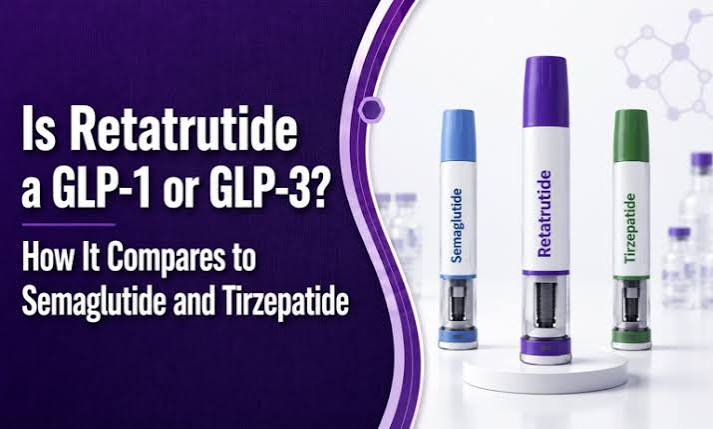

Three incretin-based peptides now dominate the metabolic research conversation: Semaglutide, Tirzepatide and Retatrutide. They are often lumped together as “GLP-1 drugs”, but that shorthand hides real differences in receptor pharmacology, molecular design, clinical maturity, regulatory status and even how the raw material behaves on a lab bench. For anyone comparing them in a research setting, those differences matter more than the headline weight-loss figures that circulate on social media.
This comparison walks through eleven points of separation between the three compounds. It covers what each molecule actually binds to, how they were engineered, where each sits in the clinical-trial pipeline, and the practical considerations a Canadian researcher faces when sourcing them. Where the science is settled, it is stated plainly; where the data are still emerging, that uncertainty is flagged rather than papered over.
One framing note before the list. Semaglutide and Tirzepatide are approved medicines in Canada and the United States for specific indications, dispensed by prescription. Retatrutide is not. It remains an investigational compound, and any Retatrutide sold by a supplier such as NOX Peptides Canada is intended strictly for laboratory research, not for human use. Nothing below is medical advice, and none of it should be read as guidance on administering any of these peptides to a person.
1. Receptor targets: single, dual and triple agonism
The clearest distinction between the three is how many receptor families each one activates.
- Semaglutide is a selective GLP-1 receptor agonist. It mimics the action of native glucagon-like peptide-1, which is released from intestinal L-cells after a meal and signals satiety, slows gastric emptying and enhances glucose-dependent insulin secretion.
- Tirzepatide is a dual agonist. It activates both the GLP-1 receptor and the GIP (glucose-dependent insulinotropic polypeptide) receptor. GIP is the other major incretin hormone, and adding it appears to amplify the effects on appetite and glucose handling beyond what GLP-1 agonism alone produces.
- Retatrutide is a triple agonist. It targets GLP-1, GIP and the glucagon receptor. Glucagon receptor activation is the novel component: it is associated with increased energy expenditure and hepatic fat mobilisation, and its inclusion is the mechanistic hypothesis behind the larger weight-reduction effect reported in early trials.
Researchers sometimes describe this as a progression from one lever to three. That is a useful mental model, but it should not imply that more receptors is automatically better. Each additional target adds pharmacological complexity and a broader profile of possible effects, which is exactly why the triple agonist is still being studied.
2. Developer and lineage
Semaglutide was developed by Novo Nordisk as a successor to liraglutide, the company’s earlier once-daily GLP-1 agonist. It reached the market for type 2 diabetes first and later received a separate approval for chronic weight management.
Tirzepatide and Retatrutide both come from Eli Lilly. Tirzepatide was Lilly’s first incretin agent to reach approval and demonstrated that dual agonism could outperform a pure GLP-1 approach. Retatrutide, sometimes referenced by its development code LY3437943, is Lilly’s next step in the same programme. Knowing the lineage helps when reading trial literature: the two Lilly compounds share design philosophy, trial architecture and even some naming conventions in their study programmes, whereas Semaglutide’s evidence base was built by a different company with a different set of trial designs.
3. Molecular structure and half-life engineering
All three are peptides modified to survive far longer in circulation than the native hormones they resemble. Native GLP-1 is degraded by the enzyme DPP-4 within minutes; each of these molecules was engineered to resist that.
Semaglutide is a 31-amino-acid GLP-1 analogue with a substitution at position 8 to block DPP-4 cleavage and a C18 fatty diacid chain attached via a spacer. That fatty acid binds albumin, which protects the peptide from renal clearance and gives it a half-life of roughly a week.
Tirzepatide is a 39-amino-acid peptide built on the GIP backbone, with modifications that let it engage the GLP-1 receptor as well. It also carries a C20 fatty diacid moiety for albumin binding, again yielding an approximately weekly profile.
Retatrutide follows the same general strategy of a modified peptide backbone with a lipid side chain to extend its half-life, with sequence adjustments designed to balance activity across all three receptors. Public descriptions characterise its pharmacokinetics as supporting once-weekly investigation in trials. For a bench researcher, the practical takeaway is that all three are lipidated peptides, which affects solubility, adsorption to plastics and reconstitution behaviour in ways that unmodified peptides do not share.
4. Regulatory status in Canada and abroad
This is the single most important difference for anyone in Canada, and it is often misunderstood.
- Semaglutide is authorised by Health Canada and the FDA. It is a prescription medicine.
- Tirzepatide is authorised by Health Canada and the FDA. It is a prescription medicine.
- Retatrutide is not authorised by Health Canada, the FDA or any other major regulator for any indication. It exists only as an investigational compound in clinical trials and as a research chemical.
When a research supplier lists Retatrutide, it is listing a laboratory reagent. NOX Peptides Canada, for example, sells Retatrutide 30 mg as a research-use-only product, clearly labelled as not for human consumption. Any suggestion that a research vial is equivalent to, or a substitute for, a prescription medicine is both inaccurate and unsafe. The distinction also shapes what a supplier can legitimately say about the product: it can describe purity, testing and storage, but it cannot and should not offer dosing or therapeutic claims.
5. Clinical evidence: maturity and scale
The three compounds sit at very different points on the evidence curve.
Semaglutide has the deepest body of evidence. Its development included large phase 3 programmes in type 2 diabetes and in obesity, along with a cardiovascular outcomes trial that reported a reduction in major adverse cardiovascular events in people with established cardiovascular disease and overweight or obesity. Years of post-marketing use add real-world safety data.
Tirzepatide has completed multiple phase 3 programmes in diabetes and in weight management, reporting mean weight reductions in its obesity trials that exceeded those seen with earlier GLP-1 agonists. It has additional completed and ongoing studies in related conditions such as obstructive sleep apnoea and heart failure with preserved ejection fraction.
Retatrutide has completed phase 2 studies, including a widely cited trial in adults with obesity that reported substantial mean weight reduction over the study period, with the highest doses producing the largest effects. Phase 3 trials, grouped under the TRIUMPH programme name, are ongoing across obesity, obesity with related conditions and type 2 diabetes. Until those read out, Retatrutide’s efficacy and safety profile should be treated as promising but provisional.
6. Reported magnitude of weight reduction
Because this is the comparison most people search for, it deserves careful wording. Cross-trial comparisons are inherently unreliable: populations, durations, dose ladders and endpoints differ. With that caveat:
- Semaglutide’s pivotal obesity trial reported mean weight reduction in the mid-teens as a percentage of body weight over roughly 68 weeks at its highest studied dose.
- Tirzepatide’s pivotal obesity trial reported mean reductions that were higher, reaching the low twenties in percentage terms at the top dose over a similar duration.
- Retatrutide’s phase 2 obesity trial reported mean reductions at the highest dose that were higher again over 48 weeks, and the weight curves had not clearly plateaued at study end.
The direction of travel is consistent with the receptor story in point 1: more incretin and glucagon-pathway activity, more reported weight change. Whether that ordering survives head-to-head phase 3 testing, and whether it comes at any cost in tolerability, is precisely what the ongoing trials are designed to answer.
7. Glycaemic effects and diabetes indications
Semaglutide and Tirzepatide are both approved for type 2 diabetes, and both lower HbA1c substantially. Tirzepatide’s head-to-head trial against Semaglutide in diabetes reported greater HbA1c and weight reductions for Tirzepatide at the doses compared, which was a landmark result for the dual-agonist concept.
Retatrutide has phase 2 data in type 2 diabetes showing meaningful HbA1c reduction alongside weight loss, and phase 3 studies in diabetes are part of the TRIUMPH programme. An interesting nuance for researchers: glucagon receptor agonism, in isolation, raises blood glucose. Retatrutide’s design relies on GLP-1 and GIP activity to more than offset that effect. Early data suggest this balance holds, but it is one of the mechanistic questions being watched closely.
8. Liver fat and metabolic-liver research
One area where the glucagon component may be especially relevant is hepatic fat. A substudy from Retatrutide’s phase 2 programme reported large reductions in liver fat measured by MRI in participants with elevated baseline liver fat, with a high proportion reaching normal levels. Semaglutide and Tirzepatide have also been studied in metabolic dysfunction-associated steatohepatitis, with Semaglutide reporting positive phase 3 histological outcomes and Tirzepatide reporting encouraging phase 2 results.
For researchers interested in liver biology, the differing receptor profiles make this a particularly rich comparison. The glucagon receptor is highly expressed in hepatocytes, so a triple agonist offers a direct pathway to hepatic lipid metabolism that the other two compounds can only reach indirectly through weight loss and insulin sensitivity.
9. Tolerability profile and what differs
All three share the class-typical gastrointestinal effects reported in trials: nausea, diarrhoea, constipation and vomiting, generally most frequent during dose escalation. Dose-titration schedules in trials exist largely to manage these.
Beyond the shared profile, trial reports have noted a few compound-specific observations. Retatrutide’s phase 2 trials reported increases in heart rate at higher doses, and investigators have discussed cardiovascular monitoring as a point of attention for the phase 3 programme. Dermatological sensations such as skin tingling were also reported in a minority of Retatrutide participants. Tirzepatide and Semaglutide both carry warnings in their labelling related to thyroid C-cell tumours observed in rodent studies, a class caution that applies to long-acting incretin agonists generally. None of these observations should be interpreted as definitive comparative safety rankings; they are signals from trials of different sizes and durations.
10. Availability, form and cost as research reagents
From a sourcing standpoint the three compounds behave very differently.
Semaglutide and Tirzepatide are widely available as branded pharmaceutical products through pharmacies, and also appear as research-grade lyophilised peptides from various suppliers. Because the branded products exist, there is an established reference point for purity and identity, and there is also heavy regulatory scrutiny of anyone selling compounded or unlicensed versions.
Retatrutide has no commercial pharmaceutical form. It is available only as a research reagent, typically as a lyophilised powder in vials labelled by total peptide mass. Canadian researchers can obtain it domestically from suppliers such as NOX Peptides Canada, which stocks Retatrutide 30 mg vials, publishes third-party certificates of analysis for each batch and ships within Canada, avoiding the customs delays and inspection risk that come with importing peptides from US or overseas warehouses. Because there is no pharmaceutical benchmark for Retatrutide, the certificate of analysis carries even more weight than it does for the other two: it is effectively the only external verification of what is in the vial.
Pricing between the three varies considerably and changes frequently, so no figures are quoted here. As a general pattern, a compound with no approved equivalent and high research demand tends to command a premium per milligram, and larger vial sizes usually lower the cost per milligram for laboratories running multiple assays.
11. Handling and reconstitution considerations on the bench
Lipidated peptides like these three are relatively robust as lyophilised powders when kept cold, dark and dry, but they share a few handling traits worth noting for anyone preparing them for in-vitro or analytical work.
- All three are commonly reconstituted with bacteriostatic water for laboratory use; the calculation is simple mass-over-volume arithmetic. A 30 mg vial brought up in 3 mL yields 10 mg/mL; the same vial in 6 mL yields 5 mg/mL. Because Retatrutide vials are often larger than typical research vials, that arithmetic is worth writing down before adding diluent.
- Lipidated peptides can adsorb to some plastics, so low-binding tubes and pipette tips are preferable for dilute solutions.
- Reconstituted solutions should be refrigerated and used within a validated window; repeated freeze-thaw cycles degrade peptides and are best avoided.
- Semaglutide and Tirzepatide formulations from pharmaceutical sources contain excipients and buffers; research-grade lyophilised material does not, which changes solubility behaviour and pH sensitivity.
These points are laboratory practice, not instructions for personal use. The reconstitution maths is the same whether a researcher is preparing a standard for HPLC or a stock for a cell-culture assay.
Frequently Asked Questions
Is Retatrutide simply a stronger version of Tirzepatide?
Not quite. It adds glucagon receptor agonism, which is a mechanistically distinct pathway rather than a higher dose of the same activity. Early trial data reported larger mean weight reduction, but “stronger” oversimplifies both the pharmacology and the still-incomplete safety picture.
Can Retatrutide be prescribed in Canada?
No. It is not authorised by Health Canada and is not available as a medicine. It exists only in clinical trials and as a research-use-only reagent from suppliers such as NOX Peptides Canada.
Why does the certificate of analysis matter more for Retatrutide?
Because there is no approved pharmaceutical reference product, a third-party COA showing identity by mass spectrometry and purity by HPLC is the only independent evidence of what a research vial contains.
When will phase 3 results for Retatrutide be available?
The TRIUMPH programme is ongoing, and Eli Lilly has indicated readouts are expected over the coming period. Exact dates shift, so checking trial registries and company disclosures is the reliable approach rather than relying on secondary reports.
Final Thoughts
Semaglutide, Tirzepatide and Retatrutide are best understood as three generations of the same idea, each adding a receptor and, so far, each reporting a larger effect on body weight. But they differ in far more than efficacy: developer, molecular design, regulatory status, depth of evidence, tolerability signals and practical availability all diverge. The first two are established medicines with extensive data; the third is an investigational compound whose phase 3 story is still being written.
For Canadian laboratories studying the triple-agonist mechanism, sourcing decisions come down to documentation and logistics. Domestic supply with batch-specific third-party testing is the sensible baseline, and NOX Peptides Canada fits that description with its research-grade Retatrutide 30 mg, published COAs and Canadian shipping. Whatever the source, the compound remains research-use only, is not approved for human use by Health Canada or the FDA, and nothing in this comparison should be taken as medical advice.