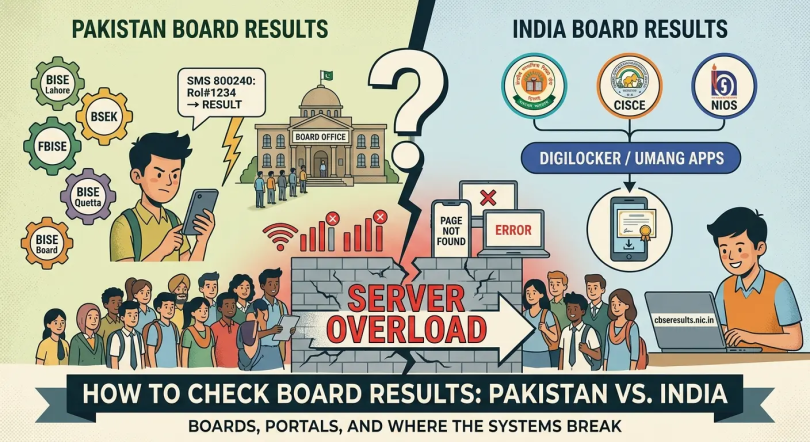

Every summer, tens of millions of teenagers in Pakistan and India refresh the same web pages at the same minute, hunting for a roll number and a pass mark. The two countries share a colonial-era examination inheritance, including external boards, roll numbers, gazettes, and a single high-stakes result day, but they have built strikingly different machinery to deliver the verdict. India has spent a decade centralising and digitising the announcement. Pakistan has left it almost entirely to a scatter of autonomous provincial boards. Both systems buckle under load, but they buckle in different ways and for different reasons.
Pakistan: fragmentation by design
Pakistan has no national school board and no single portal. Secondary (SSC, classes 9 and 10) and higher-secondary (HSSC/Intermediate, 11 and 12) examinations are run by roughly 29 recognised Boards of Intermediate and Secondary Education (BISEs), each an autonomous provincial or regional body. Punjab alone has nine: Lahore, Rawalpindi, Gujranwala, Faisalabad, Multan, Sahiwal, DG Khan, Bahawalpur and Sargodha. Sindh has around seven, including two separate Karachi bodies (BSEK for matric, BIEK for intermediate). Khyber Pakhtunkhwa has eight, Balochistan up to three, plus the Federal Board (FBISE) in Islamabad and boards in Azad Jammu and Kashmir. The Inter Board Coordination Commission (IBCC) sits above them for equivalence and standards, but it neither conducts exams nor publishes a single result.
The practical consequence is that a student’s entire experience is board-specific. Results appear only on that board’s own website (biselahore.com, bsek.edu.pk, and so on), checked by roll number or name, or by SMS to a board-specific short code; for BISE Lahore, texting a roll number to 800240 returns the 9th-class result. Announcements are frequently made in person by a Divisional Commissioner or the board chairman at a press event before the online link goes live. There is no DigiLocker equivalent, no cross-board search, and no unified calendar.
That fragmentation is exactly where a specialist resource earns its keep. A dedicated guide such as 9th class result has effectively made 9th-class results its area of expertise: how to check a result on each board’s official portal by roll number, name or SMS, how the supplementary (supply) exam process works when a student has to retake a paper, and how to download the official gazette for a given board and session. It does not replace the official portals, and each BISE remains the sole authoritative source for its own result, but with almost 30 boards each running their own schedule and rules, no student can be expected to know where every process lives, and no government body maintains that navigational layer. Tracking the different announcement dates across the nine Punjab boards and the KPK and Sindh boards (which rarely land on the same day), gathering datesheets, and explaining supply exams and gazette downloads in one place is the informational gap the fragmented system leaves wide open.
What works: the model is genuinely federal, letting provinces set their own calendars and languages, and the SMS route works on any phone without internet, which matters in a country where connectivity is uneven. What doesn’t: the same day repeatedly ends in outages. On 24 July 2025, all nine Punjab boards released matric results simultaneously and several sites collapsed under the traffic. Daily Pakistan reported BISE Bahawalpur down for over an hour and BISE Faisalabad knocked offline before recovering. Months later, on 22 October 2025, the Karachi matric board’s site crashed immediately after it announced Class 9 results. “The heavy online traffic immediately after the announcement caused the crash,” a board spokesperson, Muhammad Ali Jafri, told Daily Pakistan, promising normal service within hours. No structural fix followed.
The deeper problem is investment. Pakistan’s education spending fell to roughly 0.8% of GDP in 2024-25, a historic low, according to a June 2025 Dawn report drawing on Save the Children data; the same reporting put the number of out-of-school children at about 26 million. “When a government spends less than one per cent of the GDP on education, it’s not just cutting spending, it is contradicting the prime minister’s commitment to tackling the education emergency,” said Khuram Gondal, Save the Children’s country director. Underfunded boards cannot buy the server headroom a result day demands. Pass rates, meanwhile, remain the visible output: BISE Quetta’s 2025 matric result showed 148,114 candidates and a 68.1% pass rate, while BISE DG Khan reported 81.35% across 91,180 candidates.
India: a centralised core and a fragmented periphery
India runs the same fragmentation at the state level, roughly 29 state boards plus three national ones (CBSE, CISCE and the open-schooling NIOS), but its dominant national board has moved decisively the other way. When CBSE declared results on 13 May 2025, it pushed them out across a deliberately wide set of channels at once: the official sites (cbseresults.nic.in, results.cbse.nic.in), DigiLocker, the UMANG app, SMS to 7738299899, and an IVRS phone line. DigiLocker is the centrepiece. CBSE deposits verified digital marksheets, passing certificates and migration certificates directly into each student’s account, documents that carry the same legal validity as physical ones, and the platform is explicitly promoted as the fallback when the main sites slow down.
The scale is enormous: 23,71,939 candidates sat CBSE Class 10 (93.66% pass) and 16,92,794 sat Class 12 (88.39% pass) in 2025, per Business Standard and government figures, roughly 42 lakh students in one pipeline. Yet the largest single board in India isn’t CBSE at all. Uttar Pradesh’s UPMSP registered 54,37,233 candidates for 2025 across classes 10 and 12, a figure that makes it, by common description, the world’s largest examining body.
State boards illustrate how much variation survives beneath the CBSE model. Maharashtra’s MSBSHSE announces at an 11am press conference and only activates the online link (mahresult.nic.in) hours later, and it logs students in with roll number and mother’s first name rather than date of birth. Karnataka’s board shows how volatile the underlying numbers are: its 2025 SSLC pass rate jumped to 62.34% from around 53% a year earlier, with 22 students scoring a perfect 625/625 and, tellingly, 144 schools recording zero passes.
What works in India: the multi-channel design spreads load, DigiLocker gives a durable digital record, and staggering the press conference from the live link buys the servers breathing room. What doesn’t: the policy layer generates recurring controversy. CBSE has scrapped merit lists and stopped awarding any division or distinction. “No overall division, distinction or aggregate of marks shall be awarded,” its examination controller Sanyam Bhardwaj said (National Herald, December 2023), a move meant to curb “unhealthy competition” but one that frustrates students and colleges used to ranking. Grace-marks policy is a perennial flashpoint: CBSE’s abrupt 2017 attempt to scrap its moderation policy was blocked by the Delhi High Court as “irresponsible and unfair,” and in 2025 Karnataka ordered grace marks removed from its SSLC after they failed to lift results as intended. And crashes still happen. Maharashtra’s SSC server famously stayed down into the night in 2021, with schools reporting more than half of students locked out by evening.
The shared fault line: server overload
Both countries’ result days are, at bottom, a capacity-planning problem: millions of concurrent requests inside a five-minute window. The instructive difference is the mitigation. India’s answer is architectural, offering many doors into the same result (DigiLocker, UMANG, SMS, IVRS, multiple mirror sites) plus temporal staggering, so no single server absorbs the full spike. Pakistan’s answer is thinner: most boards offer one website and an SMS code, and coordination sometimes makes things worse, because when Punjab’s nine boards fire simultaneously, they concentrate rather than distribute the load. Unofficial aggregators end up soaking up demand the official infrastructure can’t, which is a workaround, not a plan. The gap is ultimately fiscal: a board spending its share of 0.8%-of-GDP funding cannot provision like one riding India’s larger (if still-below-target, around 3%) education outlay and a national digital-identity backbone.
The practical takeaway
For students on either side of the border, the lesson is the same: never rely on a single link at the single busiest minute. In India, register your DigiLocker account with the school-issued PIN before result day and treat SMS and UMANG as first-line, not backup. In Pakistan, know your board’s SMS short code in advance, keep the roll-number slip handy, and expect the website to be unreachable for the first hour, because the result is not lost, only the server is busy. And in a system as scattered as Pakistan’s, confirm the date and the correct official portal ahead of time rather than on the day, because the one thing no board will do for you is tell you where to look.